


Parquetry Inlaid Desk
A parquetry inlaid desk brings geometric precision and rich timbers together, offering a functional workspace with undeniable decorative presence.
Parquetry Inlaid Desk
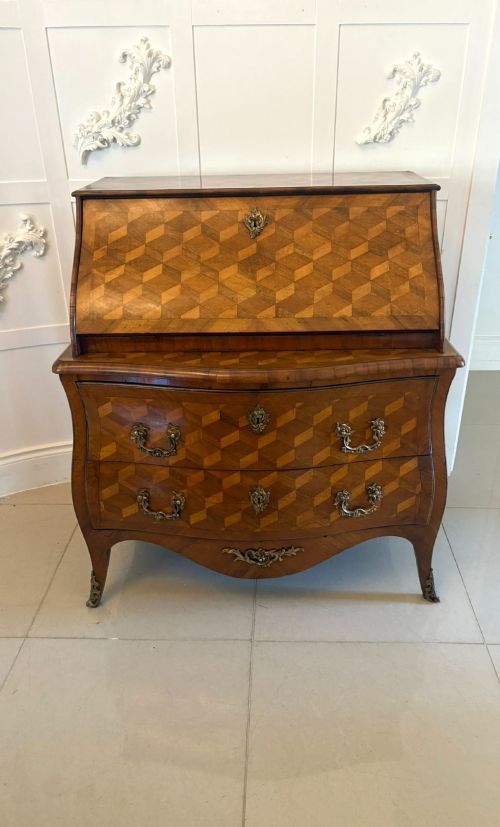
A parquetry inlaid desk combines geometric wood veneers with writing surfaces, typically appearing in forms such as bureau plats, writing tables, and bonheur du jours. These pieces span from the eighteenth century through the nineteenth century, often reflecting French revival styles like Louis XV and Louis XVI alongside Victorian craftsmanship.
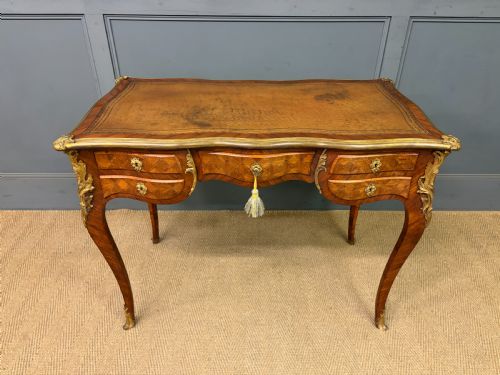
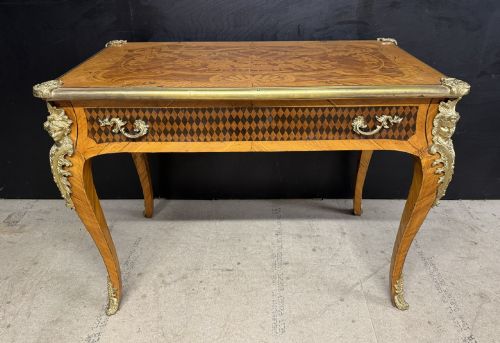
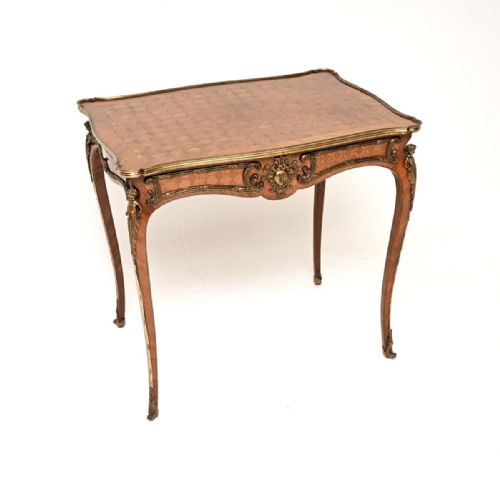
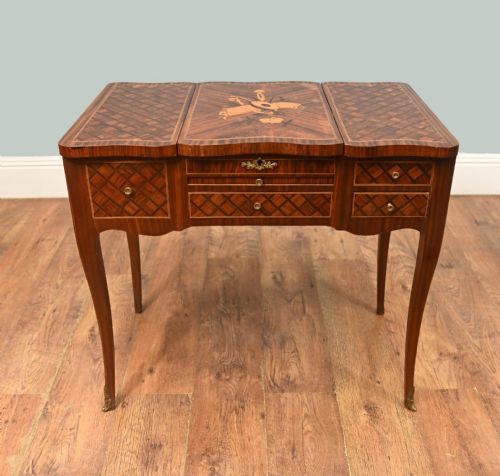
The version most frequently met on this page is the nineteenth-century French writing table or bureau plat, constructed with cabriole legs, gilt metal mounts, and intricate wood patterning. Alongside these, buyers encounter smaller writing slopes, stationery boxes, and occasional side tables that utilise similar geometric marquetry.
Makers and retailers represented across these pieces include established firms and designers such as JAS Shoolbred, Donald Ross, Edmund Nye, and Maples, alongside pieces created in the manner of François Linke. These makers produced works that ranged from utilitarian campaign items to exhibition-quality furniture intended for grand interiors.
Materials and construction
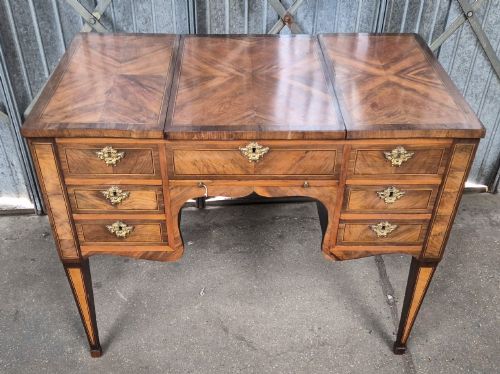
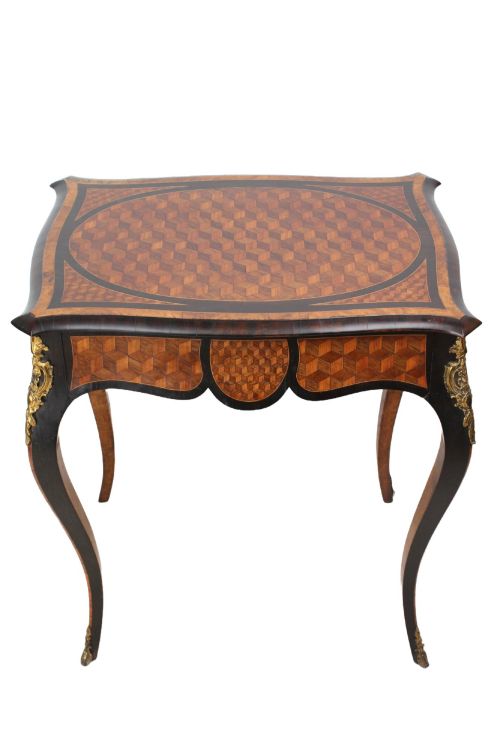
Makers constructed these desks using dense hardwood carcasses of walnut, mahogany, rosewood, and kingwood, overlaid with carefully cut geometric veneer patterns. The geometric precision of parquetry relies on exact carpentry, where small polygonal tiles of contrasting timbers fit tightly together to form cubes, stars, or diagonal grids.
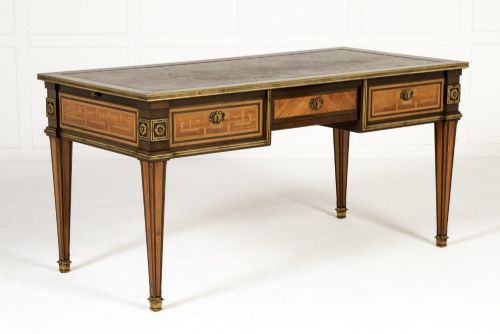
Surface detailing frequently includes ormolu mounts, cast bronze, and brass edging to protect and highlight the contours of the desk. Writing surfaces often incorporate inset leather panels, while internal compartments utilise satinwood and secondary timbers for drawers and pigeonholes.
Several pieces preserve small secret compartments tucked behind dummy book spines and sliding panels, designed for private letters.
Distinctions in quality
The primary distinction lies in the crispness of the geometric pattern cutting and the selection of timber veneers. Superior examples display perfectly flush joints between individual veneer tiles without visible gaps or excessive filler, using high-figure timbers like kingwood and walnut that retain rich natural contrast.
Mount quality separates standard production from exhibition pieces. Finer desks feature heavier, finely chased ormolu mounts that fit the carcass contours precisely, whereas lesser pieces utilise simpler, cast metal fittings with minimal hand-finishing.
JAS Shoolbred·Donald Ross·Edmund Nye·Maples·Francoise Linke
The Parquetry Inlaid Desk Glossary
- Parquetry
- Geometric mosaic woodwork formed by fitting small wooden tiles together to create decorative patterns on furniture surfaces. This technique differs from pictorial marquetry by focusing on repeating abstract shapes like cubes and chequers.
- Bureau plat
- A freestanding writing table fitted with drawers across the frieze, lacking a superstructure. These desks typically feature finished backs so they can sit in the centre of a room.
- Kingwood
- A dense, heavy tropical timber prized for its rich violet-brown colouring and dark striping. It was widely utilised by cabinetmakers during the eighteenth and nineteenth centuries for high-status French furniture.
- Ormolu
- Gilded bronze used for decorative mounts, handles, and sabots on furniture. High-quality ormolu exhibits sharp chisel work and deep fire-gilding lustre.
- Bonheur du jour
- A small, light ladies writing desk featuring a raised cabinet or tier of shelves and drawers above the main writing surface. The form gained popularity in mid-eighteenth-century France and remained a staple of revival furniture.
Parquetry Inlaid Desk: Frequently Asked Questions
How do I care for the veneer?
Keep the desk away from direct sunlight and steady heat sources to prevent the timber veneers from drying and lifting. Regular dusting with a dry, soft cloth maintains the finish without risking moisture damage to the antique glue beneath.
Apply a light application of quality beeswax periodically to nourish the wood and preserve the depth of the parquetry pattern. Avoid modern silicone sprays, which can penetrate open grain and interfere with future conservation.
Were these desks used for writing?
Many of these pieces served as primary administrative desks for correspondence, record-keeping, and estate management. The inclusion of drawers and stationery compartments accommodated inkwells, quill pens, and folded paper.
Smaller examples, such as the bonheur du jour or writing slope, were designed for casual correspondence in private sitting rooms rather than heavy daily business use.
How do I date a parquetry desk?
Dating relies on examining the secondary timbers inside the drawers, the method of carcass construction, and the stylistic vocabulary of the mounts and legs. Eighteenth-century pieces generally show hand-cut dovetails and native European softwoods as secondary framing.
Nineteenth-century revival pieces often incorporate machine-sawn elements alongside period-accurate parquetry patterns inspired by earlier Louis XV and Louis XVI designs.
What is the difference between parquetry and marquetry?
Parquetry strictly uses geometric tiles arranged in repeating patterns such as cubes, lozenges, and triangles to cover a surface. It relies on mathematical precision rather than pictorial representation.
Marquetry, by contrast, employs varied veneers to create pictorial scenes, floral sprays, or scrolling foliage. Both techniques appear frequently across the desks listed on this page.