



Parquetry Cabinet Desk
A parquetry cabinet desk marries geometric wood veneers with a functional writing surface, offering a refined centrepiece for study or reception spaces.
Parquetry Cabinet Desk
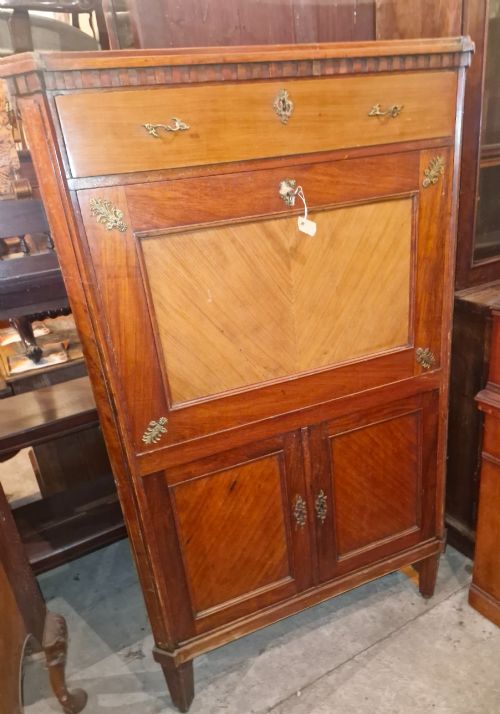
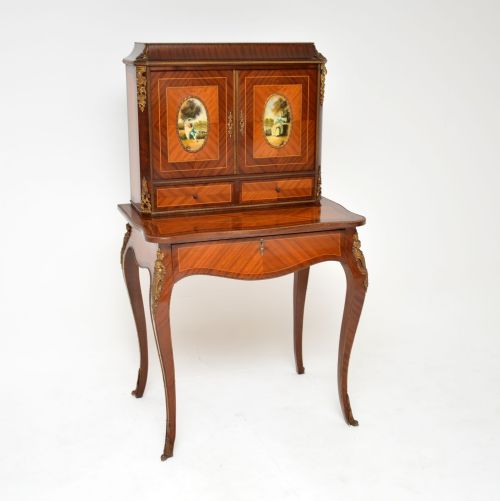
A parquetry cabinet desk is primarily encountered as a French secrétaire à abattant or a bonheur du jour originating from the nineteenth century, blending cabinet storage with a writing surface. These pieces range from compact ladies' writing desks to taller drop-front cabinets designed for correspondence and display.
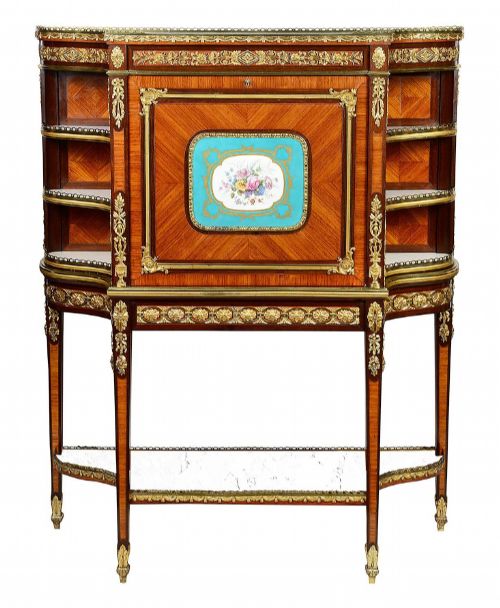
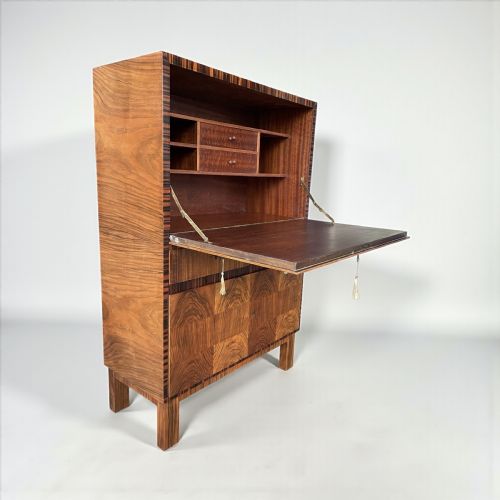
The selections span revival aesthetics such as Louis XV and Louis XVI styles, alongside later Art Deco interpretations and Grand Regency forms. Buyers seeking this category encounter variations incorporating marble tops, ceramic plaques, and specialised compartments behind fitted fall-front doors.
Materials and construction
Construction relies heavily on exotic hardwoods like kingwood, rosewood, walnut, and tulipwood applied as geometric veneer patterns over sturdier secondary timbers. Cabinetmakers utilised precise sawing methods to align grain patterns across complex curved and flat surfaces.
Metal mounts in ormolu, gilt bronze, and brass protect corners and frame panels, while inset plaques of porcelain or Vernis Martin panels provide decorative focal points on cabinet doors and writing flaps.
One cylinder desk comes attributed to Japanese Yosegi parquetry traditions, proving that geometric wood-mosaic travelled far beyond Parisian workshops.
Assessing craftsmanship and finish
Quality separates through the precision of the veneer work and the crispness of the cast bronze or ormolu mounts affixed to the carcase. Finer examples display meticulous geometric alignment in the parquetry and hand-chased metalwork rather than mass-produced cast fittings.
Internal complexity also dictates grade, with superior desks featuring secret drawers, fitted pigeonholes, and matched secondary woods inside the writing compartment instead of plain secondary linings.
Blake London·Jean Werner·Millet
The Parquetry Cabinet Desk Glossary
- Parquetry
- Geometric mosaic woodwork formed by small veneer pieces laid down in repeating patterns like cubes or herringbone. This technique defines the surface decoration of the primary writing flap and cabinet doors.
- Secrétaire à abattant
- A tall upright cabinet featuring a drop-front writing panel that conceals internal drawers and pigeonholes. It provides vertical storage combined with a fold-down desk surface.
- Bonheur du jour
- A light ladies' writing desk topped with a small cabinet, shelf, or set of drawers. Introduced in the eighteenth century, it remained popular through Victorian revival periods.
- Ormolu
- Gilt bronze ornamentation applied to furniture corners, feet, and friezes. The metal is cast and chased to add decorative relief before being gilded.
- Vernis Martin
- A type of simulated Japanese lacquer developed in France during the eighteenth century and replicated in later revival pieces. It uses successive layers of varnish to create translucent painted panels.
Parquetry Cabinet Desk: Frequently Asked Questions
What is a secretaire abattant?
A secretaire abattant is a tall upright cabinet with a hinged front panel that folds down to create a flat writing surface. Behind this fall-front door lie small drawers and compartments for letters and papers.
Lower doors typically open to reveal additional shelving for general storage, making the piece suitable for both writing and room organisation.
What wood is kingwood?
Kingwood is a dense tropical hardwood belonging to the rosewood genus, prized for its rich dark brown colouring and distinct golden or violet veining. It was a favored material for high-end French cabinetmakers.
Its striking grain made it ideal for geometric parquetry patterns on nineteenth-century desks and cabinets.
Are these desks suitable for daily use?
These desks accommodate modern writing tasks and laptop use if the working height and depth match your requirements. The fold-down writing surfaces on drop-front models provide adequate space for contemporary correspondence.
Care must be taken with antique polished surfaces and marble tops to prevent moisture rings or scratches during regular use.
How do I tell Louis XV and Louis XVI styles apart?
Louis XV style pieces, often called French Rococo Revival, feature sweeping curves, cabriole legs, and asymmetrical ormolu mounts. The overall silhouette emphasises flowing organic lines.
Louis XVI style furniture moves toward straight lines, symmetrical geometry, fluted columns, and neoclassical motifs, reflecting a shift back to classical proportions.