


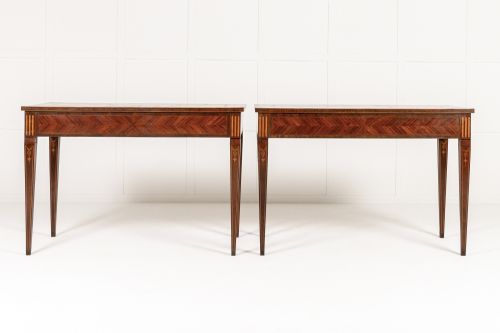


Pair Walnut Pier Tables
Pair walnut pier tables bring architectural balance to a room, offering matched surfaces and striking design that elevate any interior space.
Pair Walnut Pier Tables
When you search for pair walnut pier tables, you are looking at matching sets of console and side tables designed to sit flush against a wall, frequently beneath a mirror or window. These decorative furnishings appear in various historical iterations, ranging from eighteenth-century Italian designs to nineteenth-century French interpretations and later twentieth-century Art Deco forms.
How they were made
Cabinetmakers utilised walnut and burr walnut timber, often laid as delicate veneers over secondary woods to create striking grain patterns on the table surfaces. Kingwood and fruitwood also appear in regional pieces, adding tonal variation and contrast to the construction.
Heavier structural elements frequently incorporate carved wood and parcel-gilt details, while wrought iron supports occasionally provide additional strength. Many of these tables are finished with fitted marble tops, requiring precise stone-masonry skills to match the wooden bases.
Pair Walnut Pier Tables Retail Price Guide 2026
Typical asking prices for pair walnut pier tables among the pieces listed under this phrase on Sellingantiques today, from the lower quarter to the upper quarter. They describe what is for sale here now, not the wider market.
Current listings feature nineteenth-century and eighteenth-century pieces alongside twentieth-century Art Deco examples, utilising walnut, burr walnut, marble, and wrought iron.
What varies in quality
The refinement of the carved ornamentation and the symmetry of the matched pair separate standard pieces from exceptional examples. Skilled joinery and the selection of highly figured burr walnut veneer indicate superior workshop output.
The integration of heavy marble tops and the crispness of parcel-gilt detailing demonstrate the artisan's capability. Pieces that maintain structural integrity alongside elaborate stylistic flourishes represent the upper tier of the range.
The Pair Walnut Pier Tables Glossary
- Pier table
- A decorative table designed to stand against a wall, typically between two windows or beneath a pier glass mirror. These pieces often feature flat backs and elaborate front legs.
- Demi-lune
- A half-moon shaped table that sits flat against the wall, offering a compact footprint. This curved form was particularly popular in eighteenth-century Italian design.
- Burr walnut
- A prized wood harvested from the abnormal growth of a walnut tree, yielding swirling, knotty grain patterns. Cabinetmakers sliced this wood into thin veneers for decorative surfaces.
- Parcel-gilt
- A decorative technique where specific carved details are partially covered in gold leaf. This method highlights particular motifs against a dark walnut background.
- Console table
- A table supported by wall brackets or front legs, functioning primarily as a decorative display surface. They frequently appear paired with matching wall mirrors.
Pair Walnut Pier Tables: Frequently Asked Questions
What is a pier table?
A pier table is an ornamental console designed to stand against a wall, traditionally placed between two windows beneath a tall mirror. They serve as decorative display surfaces rather than heavy utility furniture.
These tables were manufactured in matched pairs to create symmetry in formal reception rooms and grand hallways. Their slender proportions allowed them to fit narrow architectural wall spaces.
How do I style them?
Place matching tables symmetrically along a large wall, perhaps beneath matching mirrors or large artwork to anchor the room. Keep the surfaces balanced with complementary lamps or decorative objects.
Because these tables are narrow, they work exceptionally well in hallways, living rooms, and dining areas without obstructing walking paths. Allow the wood grain and marble tops to remain visible rather than crowding them with items.
How do I date walnut furniture?
Dating relies on examining the timber construction, tool marks, joinery methods, and the prevailing stylistic period of the carving. Eighteenth-century pieces often display hand-cut joinery and regional timber usage, while nineteenth-century revivals borrow freely from earlier Baroque and Rococo vocabularies.
Reviewing the specific type of veneer application and secondary woods helps narrow down the century of manufacture. Stylistic markers like Art Deco geometric lines or Italian Baroque curves provide clear chronological clues.
Are marble tops original?
Marble tops on antique tables were typically fitted during the initial construction to provide a durable, luxurious surface for display. Examining the underside and the fit against the wooden frame reveals how the stone was integrated.
While some tops may be later replacements due to historical damage, many survive with their original stone intact. The weight and edge profiling of the marble usually correspond to the period of the base.