

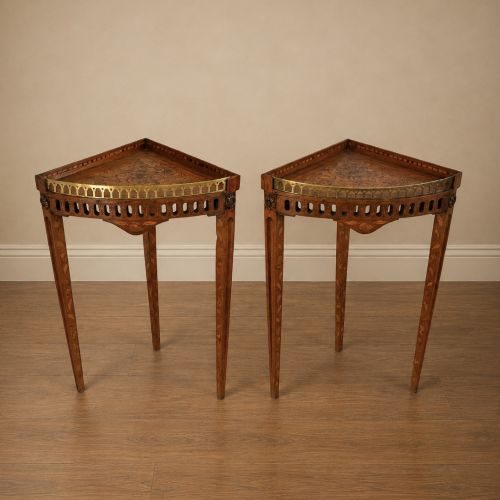


Pair Walnut Lamp Stands
Pair walnut lamp stands bring rich timber tone and period form to a room, offering functional surface space atop balanced paired designs.
Pair Walnut Lamp Stands
When buyers search for pair walnut lamp stands, they encounter matched sets of small tables, bedside cabinets, and floor lamps originating from various historical eras. The selection spans 18th Century neoclassical design, Victorian production, French provincial examples, and sleek Art Deco pieces from the 1920s and 1930s.
Bedside cabinets and side tables dominate the options, often doubling as lamp stands due to their compact footprints and surface proportions. Buyers frequently find pieces incorporating practical drawers, open tiers, or brass galleries alongside the characteristic walnut timber.
The aesthetic variety ranges from ornate Georgian marquetry inlay to clean modernist lines by makers such as Hille. This mix allows a buyer to source matched pairs that either anchor a traditional interior or complement a modernist room scheme.
How they were made
Cabinet makers utilised solid walnut and figured burr walnut veneer applied over secondary timbers like pine to achieve striking grain patterns on table tops and cabinet doors. Marquetry inlay, satinwood stringing, and circular mouldings frequently add decorative contrast to the primary dark wood surfaces.
Metal components such as brass galleries, drop handles, and specialised mounts were integrated into Georgian and Victorian designs to secure items and accent the timber. Floor lamps and tables rely on sturdy turned or stepped wooden columns and bases for structural stability.
Pair Walnut Lamp Stands Retail Price Guide 2026
Typical asking prices for pair walnut lamp stands among the pieces listed under this phrase on Sellingantiques today, from the lower quarter to the upper quarter. They describe what is for sale here now, not the wider market.
Listings feature walnut, burr walnut veneer, satinwood, pine, and glass across 18th Century, Victorian, 1920, and 1930 periods.
What varies in quality
The hierarchy of quality rests primarily on the choice of timber and the precision of decorative execution, particularly in how burr walnut veneers are matched across a pair. Superior examples display symmetrical grain patterns and meticulous marquetry or inlay work that remains crisp and secure.
Structural integrity and original hardware define the upper tier, where brass galleries, fitted drawers, and distinct period stylings like Queen Anne revival curves are preserved without heavy alteration. Lesser pieces often exhibit simpler construction methods and less dynamic timber selection.
Hille
The Pair Walnut Lamp Stands Glossary
- Burr walnut
- A prized timber cut from walnut tree growths, featuring swirling, highly figured grain patterns. It is frequently used as a decorative veneer on cabinet doors and tabletops.
- Marquetry
- The art of applying pieces of veneer to a structure to form decorative patterns and pictures. Georgian pieces often utilise this technique with contrasting woods like satinwood.
- Brass gallery
- A miniature metal railing fitted around the edge of a table top to prevent items from sliding off. This detail is commonly found on 18th Century and neoclassical designs.
- Art Deco
- A design style characterised by sleek geometric shapes, streamlined forms, and modern materials popular during the 1920s and 1930s. Pieces from this era often feature clean walnut surfaces.
- Pot cupboard
- A traditional enclosed bedside cabinet originally designed to house a chamber pot. Victorian and early 20th-century examples frequently function as lamp stands today.
Pair Walnut Lamp Stands: Frequently Asked Questions
What periods do these pieces span?
The inventory covers 18th Century neoclassical works, Victorian designs, and 1920s or 1930s Art Deco creations.
Buyers can select pieces ranging from ornate Georgian marquetry to streamlined modernist tables.
How are these stands typically used?
They serve primarily as bedside cabinets, side tables, or floor lamps to provide surface space and illumination.
Matched pairs allow for symmetrical placement on either side of a bed or sofa.
What woods appear in these listings?
Walnut and burr walnut veneer form the primary visual surfaces across the majority of the items.
Secondary materials include satinwood for stringing, pine carcases, and brass for hardware accents.
Are these items sold individually?
The selection consists entirely of matched pairs designed to be purchased and displayed together.
This pairing ensures visual consistency for balanced interior layouts.
Do these pieces include storage?
Many of the bedside cabinets and side tables incorporate enclosed cupboards, open tiers, or pull-out drawers.
Floor lamps and certain corner tables provide surface areas without enclosed storage compartments.