


Pair Staffordshire Greyhounds
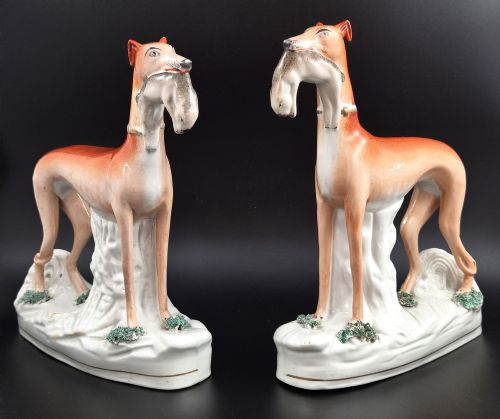
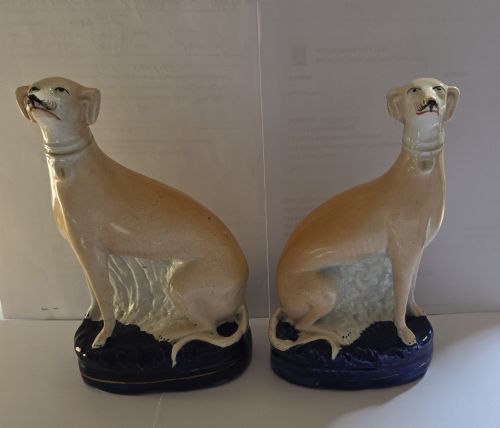
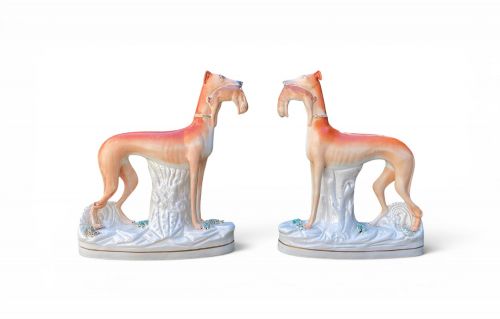
Pair Staffordshire greyhounds are quintessentially Victorian mantelpiece ornaments depicting seated hounds, prized by collectors for their charming depiction of hunting dogs.
Pair Staffordshire Greyhounds
When you search for pair staffordshire greyhounds, you encounter nineteenth-century ceramic figures modelled as seated hounds, often accompanied by hares or rabbits. These decorative ornaments and desk accessories capture the Victorians' fascination with hunting culture and domestic animal portraiture.
The versions most commonly met on this page date from the Victorian period, spanning the mid to late nineteenth century around eighteen fifty to eighteen eighty. They appear primarily as symmetrical pairs intended to flank a fireplace or centrepiece on a mantel.
Materials and Techniques
Makers formed the figures using traditional Staffordshire pottery methods, occasionally incorporating functional elements such as inkwells or quill holders into the base design alongside the seated dogs.
Listings span the Victorian era from eighteen fifty to eighteen eighty, encompassing earthenware, lead glaze, and enamel paint.
Assessing Quality and Character
The presence of hares, rabbits, or functional additions like inkwells often elevates the complexity of the piece. Matched pairs with intact gilding and minimal wear represent the higher end of the range found in nineteenth-century production.
Thomas Parr
The Pair Staffordshire Greyhounds Glossary
- Earthenware
- A porous pottery body fired at lower temperatures, commonly used for nineteenth-century Staffordshire figures. It requires a glaze to become impermeable to liquids.
- Lead glaze
- A glossy coating containing lead oxide applied to pottery before firing. This produces a bright, smooth finish typical of Victorian ceramics.
- Enamel paint
- Vitreous pigments applied over the fired glaze and refired at a lower temperature. It provides the vibrant colours seen on collars and hares.
- Quill holder
- A desk accessory featuring a hollow or channel designed to hold writing feathers. In Staffordshire pottery, these are often integrated into the base of animal figures.
- Matched pair
- Two symmetrical figures created to face one another as a decorative set. They share identical sizing, modelling, and painted details.
Pair Staffordshire Greyhounds: Frequently Asked Questions
What are pair staffordshire greyhounds?
These pieces are nineteenth-century ceramic mantel ornaments modelled as seated hunting dogs, frequently paired with hares or rabbits. They reflect the popular Victorian taste for animal sculpture in domestic interiors.
Potters produced them in various sizes, ranging from small desk accessories like inkwells and quill holders to large decorative figures designed for display on a fireplace mantel.
How were they used in Victorian homes?
Victorian households displayed these matched pairs prominently on mantelpieces, often arranged symmetrically on either side of a clock or centrepiece. Their cheerful presence brought themes of the hunt into the parlour.
Certain examples served a practical dual purpose on writing desks, incorporating inkwells or quill holders alongside the modelled hounds while maintaining their decorative appeal.
How can I date my staffordshire greyhounds?
Dating relies on stylistic clues, manufacturing techniques, and the presence of specific decorative elements like cobalt glaze or gold leaf. Most recorded pieces date from the mid to late nineteenth century.
Earlier examples from around eighteen fifty tend to feature simpler modelling, whilst pieces from eighteen eighty often display more elaborate bases and refined enamel painting.
Why do some greyhounds have hares?
The inclusion of hares or rabbits references the popular pastime of coursing and hunting associated with greyhounds and whippets in the nineteenth century. Potters combined the hounds with their quarry to create a more dynamic narrative scene.
These figures with hares in their mouths or beside them are particularly sought after by collectors for their storytelling quality and visual balance in a pair.