


Pair Victorian Ceramic Greyhounds
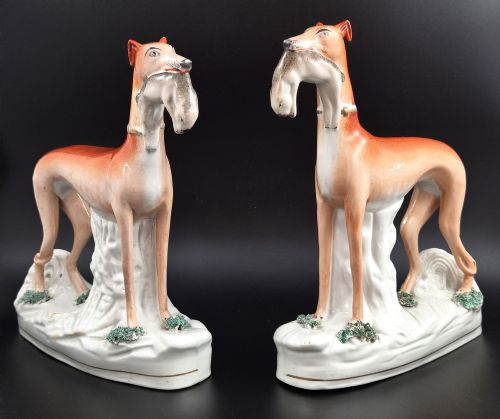
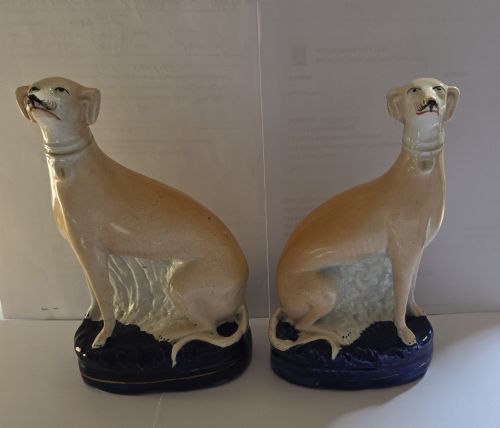
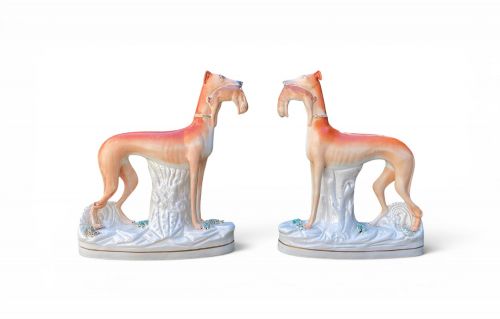
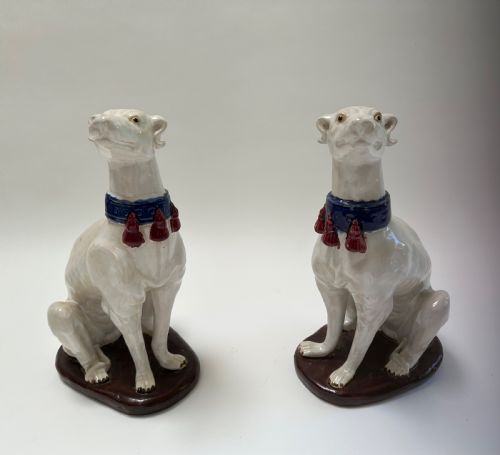
Pair victorian ceramic greyhounds bring the spirited elegance of nineteenth-century hunt sculpture directly to your mantelpiece.
Pair Victorian Ceramic Greyhounds
When you search for pair victorian ceramic greyhounds, you encounter sculptural mantle ornaments and desk accessories modelled as seated or recumbent hounds. These figures capture the distinct silhouette of the breed, often posed alongside hunted hares or serving practical roles as inkwells and quill holders.
The pieces on this page stem primarily from the Victorian era, spanning dates from eighteen fifty to eighteen eighty, alongside related Staffordshire pottery and Italian majolica examples. Most specimens arrive as matched pairs, designed to sit symmetrically at either end of a shelf or sideboard.
How they were made
The manufacturing process combined mass-producing slip-cast or pressed pottery bodies with individual hand-finishing by factory painters. This dual approach allowed workshops to produce consistent sculptural forms while giving each pair unique character through brushwork.
Listings feature Victorian earthenware and porcelain figures finished in lead glaze, enamel paint, and gold leaf.
What varies in quality
The presence of functional elements like fitted inkwells or quill holders also elevates a piece, as does the survival of original gold leaf highlights and unblemished glaze surfaces. Simpler country pottery variants offer rustic charm, whereas finely painted porcelain and earthenware demonstrate higher artistic ambition.
Thomas Parr
The Pair Victorian Ceramic Greyhounds Glossary
- Earthenware
- Porous pottery fired at lower temperatures, commonly used for nineteenth-century figures before being glazed. It forms the structural body of most Staffordshire animal models.
- Enamel paint
- Opaque vitreous pigment applied over the fired glaze to add colour to eyes, collars, and ancillary details. Artisans fired the pieces again at a lower temperature to fuse the paint.
- Inkwell
- A small container for holding liquid writing ink, frequently integrated into the base of desk accessories alongside pen rests. Greyhound figures were popular subjects for these functional pieces.
- Lead glaze
- A glossy coating containing lead oxide applied to pottery before a final firing to create a smooth, waterproof surface. It gives early ceramic figures their characteristic shine.
- Quill holder
- A desk accessory featuring a channel or loops designed to store writing feathers when not in use. Greyhound pairs often incorporated these troughs into their modelled bases.
Pair Victorian Ceramic Greyhounds: Frequently Asked Questions
Were these dogs used as toys?
These ceramic greyhounds served strictly as decorative ornaments or functional desk accessories rather than children's playthings. Victorians placed them on mantelpieces and tables to display sporting interests.
Their robust earthenware construction helped them endure generations of domestic display without suffering damage from daily household use.
Why are some figures paired with hares?
Hares reference the traditional rural sport of coursing, which formed a central part of Victorian country life. Including the prey beneath or beside the hounds emphasised their sporting heritage.
This composition allowed makers to create balanced sculptural pairs that told a narrative story about the hunt on the fireplace.
Can I use the inkwells for writing?
Using antique inkwells for modern writing is discouraged because dried ink can permanently stain the porous interior ceramic. Chemical residues may also degrade the historic lead glaze over time.
It remains safer to treat these pieces as decorative sculptures rather than functional stationery.