
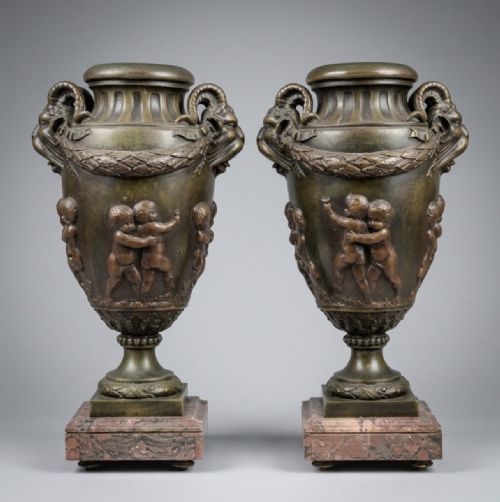
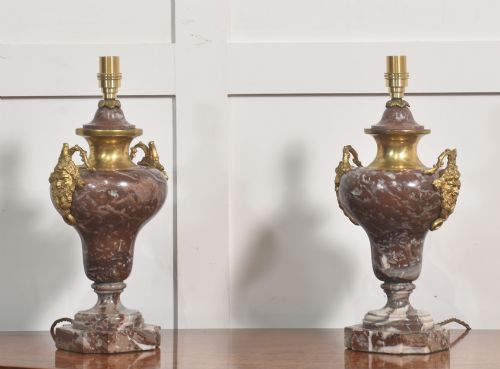
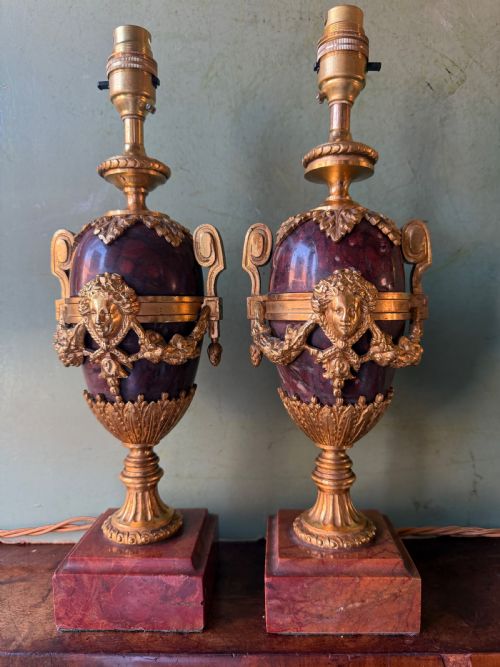


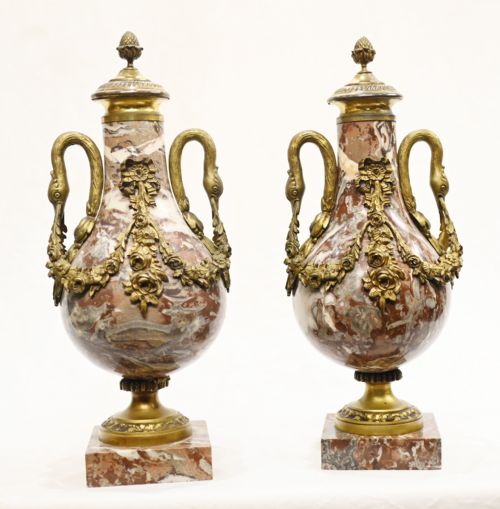

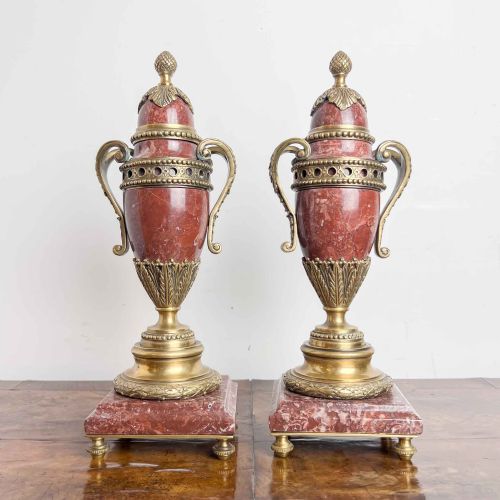


Pair Red Marble Urns
These pair red marble urns bring classic stone and metalwork into a room, offering symmetric presence and rich colour.
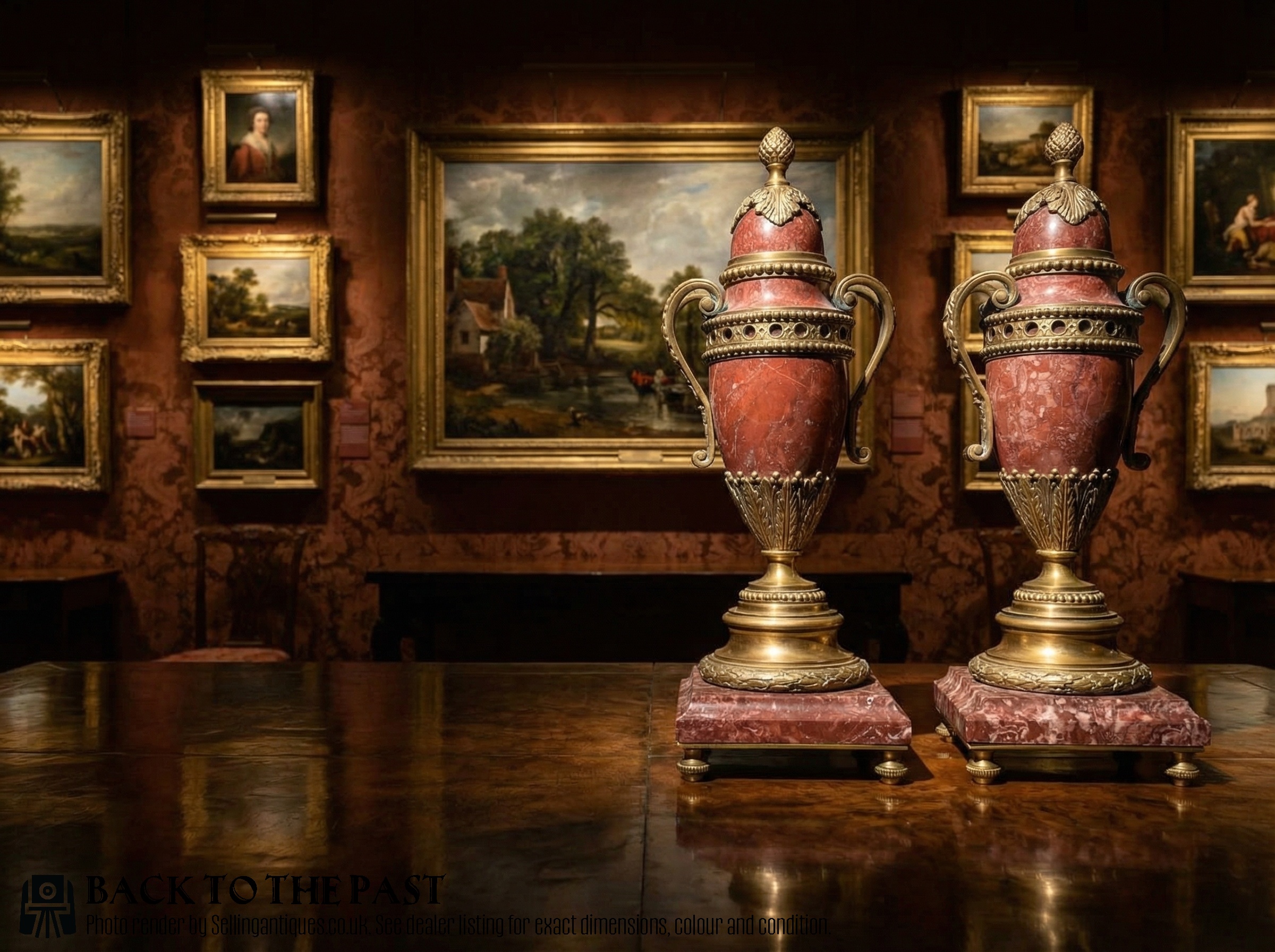
Pair Red Marble Urns
When you search for pair red marble urns, you encounter decorative objects designed for symmetry and display across nineteenth-century interiors. These pieces take the form of ornamental urns, cassolettes, and table lamps shaped by classical traditions.
The versions most frequently met on this page combine rouge or quartz marble bodies with metal mounts in ormolu, gilt bronze, brass, or bronze. Many originate from French workshops working in Neoclassical, Louis XVI, and Empire styles.
Beyond standard decorative vessels, the selection includes pieces adapted as lighting or paired with pedestals and tazzas. Each pair reflects the nineteenth-century taste for Grand Tour souvenirs and classical revival forms.
How they were made
Makers shaped solid red marble, rouge marble, or quartz marble into classical vase and urn bodies on a lathe or by hand. These stone elements provide the heavy, colourful foundation of each piece.
Foundry workers cast mounts, handles, and bases in bronze, brass, or spelter before finishing them with gilt or ormolu. Artisans then joined the metal fittings securely to the stone components using pins or threaded rods.
Listings feature nineteenth-century pieces incorporating marble, ormolu, bronze, and brass within French Neoclassical and Empire styles.
What varies in quality
The crispness of the cast metal mounts distinguishes finer pieces from simpler ones. Richly chased ormolu and detailed bronze work show sharp definition in leaf scrolls and classical motifs, whereas lesser examples rely on smoother, unadorned brass or spelter.
The choice and figuring of the marble itself set the standard for the object. Deeply variegated rouge stone with pronounced veining commands attention ahead of uniform or plain stone slabs.
The Pair Red Marble Urns Glossary
- Ormolu
- Gilt bronze mounts applied to furniture and decorative objects. The technique involves fusing a gold-mercury amalgam to a bronze base.
- Cassolette
- A decorative vase or urn featuring a reversible lid that transforms the vessel into a perfume burner or candle holder. These often incorporate gilt bronze mounts.
- Tazza
- A shallow ornamental cup or vase mounted on a stem and foot. They frequently appear alongside urns in classical decorative schemes.
- Spelter
- A zinc alloy used as a less expensive alternative to bronze for cast figures and mounts. It is frequently bronzed or painted to simulate heavier metals.
- Grand Tour
- The nineteenth-century practice of collecting classical antiquities and souvenirs across Europe. Pieces from this context often emulate ancient Roman and Greek forms.
Pair Red Marble Urns: Frequently Asked Questions
How were pair red marble urns used historically?
These vessels served primarily as decorative garnitures on mantelpieces, sideboards, and pedestals within formal nineteenth-century reception rooms.
Some examples were specifically adapted later for interior lighting or utilised as cassolettes to hold scents.
Are these urns made of real marble?
The listings show bodies fashioned from natural stone including rouge marble, quartz marble, and general varieties of marble.
This solid stone provides significant weight and distinct natural veining to each piece.
What styles do these urns represent?
The inventory reflects French Empire, Neoclassical, and Louis XVI styles originating from nineteenth-century workshops.
These designs draw directly on classical antiquity and the Grand Tour aesthetic.
How do I care for marble and ormolu?
Dust marble gently with a dry, soft cloth and avoid acidic cleaners that can etch the polished stone surface.
Clean gilt bronze and ormolu mounts with equal care using a dry brush, keeping moisture away from the metal joins.