


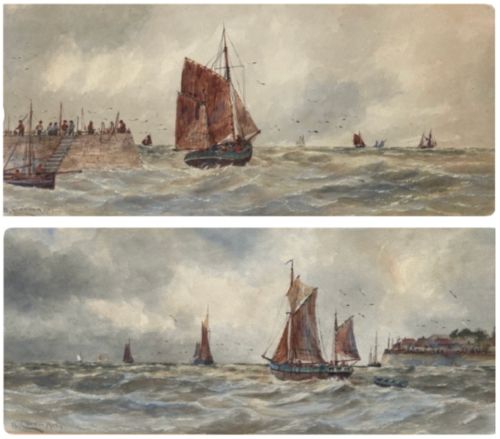


Pair Original Marine Paintings
Pair original marine paintings bring coastal atmosphere and maritime history directly into a room, offering matched balance through complementary scenes.
Pair Original Marine Paintings
These works present balanced duos of nautical subjects, capturing coastal scenes, fishing boats, and open waters across matched compositions. When a buyer searches for pair original marine paintings, they encounter authentic works created in pairs rather than single isolated pictures.
The selections span the nineteenth century, the Victorian era, and the Edwardian period, showcasing British maritime realism alongside traditional marine art. Most examples on this page appear as watercolours on paper or oil paintings on canvas and board, frequently housed within their original gilt wood frames.
Materials and construction
Artists painted these scenes using oil paint or watercolour pigment applied to canvas, prepared board, or heavy paper supports. The physical creation relies upon traditional brushwork to capture the movement of water, the texture of sails, and changing atmospheric conditions over the sea.
Framing forms an integral part of the physical object, utilising gilt wood and gold leaf to enclose and protect the painted surface. Many works retain their period glass or original wooden backing boards, preserving the piece in the state intended by the maker.
Pair Original Marine Paintings Retail Price Guide 2026
Typical asking prices for pair original marine paintings among the pieces listed under this phrase on Sellingantiques today, from the lower quarter to the upper quarter. They describe what is for sale here now, not the wider market.
The listings on this page span the nineteenth century, the Victorian era, and the Edwardian period, executed in oil and watercolour.
Distinctions in quality
The standard of execution separates accomplished maritime works from simpler decorative pieces, particularly in the accurate rendering of rigging, hull construction, and water movement. Superior examples demonstrate a confident handling of light and shadow that conveys the genuine atmosphere of the coast.
The integrity of the original pairing matters significantly, as matched works conceived together hold greater visual harmony than assembled pairs. Furthermore, the condition of the pigment, the stability of the canvas or paper, and the preservation of the period gilt frame influence the overall character of the work.
William Cannon·Abraham Hulk I·Gustave De Bréanski·Adrian Van Porten·Thomas Rose Miles RCA·Gordon Meadows
The Pair Original Marine Paintings Glossary
- Gilt wood
- Wood coated with a thin layer of gold leaf or metallic gilt paint to create a decorative frame. These frames often show age-related patination that confirms their period origin.
- Maritime realism
- An artistic style focused on depicting ships, coastal scenes, and marine life with a high degree of visual accuracy. This approach prioritises truthful observation of nautical architecture and weather conditions.
- Seascape
- A work of art depicting the sea, coastal views, or ships operating upon open water. It forms the primary subject matter for the paintings found within this category.
- Watercolour pigment
- Finely ground colour particles mixed with a water-soluble binder, applied to paper supports. This medium allows for luminous washes that suit atmospheric depictions of sky and sea.
Pair Original Marine Paintings: Frequently Asked Questions
How do I hang a pair of marine paintings?
Display the two pictures at eye level with a consistent gap between them to maintain the visual balance intended by the artist. Aligning the frames along their top edges often creates the cleanest presentation on a wall.
Ensure the wall space receives indirect light to protect the pigments on canvas or paper from fading over time. Heavy gilt frames require secure fixings anchored directly into wall studs or appropriate masonry plugs.
What subjects appear in these marine paintings?
The works depict various maritime themes, including fishing boats navigating coastal waters, sailing vessels on the open sea, and specific coastal landmarks. Scenes often capture changing weather conditions, from calm coastal inlets to turbulent open water.
Many pieces focus on the daily labour of working vessels and their crews operating around British shores. Urban maritime views, such as scenes along the Thames, also feature among the available watercolours and oils.
How do I care for antique watercolours?
Protect paper-based watercolours by keeping them away from direct sunlight and sources of excessive heat or dampness. Ultraviolet light causes fading in watercolour pigments much faster than in oil paints.
Glazed frames should remain sealed to prevent dust and moisture from reaching the paper surface. Consult a professional conservator if the backing paper or mount shows signs of foxing or deterioration.
How can I tell the Victorian period pieces?
Victorian marine art often displays specific stylistic conventions in the rigging of vessels and the handling of dramatic coastal light. Examination of the stretcher frames, canvas stamps, or framing materials can provide additional chronological clues.
Signatures, dates, and inscriptions written on the reverse of the canvas or board frequently document the exact year of creation. Edwardian works from the subsequent decade tend toward lighter palettes and distinct framing profiles.