

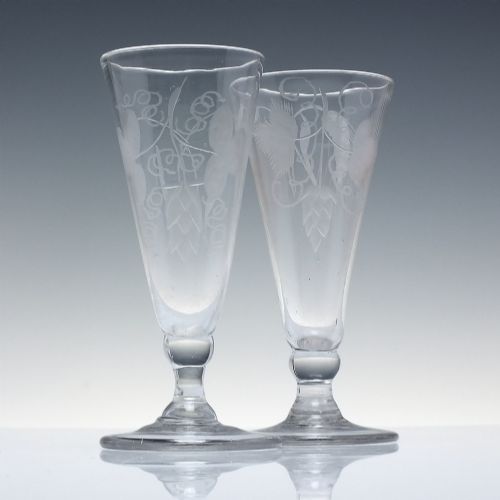
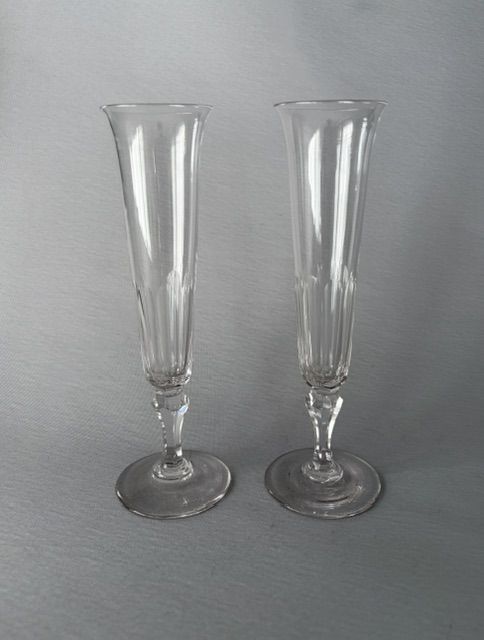
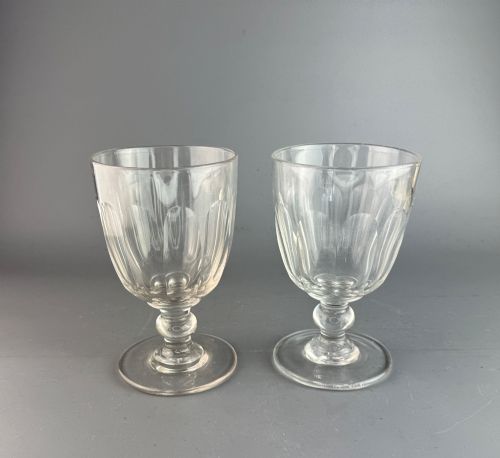


Pair of Glass Flutes
A pair of glass flutes brings symmetrical height and clarity to a table setting, spanning Georgian and Victorian forms.
Pair of Glass Flutes
A search for a pair of glass flutes centres on tall, slender drinking vessels designed for sparkling wines and champagne, alongside related tall glassware.
The archive shows that early Victorian and Georgian examples dominate the record, alongside pieces from the nineteenth century and Edwardian period.
Buyers will encounter items ranging from dedicated champagne flutes in clear lead glass to larger trumpet vases and decanters functioning as display pairs.
Materials and construction
Makers utilised clear glass, lead crystal and cranberry glass, shaping vessels through blowing and hand-finishing techniques.
Decoration often involved intricate wheel-cutting to create facets on the bowls and stems, catching the light across the surface.
Some pieces incorporate applied or flashed colour, while others rely purely on the clarity and refractive index of lead glass.
Pair of Glass Flutes Retail Price Guide 2026
Typical asking prices for pair of glass flutes among the pieces listed under this phrase on Sellingantiques today, from the lower quarter to the upper quarter. They describe what is for sale here now, not the wider market.
Listings feature periods from the Georgian era through to the 1930s, utilising clear glass, lead crystal, and cranberry glass.
Distinctions in quality
The standard of cutting determines the crispness of the facets and the tactile sharpness of the pattern against the hand.
Clarity of the metal, freedom from internal bubbles, and the consistent weight of matching pairs separate standard production from exceptional work.
Moser Crystal·Otto Prutscher·Wiener Werkstätte
The Pair of Glass Flutes Glossary
- Lead crystal
- Glass containing lead oxide, which increases the weight, brilliance and refractive index of the material. This composition allows for deeper, sharper cutting than standard soda-lime glass.
- Cranberry glass
- A rich red glass produced by adding gold chloride to the molten batch. It appears most frequently in Victorian vases and decorative table objects.
- Cut glass
- Glass decorated by holding the vessel against a rotating abrasive wheel to carve facets and patterns. The technique was widely employed throughout the nineteenth century.
- Trumpet vase
- A vessel shaped like a widening horn with a narrow base, frequently recorded in large nineteenth-century examples. These pieces provide significant vertical presence on a surface.
Pair of Glass Flutes: Frequently Asked Questions
How do I date an old pair of glass flutes?
Dating relies on examining the form, the weight of the metal, and the style of the cutting. Earlier pieces often display pontil marks on the base where the punty rod was detached.
Comparing the silhouette against known Georgian and Victorian examples helps narrow the decade of production.
Were these flutes used for champagne?
Many examples recorded in archives served specifically as champagne flutes, particularly during the Victorian era. Their tall bowls were designed to retain the effervescence of sparkling wines.
Other listed tall vessels functioned as wine flutes or decorative trumpet vases rather than everyday tableware.
How should I care for antique glass flutes?
Antique glassware requires gentle hand washing in lukewarm water with mild detergent. Avoid sudden temperature changes to prevent thermal shock to the delicate metal.
Storing them upright on a stable surface prevents chipping to the fragile rims of the bowls.