
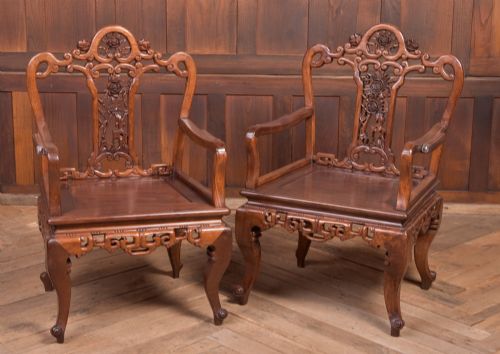
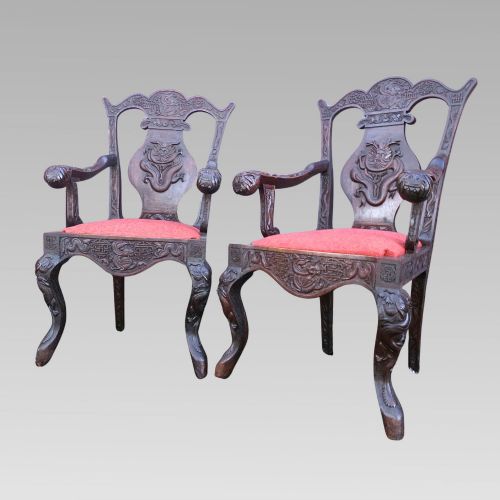


Pair of Chinese Armchairs
These pair of chinese armchairs bring historic seating into modern rooms through traditional forms originating in the Qing dynasty and nineteenth century.
Pair of Chinese Armchairs
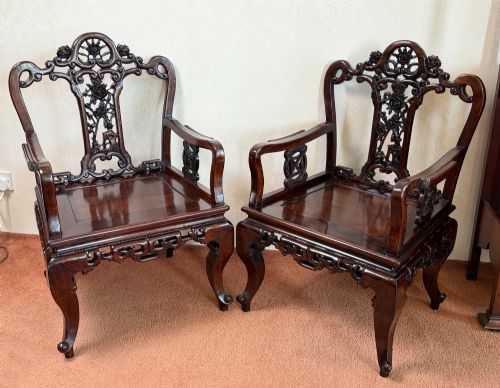
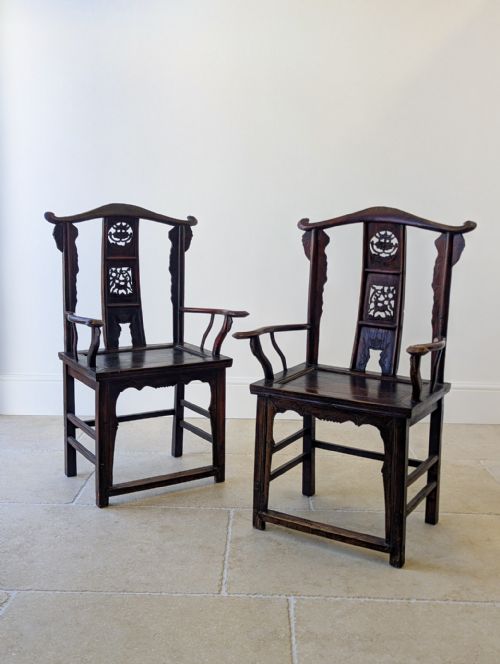
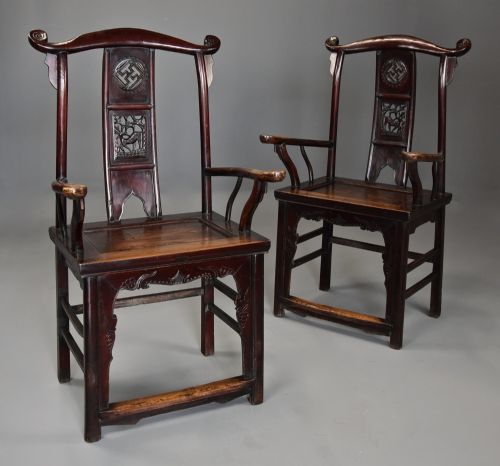
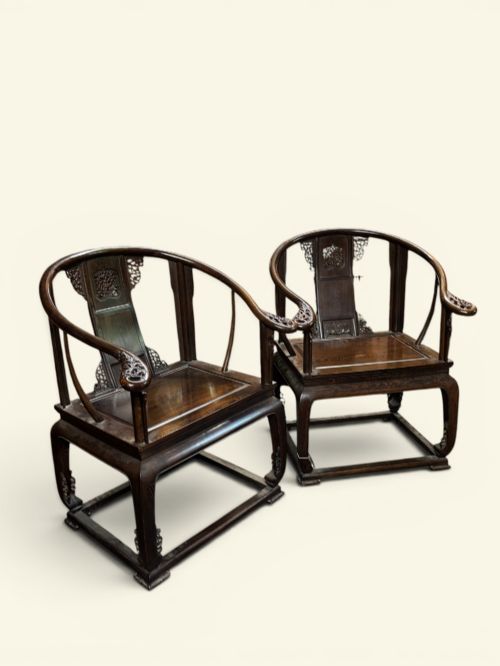
A pair of chinese armchairs encompasses seating forms ranging from scholar chairs with high crestrails to horseshoe designs and heavy throne chairs. The examples seen here date predominantly from the nineteenth century, including pieces reflecting Qing dynasty styles and export work.
Buyers encounter regional interpretations built in elm, dense hardwoods, and hongmu, often retaining carved details or lacquer finishes. Many of these chairs function well as seating or decorative accents in contemporary interiors.
How they were made
Construction relies on traditional timber framing using native Asian hardwoods, elm, and hongmu, paired with structural joinery that avoids metal fasteners. Artisans shaped components such as yoke-back crestrails and rounded horseshoe arms through steam bending and careful carving.
Surfaces frequently show applied red or black lacquer, brass inlay, cane panels, or carved dragon motifs executed in high relief. The resulting pieces balance structural durability with decorative surface detail.
Listings feature woods spanning elm, hongmu, rosewood, and lacquered hardwood across nineteenth and early twentieth century periods.
What varies in quality
Quality rests in the crispness of the wood carving, the density of the chosen timber, and the preservation of original surface finishes like red lacquer or polished patina. Heavier hongmu and dense hardwood variants demonstrate greater material selection than lighter elm examples.
Proportion and structural integrity distinguish standard production from exceptional scholar or throne chairs, particularly where joinery remains tight and original components are intact.
The Pair of Chinese Armchairs Glossary
- Yoke-back
- A chair design featuring a crestrail curved to resemble an ox yoke, common in scholar seating. This form supports upright posture.
- Horseshoe-back
- A continuous curved toprail and armrest sweeping down to the seat, offering an ergonomic embrace. It represents a classic Chinese seating form.
- Hongmu
- A dense, red-brown tropical hardwood utilised for high-status furniture. It translates literally to red wood.
- Lacquer
- A durable natural resin coating applied in multiple layers to wood surfaces for protection and decoration. It often appears in red or black on these pieces.
- Cane
- Woven rattan strips used for seat panels or backrests to provide flexible support. It is common in warmer climate seating.
Pair of Chinese Armchairs: Frequently Asked Questions
How do I place a pair in a modern room?
These armchairs serve well as flanking seating around a fireplace or as statement reading chairs in a living space.
Their distinct silhouettes contrast cleanly against minimalist contemporary furniture while adding historical texture to neutral walls.
What is the difference between a scholar chair and a throne chair?
Scholar chairs feature restrained lines with high yoke backs designed for upright contemplation during reading or writing.
Throne chairs are larger, heavier pieces defined by deep carvings and imposing proportions meant for formal reception rooms.
Are elm armchairs durable for daily use?
Elm provides a resilient and fibrous timber that handles everyday seating demands while remaining slightly lighter than dense hongmu hardwoods.
Many nineteenth-century elm examples retain stable frames supported by traditional joinery.
How do I identify a horseshoe arm shape?
The horseshoe arm sweeps in a single continuous curve from the backrest down to the front posts, creating a rounded enclosure.
This ergonomic form distributes weight evenly across the arms and back.