



Pair Mounted Paintings
Pair mounted paintings bring balanced decoration to a wall, offering matched artistry in watercolour, oil, and silk.
Pair Mounted Paintings
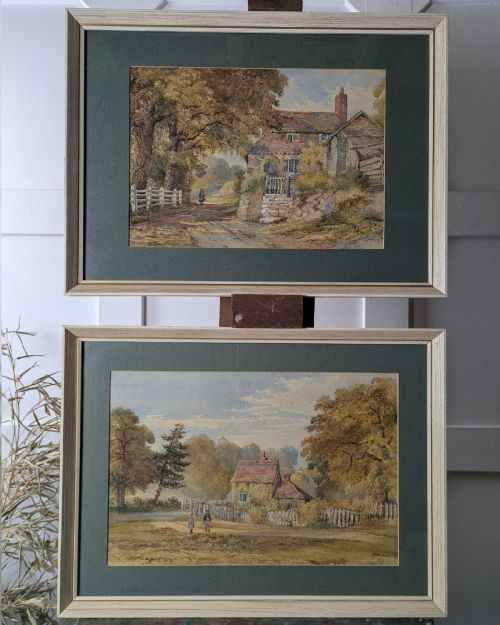
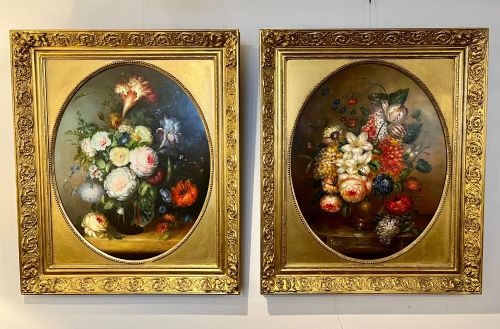
When you search for pair mounted paintings, you encounter matched works executed across the nineteenth and early twentieth centuries. These pieces encompass framed watercolours, oil on board paintings, and silk panels presented together.
The selections on this page showcase varied subjects including Dutch style still life compositions, maritime scenes, botanical studies, and charming illustrations of children at play. Originating from periods such as the Victorian era and the Meiji period, these coordinated pairs are ready for immediate hanging.
Materials and construction
Artists worked primarily on paper, board, and silk using watercolour and oil paints. These mediums captured fine details in botanical studies, maritime views, and figurative illustrations.
Framing often incorporated wood, glass, and gold leaf or gilt wood accents to protect and enhance the artwork. The combination of gilded surrounds and protective glazing defines the presentation of these paired works.
Pair Mounted Paintings Retail Price Guide 2026
Typical asking prices for pair mounted paintings among the pieces listed under this phrase on Sellingantiques today, from the lower quarter to the upper quarter. They describe what is for sale here now, not the wider market.
Listings feature works from the nineteenth and early twentieth centuries, utilising watercolour, oil on board, and silk.
Assessing the work
Quality rests upon the skill of the brushwork and the clarity of the composition, distinguishing accomplished hands from simpler decorative output. Named artists and identified regional subjects elevate the interest of a pair.
The preservation of the paper, silk, or board combined with the harmony of the original framing determines the overall standing of the matched set. Uniformity in condition across both pieces maintains their visual balance.
Robert A. Nottingham·Karl Feiertag·Alfred Rimmer·Francis Moltino·T Fairfax
The Pair Mounted Paintings Glossary
- Watercolour
- A painting method where fine pigment is suspended in water-based solution, commonly applied to paper. This technique yields translucent washes and delicate details.
- Oil on board
- A painting execution utilising oil colours spread upon a rigid wooden or composite board surface. This medium allows for rich textures and deep colour saturation.
- Gilt wood
- Timber frames finished with a thin layer of gold leaf or metallic gilt powder. Such ornamentation was standard for framing fine art in the nineteenth century.
- Meiji Period
- The era in Japanese history spanning from 1868 to 1912, noted for artistic output including paintings on silk intended for export.
- Victorian
- The period of British history corresponding to the reign of Queen Victoria, influencing the style and domestic presentation of many watercolours.
Pair Mounted Paintings: Frequently Asked Questions
How should pair mounted paintings be hung?
Hang the two pieces at eye level with consistent spacing between them to maintain their visual symmetry. Aligning the top edges creates a clean, balanced line on the wall.
Keep them away from direct sunlight to protect watercolours and silk from fading. Stable indoor humidity also prevents the wooden frames and backing boards from warping.
What subjects do these pairs feature?
The subjects range widely from Dutch style still life arrangements and maritime river views to botanical studies and children at play. Many capture specific topographical locations or traditional genre scenes.
Artists frequently produced these works in matched sets to decorate domestic interiors with complementary imagery. Each pair tells a unified visual story across both frames.
How do I identify Victorian watercolours?
Victorian watercolours often utilise muted earth tones, precise pen and ink outlines, and subject matter focused on landscapes, architecture, or portraiture. Paper stocks from this era typically exhibit heavier weights and period watermark characteristics.
The framing generally involves ornate gilt wood or simple moulded timber moulding with protective glass. Signatures, when present, reflect nineteenth-century script styles.
Are these artworks framed?
Yes, the pieces are supplied within their protective frames, usually incorporating glass and wood surrounds. This preserves the delicate paper, board, or silk surfaces from environmental dust and handling.
The framing materials often match the period of the artwork, ranging from simple timber to gilded mouldings.