

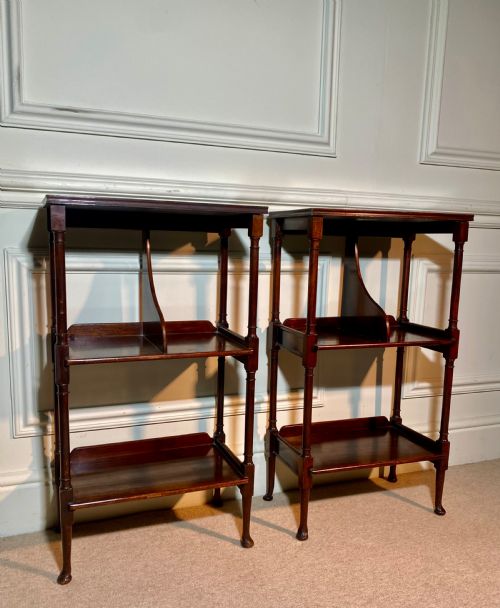


Pair Mahogany Open Stands
Pair mahogany open stands bring architectural warmth and practical display to a room, offering adaptable tiered surfaces in rich timber.
Pair Mahogany Open Stands
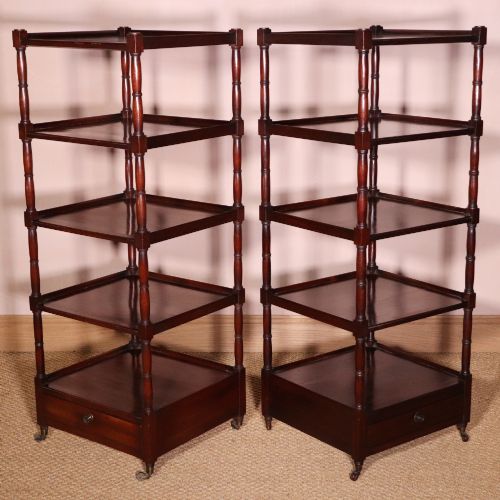
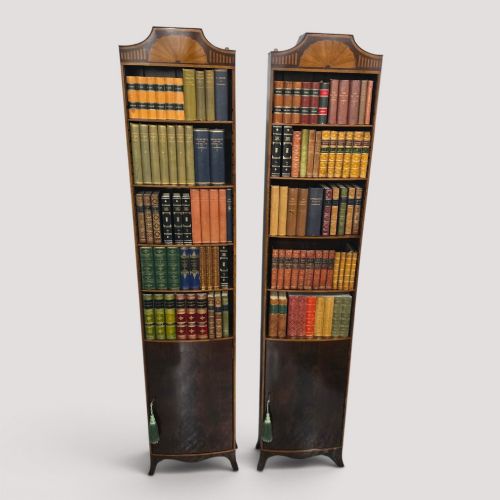
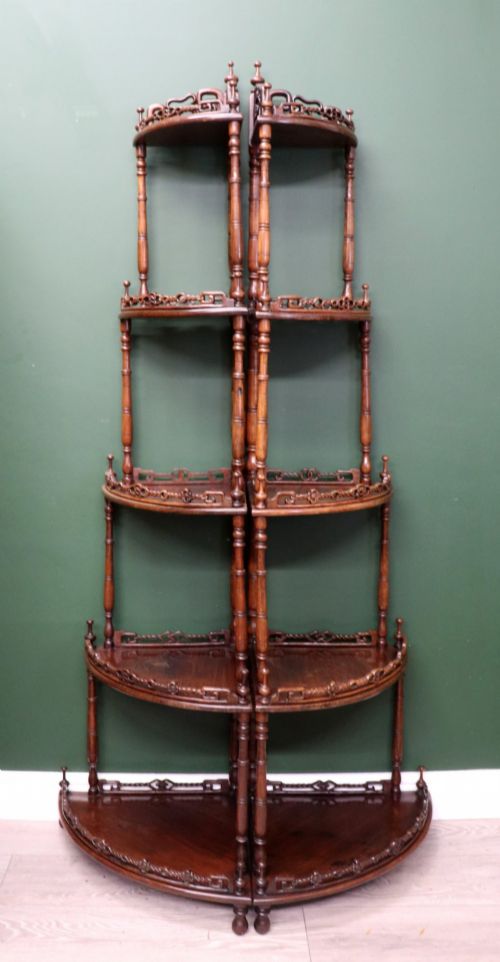
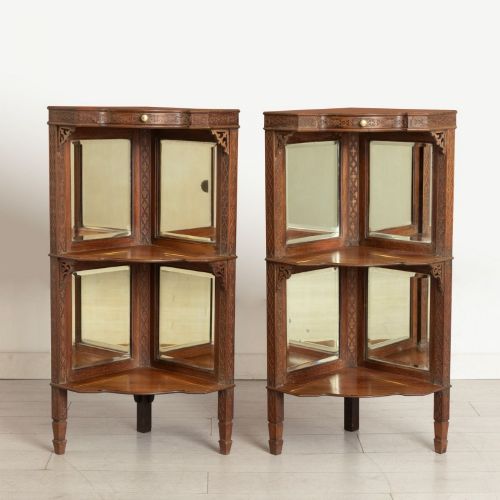
When you search for pair mahogany open stands, you are looking at matching items designed for display and storage, predominantly appearing on this page as nineteenth-century corner whatnots, waterfall bookcases, and bedside night stands. These pieces utilise rich timber to provide accessible, tiered shelving without doors.
The selection ranges from Victorian corner whatnots and Edwardian bedside shelves to Art Deco lamp tables and Regency revival waterfall bookcases. They function flexibly in domestic spaces as corner display cabinets or side tables.
Materials and construction
Construction relies heavily on mahogany, paired occasionally with walnut for contrasting visual depth in the timber grain. Makers shaped these open stands with open tiers, shelves, and tiered platforms.
Brass fittings and ormolu mounts appear as decorative metal elements on specific nineteenth-century bookcases and cabinets. Mirror glass is also integrated into certain display-oriented pieces.
Makers built these stands as open structures without solid doors, utilising graduated shelf heights in waterfall designs or sturdy vertical corner columns for stability.
A pair of bedside stands might begin life as a grand corner whatnot's ambitious little cousin.
Assessing quality in pair mahogany open stands
Quality rests on the depth of the mahogany grain and the sophistication of the joinery connecting the tiers or shelves. Superior examples show careful selection of timber figures across both matching pieces.
The presence of cast ormolu mounts and brass details elevates standard open stands into finer decorative objects. Finer execution is visible in the proportion of graduated shelves and the crispness of turned supports.
Edwards & Roberts
The Pair Mahogany Open Stands Glossary
- Whatnot
- A piece of furniture with multiple open shelves for displaying small objects or books. It usually stands on slender vertical supports.
- Waterfall bookcase
- A set of open shelves where each level steps back progressively from the one below. This creates a cascading profile reminiscent of a waterfall.
- Ormolu
- Gilded bronze or brass applied as a decorative mount on furniture. It adds metallic contrast to the timber surface.
- Edwardian
- The period of British history covering the reign of King Edward VII, noted for lighter furniture forms. Pieces from this era often simplify earlier Victorian proportions.
- Regency revival
- A stylistic movement looking back to the Regency period for decorative motifs and forms. It reinterprets classic curves and open shelf layouts.
Pair Mahogany Open Stands: Frequently Asked Questions
What rooms suit open stands?
These open stands function well in sitting rooms, bedrooms, and corners where display space is needed without heavy cabinetry. Their open tiers keep rooms feeling spacious while holding books or lamps.
Matching pairs allow for symmetrical placement on either side of a fireplace, window, or bed. They adapt easily from bedside tables to corner display units.
How do waterfall bookcases differ?
Waterfall bookcases feature graduated shelves that step back toward the top in a cascading line. This tiered silhouette separates them from standard rectangular bookcases.
They provide shallow upper shelves for smaller volumes and deeper lower tiers for larger books. This graduation creates a distinct architectural profile.
Are these stands sturdy enough?
The structural stability depends on the timber frame, corner columns, and shelf fixings. Solid mahogany construction provides the necessary strength for holding books and display objects on open tiers.
Checking how the shelves join the vertical supports reveals the build quality. Well-made nineteenth-century and Edwardian examples remain robust for daily use.
How do I date an Edwardian stand?
Edwardian stands typically show lighter timber tones and simpler proportions than heavier Victorian pieces. Their design draws on earlier styles but uses more restrained ornamentation.
Bedside night stands and simple shelf units from this period prioritise practical domestic utility. The construction techniques and hardware offer clues to their early twentieth-century origins.