
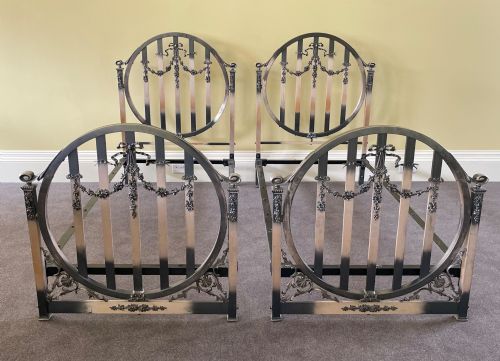


Pair French Twin Beds
Pair french twin beds bring matching continental elegance to a bedroom, offering twin sleeping frames designed to sit side by side or separately.
Pair French Twin Beds
When you search for pair french twin beds, you encounter matching sets of single bed frames and bedsteads originating from continental Europe, predominantly Britain and France. The pieces span periods from the nineteenth century through the art deco era, encompassing Victorian and Edwardian examples.
You meet various configurations in these listings, including no end single beds, corbeille styles, and platform beds. Many items arrive alongside ensuite bedside cabinets or feature provisions to be joined together.
The aesthetic draws heavily on classical European revivals, displaying Louis XVI style, French Empire, Art Nouveau, and Rococo Revival forms. Walnut, mahogany, fruitwood, and painted woods dominate the construction alongside wrought iron and nickel plating.
How they were made
Cabinetmakers constructed these bed frames from solid hardwoods like walnut, mahogany, and fruitwood, often applying intricate parquetry or carving directly into the timber. Painted wood finishes utilise polychrome details, gilt accents, and hand-painted portrait panels.
Metal frames incorporate wrought iron, cast iron, and nickel plating, frequently paired with decorative ormolu mounts. Upholstered elements utilise fabric, cane panels, and painted leather to soften the headboards and footboards.
Listings feature items spanning the nineteenth century through the 1930s, incorporating walnut, mahogany, painted wood, and iron.
What varies in quality
The distinction between standard workshop output and superior craftsmanship rests in the depth of the carving and the refinement of the timber selection. Finer examples display meticulous hand-painted detailing on portrait panels and precise parquetry work across the wood surfaces.
Hardware and secondary materials also differentiate the tiers, with heavy ormolu mounts, quality nickel plating, and intact cane or leather panels elevating the piece. The integrity of the original painted finishes and structural joinery dictates the overall caliber of the bedstead.
The Pair French Twin Beds Glossary
- Corbeille
- A French bed style featuring a curved, basket-like headboard and footboard that wraps around the mattress. This design creates an enclosed, cocooning shape popular in twentieth-century continental bedrooms.
- Ormolu
- Gilded bronze mounts applied to furniture for decorative effect. It adds a bright metallic contrast against dark hardwoods like mahogany.
- Parquetry
- Geometric wood mosaic work used for surface decoration on floors and furniture. Skilled artisans piece together small veneer triangles and polygons to form repeating patterns.
- No end
- A bed frame configuration lacking a high footboard, presenting an open profile at the base. This layout suits smaller rooms by maintaining visual flow.
Pair French Twin Beds: Frequently Asked Questions
Can pair french twin beds be joined together?
Certain models are manufactured specifically to be linked together to form a wider sleeping surface when required. You should check individual listings for joinery fixings or consult the dealer regarding compatibility.
Separating or uniting the frames depends entirely on the original design of the side rails and foot structures. Many twin sets remain as individual single beds designed to sit symmetrically in a guest room.
What mattress size fits these antique beds?
Antique single and twin frames often vary slightly from modern standard mattress dimensions due to historical sizing conventions. Measuring the internal clearance between the headboard and footboard remains essential before ordering a new mattress.
Custom or bespoke mattress makers can usually accommodate older French dimensions to ensure a snug fit within the wooden or metal rails. Slatted bases or modern platform inserts frequently need adjustment to sit correctly inside antique side rails.
How do I care for painted wood and gilt frames?
Painted and gilded surfaces require gentle dusting with a soft, dry cloth to prevent abrasion. Avoid modern chemical sprays and water, which can lift delicate gesso, gilt, and hand-painted details.
Maintaining a stable room temperature away from direct sunlight protects the painted timber and leather panels from cracking or fading over time. Professional conservation is advised for any structural restoration of antique finishes.
How do I identify a Louis XVI style bed?
Louis XVI style pieces display neoclassical restraint, characterised by straight tapered legs, fluted columns, and geometric symmetry. Carved motifs often incorporate ribbons, floral garlands, and classical urns rather than heavy asymmetrical curves.
This aesthetic emerged in late eighteenth-century France and inspired numerous revivals throughout the nineteenth and early twentieth centuries. The clean architectural lines differentiate it clearly from the more exuberant Rococo style.