
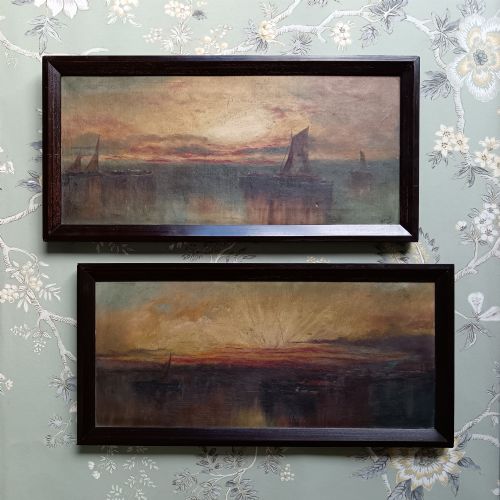
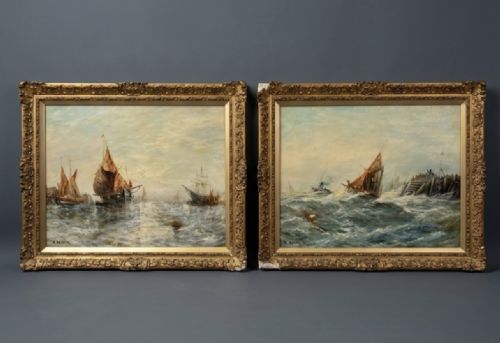
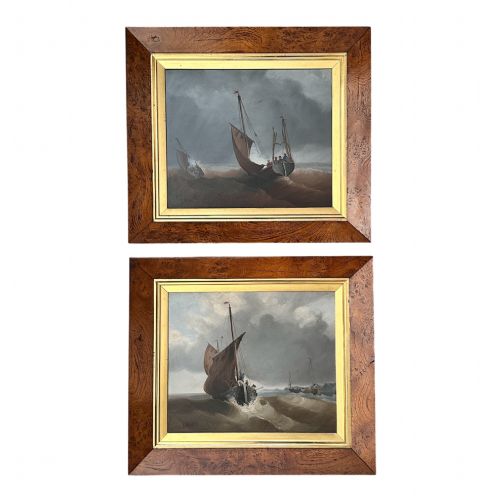
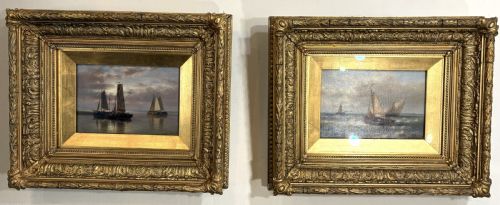


Pair Framed Maritime Art
Pair framed maritime art brings together matching coastal scenes and shipping views, matched by scale and subject to hang side by side on a wall.
Pair Framed Maritime Art
When you search for pair framed maritime art, you encounter balanced sets of coastal scenes, shipping views and seascapes designed to complement each other in domestic interiors. These matched duos typically comprise two works sharing a similar scale, palette and subject matter, such as sunrise and sunset compositions or companion ports.
The pieces on this page span the nineteenth century and the early twentieth century, taking the form of oil paintings on canvas or board, watercolours, gouaches and framed prints. You are most likely to meet Victorian and Edwardian oil paintings housed in period wooden or gilt frames, depicting fishing boats, coastal cliffs and harbour traffic.
How they were made
Artists painted these marine works primarily in oil or watercolour, applying pigment to stretched canvas, wooden panels, heavy paper or enamel plaques. Oil paintings capture the light on water and the texture of billowing sails through layered brushwork, while watercolours rely on washes to render atmospheric coastal skies and translucent seas.
The frames form an integral part of the physical object, utilising wood, gesso, giltwood and gold leaf to create ornate borders or simple ebonised surrounds. Many retain their original or period frames, which protect the edges of the canvas or paper and contribute to the visual weight of the matched pair.
Listings feature oil paint, watercolour and gouache on canvas, board and paper, housed in wood and giltwood frames.
What varies in quality
The distinction between ordinary and superior pairs lies in the hand of the artist and the cohesion of the matched pair. Master painters handle light, movement and maritime architecture with confident brushwork that brings water and vessels to life, whereas lesser hands produce stiff, formulaic waves and static shipping.
Condition and originality also separate the standard from the exceptional. Pairs that survive intact with their matching original frames, stable paint surfaces and legible signatures command greater attention than works with excessive retouching, mismatched framing or degraded paper.
B Nash·John Moore of Ipswich·Abraham Hulk I·Gustave De Bréanski·Pieter Cornelis Dommersen·Adrian Van Porten·George Dodgson Callow·Jan van Couver·Thomas Bush Hardy·Ebeneezer Colls·Hubert Thornley·John James Wilson·Walter Meegan·Thomas Rose Miles·John Mc Ghie·Francis Moltino·Walter Williams·Gordon Meadows
The Pair Framed Maritime Art Glossary
- Seascape
- A painting, photograph or other work of art that depicts the sea. These works focus primarily on coastal waters, waves and maritime weather.
- Giltwood
- Wood that has been carved and covered with a thin layer of gold leaf or gold paint. This material appears frequently on the decorative frames enclosing nineteenth-century paintings.
- Ebonised
- Wood treated with a stain or finish to imitate ebony. This dark, polished surface provides a stark contrast against lighter watercolour paintings.
- Gouache
- An opaque watercolour paint consisting of pigment mixed with a water-bound binding agent. It dries to a matte finish and yields dense colour for coastal cliffs and skies.
Pair Framed Maritime Art: Frequently Asked Questions
How do I hang a pair?
Hang the two pieces at eye level with a consistent gap between them so the horizon lines align across the wall. This balance creates a unified focal point in a room.
Ensure the frames are securely anchored using two fixings per picture to prevent shifting. Matching pairs look best when centred over a piece of furniture or given breathing room on an open wall.
Were these always sold together?
Artists often painted companion pieces concurrently, intending them to be displayed side by side as a matched set. Subjects like sunrise and sunset or companion ports were naturally conceived as pairs.
Over the decades, some sets became separated, but those surviving together preserve the artist's original decorative intent. Check that the framing and canvas sizes match to confirm their shared origin.
What is a barque?
A barque is a sailing vessel with three or more masts, having the foremast and mainmast square-rigged and the mizzenmast fore-and-aft rigged. This rig allowed large merchant ships to operate efficiently with smaller crews.
Artists frequently depicted barques in nineteenth and early twentieth-century marine art due to their commercial importance. Their distinctive rigging helps date and contextualise maritime scenes.