
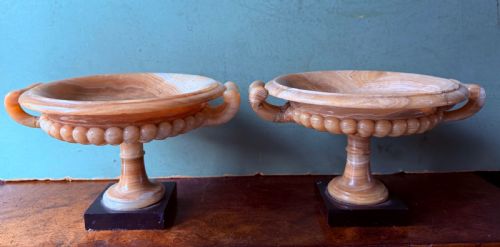
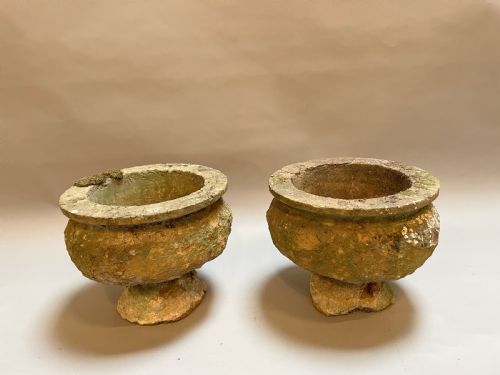


Pair Carved Stone Urns
These pair carved stone urns are sculptural vessels hewn from marble, alabaster and limestone to bring classical presence to house and garden.
Pair Carved Stone Urns
When you search for pair carved stone urns, you encounter ornamental vessels and tazzas shaped from natural mineral substances. These objects range from compact Grand Tour souvenirs designed for tabletop display to substantial garden planters intended for outdoor courtyards.
The pieces listed on this page span the eighteenth, nineteenth and twentieth centuries, taking forms such as classical campana shapes, cassolettes and architectural finials. Many draw on Neoclassical, Victorian and French design vocabularies, often mounted on contrasting marble bases or plinths.
How they were made
Makers shaped these items by hand-carving blocks of solid stone, utilising materials such as highly-figured alabastro egiziano, white onyx, breccia medicea marble and soft limestone. Artisans turned the stone on lathes or chiseled the mass directly to achieve classical proportions and hollow interiors.
Surface detailing relied on manual incision and polishing, creating textural contrast between smooth bowls and fluted or floral relief decoration. Selected items incorporate secondary elements of brass and fabric, particularly in the construction of period table lamps.
Materials across these listings include marble, alabaster, limestone, white onyx and salt-glazed stone, spanning the eighteenth to twentieth centuries.
What varies in quality
Quality in these objects rests upon the natural figuring of the stone and the crispness of the carving. Highly-figured marbles and intricately detailed alabaster display superior geological depth and manual skill compared to plainer, uniform materials.
Proportion and fidelity to classical design dictate the distinction between standard decorative pieces and finer sculptural works. Well-balanced forms, harmonious matching in a pair, and sophisticated treatments such as black marble block bases elevate the standing of an individual piece.
The Pair Carved Stone Urns Glossary
- Campana urn
- A bell-shaped vessel with an everted rim and a pedestal foot, originating in classical antiquity and revived during the Neoclassical period.
- Grand Tour
- A nineteenth-century travel phenomenon where wealthy Europeans collected souvenir artefacts, including small-scale alabaster and marble tazzas.
- Cassolette
- A decorative vase or urn featuring a reversible lid that functions either as a solid cover or a burner, seen in French lighting adaptations.
- Breccia Medicea
- A distinctive polychrome marble characterised by angular fragments suspended in a contrasting matrix, utilised in Italian Neoclassical pieces.
Pair Carved Stone Urns: Frequently Asked Questions
Where should I place marble urns?
Smaller alabaster and marble versions suit interior side tables, mantelpieces and desks, while robust limestone and salt-glazed examples belong in gardens.
Keep indoor stone objects away from direct heat sources to protect natural materials from drying and cracking over time.
How do I clean carved stone?
Dust surfaces gently with a dry, soft cloth to prevent the accumulation of grit within carved details and crevices.
Avoid using water, chemical cleaners or abrasive agents on softer stones like alabaster and onyx, as moisture damages their porous structure.
Are these urns weather-resistant?
Pieces explicitly designated as garden planters or made from durable limestone and salt-glazed stoneware withstand outdoor conditions across seasons.
Alabaster, onyx and delicate table lamps remain strictly for interior use because frost and moisture degrade their polished finishes.
What defines Neoclassical style?
Neoclassical design draws direct inspiration from the art and architecture of ancient Greece and Rome, emphasising symmetry, restraint and classical motifs.
Items in this style typically feature clean architectural lines, urn profiles, acanthus leaves and classical pedestal bases.