
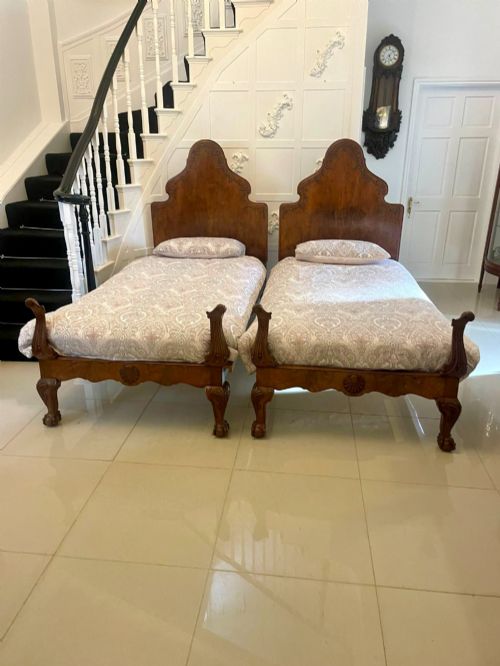
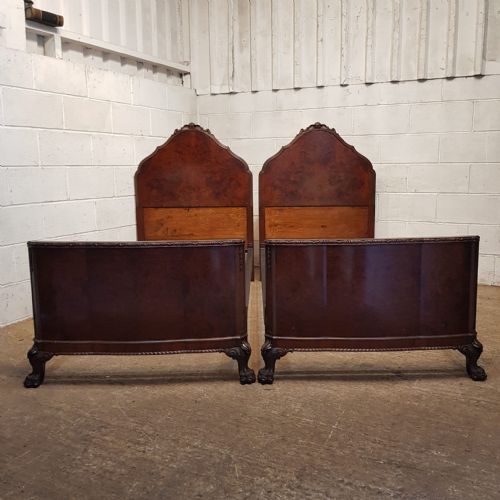


Pair Carved Single Beds
These pair carved single beds bring classical proportions and timber warmth to a bedroom, offering a matching sleeping setup.
Pair Carved Single Beds
When you search for pair carved single beds, you enter a market defined by matching timber frames built for individual sleepers. These pieces span the nineteenth and twentieth centuries, originating from English workshops and continental makers alike.
You are most likely to meet burr walnut and carved oak examples dating from around nineteen hundred to nineteen twenty. The selection ranges from French Louis XVI revival and Rococo styles to simpler English country house forms.
The objects themselves function as complete bed frames designed to hold single mattress sizes. Many retain their original headboards and footboards, showing elaborate scrollwork, linenfold panelling, or painted portrait details.
How they were made
Cabinetmakers constructed these frames using solid hardwoods and decorative veneers over secondary timbers. Walnut, burr walnut, oak, and mahogany provide the primary structural integrity and visual grain patterns across the surviving pieces.
Carving and parquetry define the surface ornamentation, executed by hand using gouges and chisels on solid sections of fruitwood or walnut. Some examples incorporate painted leather panels, polychrome portraits, or gilt highlights applied directly to the carved wood.
Joinery techniques rely on traditional mortise and tenon connections alongside iron or brass bed bolts to secure the headboards, footboards, and side rails together. Upholstered sections use internal webbing and padding beneath leather or fabric coverings.
Some single beds come with ensuite bedside cabinets, ensuring your night-time glass of water matches the headboard.
What varies in quality
The depth and crispness of the hand carving separate standard production frames from superior examples. Sharp, undercut foliage and well-defined scrollwork indicate a maker with high technical skill.
The choice of timber grain dictates visual hierarchy, with book-matched burr walnut veneers commanding greater attention than plain painted timber. Timber selection reflects the ambition of the original commission.
Maker attribution elevates certain pieces, particularly those bearing stamps from established firms like Heal and Son or Staples and Co. Construction robustness in the side rails and footboard joints also marks out superior manufacture.
Heal & Son·Heal's·Staples & Co.
The Pair Carved Single Beds Glossary
- Burr walnut
- A highly figured wood veneer taken from the burl growths of walnut trees. This material displays swirling knot patterns prized for luxury furniture.
- Linenfold
- A style of wood carving that mimics folded parchment or linen cloth. It appears frequently on early twentieth-century oak panels.
- Corbeille
- A French bed style featuring an incurved, rounded headboard and footboard resembling a basket. These frames often showcase extensive carved woodwork.
- Parquetry
- Geometric wood mosaic work used for decorative surfaces. Makers assemble small blocks of contrasting timbers to create repeating patterns.
- Polychrome
- Decorated in multiple colours. This technique appears on painted portrait panels set into the woodwork.
Pair Carved Single Beds: Frequently Asked Questions
What size mattress do these fit?
Most of these historic single frames accommodate standard single mattresses, though older continental pieces can vary slightly from modern dimensions.
It is essential to measure the internal length and width between the side rails before ordering a custom mattress.
How do you assemble them?
The headboard and footboard connect to two long side rails using internal metal bolts or traditional slot-in brackets.
Two people make assembly straightforward, ensuring the frame stays square and stable during tightening.
Can modern slats be used?
Many frames accept modern wooden slat rolls laid across internal support ledges to hold contemporary mattresses securely.
This method avoids altering the original timber structure while providing proper support for daily use.
How do you date the styles?
Stylistic clues such as linenfold carving point to Arts and Crafts revival work around nineteen hundred, while parquetry often indicates slightly later Edwardian production.
Timber choices and construction hardware help confirm whether a piece originates from the nineteenth century or the interwar period.