
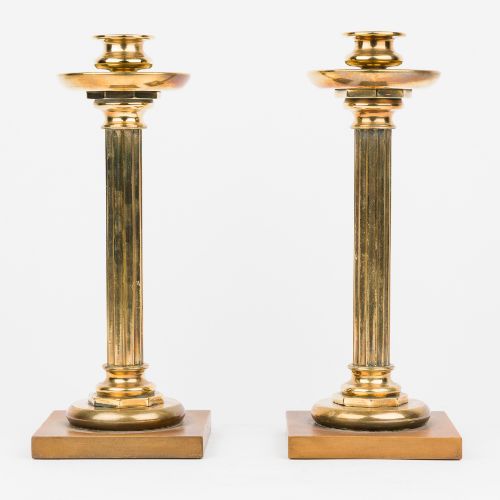


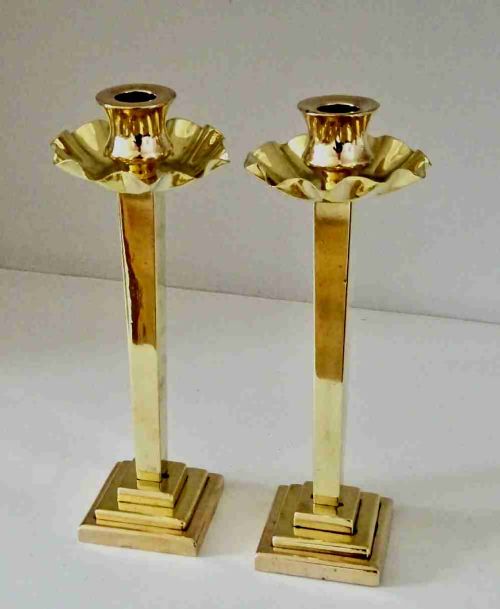

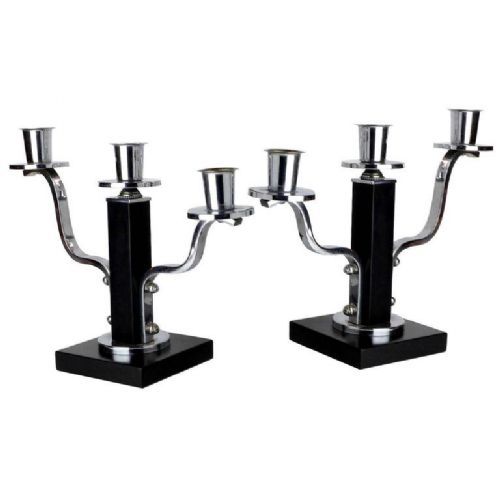
Pair Art Deco Candlesticks
Pair art deco candlesticks bring geometric symmetry and industrial flair to a table, combining utilitarian function with striking twentieth-century design.
Pair Art Deco Candlesticks
Pair art deco candlesticks embody the stylistic shifts of the early twentieth century, spanning decades from the 1910s through the 1950s. The selection ranges from robust metalwork originating in Dutch workshops to delicate pressed glass from continental makers.
Most examples found on this page date from the 1920s and 1930s, reflecting the height of modernist and geometric movements. Buyers will encounter standard taper holders alongside heavier pricket forms and table lamps designed for twin illumination.
Forms vary from stepped silver-plated shafts to moulded glass and colourful synthetic resins like Bakelite. They were produced for domestic dining and mantel displays, intended to catch candlelight on polished surfaces.
Materials and construction
Metal versions utilise casting, hammering, and plating techniques on brass, bronze, pewter, and silver. Wrought iron and patinated finishes provide darker, industrial textures, while silver plating and sterling silver offer a polished finish.
Glass examples rely on pressing, moulding, and cutting techniques, sometimes incorporating uranium glass or opaque black glass. Early plastics such as Bakelite and Catalin appear alongside chrome and nickel-silver mounts.
Listings feature candlesticks from the 1910s to the 1950s, constructed in brass, silver plate, bronze, and pressed glass.
Distinctions in quality
Quality rests in the crispness of the geometric casting and the integrity of the joins between base and stem. Finer metal examples show precise hand-finishing and substantial weight, whereas lesser pieces feel hollow or rely purely on surface plating.
In glass and early plastics, superior pieces display sharp moulding seams polished flat and rich, saturated colour without internal bubbles. Maker attribution and signed metalwork elevate a pair beyond standard mass-produced lighting.
Robert Edgar Stone·Just Andersen·Carrington & Co·R Lalique
The Pair Art Deco Candlesticks Glossary
- Pricket
- A candlestick featuring an upward-pointing metal spike that impales the base of the candle. This form appears frequently in heavier brass and iron ecclesiastical or Amsterdam School designs.
- Bakelite
- An early synthetic phenol-formaldehyde resin used for colourful, durable bases and stems. It is often paired with chrome or nickel-silver mountings.
- Guilloché
- A decorative mechanical engraving technique producing precise, intricate patterns beneath a translucent enamel coating. This is commonly found on silver and chrome dressing table items.
- Amsterdam School
- An architectural and design movement from the Netherlands characterised by expressive brickwork, organic forms, and rich metalcraft. Pieces in this style often feature patinated brass and iron.
- Sterling silver
- An alloy consisting of silver and other metals, usually copper, containing 92.5 percent silver by mass. Hallmarks stamped into the metal typically indicate the assay office and date.
Pair Art Deco Candlesticks: Frequently Asked Questions
How do I clean tarnished silver-plated candlesticks?
Use a soft cloth with a mild, non-abrasive silver polish to remove oxidation gently. Avoid harsh chemical dips that strip protective layers from vintage plating.
Take care around weighted bases and soldered joints to prevent moisture ingress. Store them in dry environments to slow future tarnishing.
What is the difference between brass and bronze?
Brass is an alloy made primarily of copper and zinc, yielding a bright golden appearance. Bronze consists mainly of copper combined with tin, producing a darker, warmer tone.
Both materials were cast and patinated during the period. Bronze generally carries more weight and resists corrosion better than standard brass.
Are uranium glass candlesticks safe to use?
Uranium glass contains trace amounts of uranium oxide added to create a distinctive green or yellow hue that glows under ultraviolet light. The radiation emitted is extremely low and considered safe for display.
They should not be used to hold food or drink, but normal handling as decorative objects poses no risk. Wash them gently by hand rather than using a dishwasher.
How can I tell the 1920s from the 1930s?
Pieces from the 1920s often combine Art Nouveau fluidity with emerging geometric lines, featuring hand-wrought metals and organic glass motifs. The 1930s lean fully into streamline moderne, chrome, and mass-produced synthetic plastics.
Examining any accompanying hallmarks or registration numbers helps narrow down the exact decade of production.