
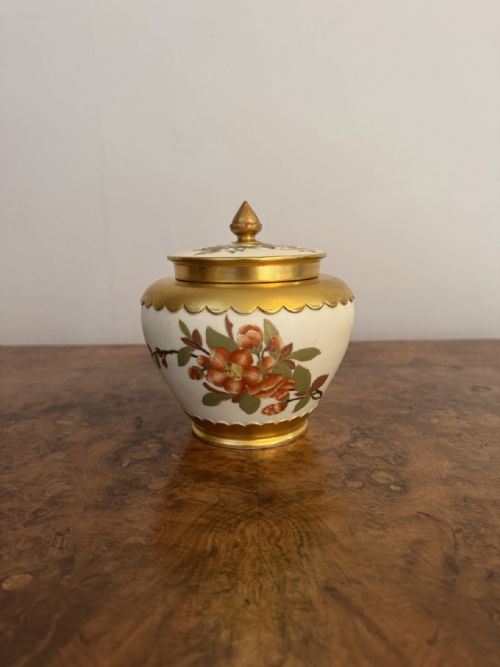


Painted Porcelain Potpourri Jar
These painted porcelain potpourri jar examples bring nineteenth and twentieth century ceramic artistry into domestic spaces with pierced covers designed for scent diffusion.
Painted Porcelain Potpourri Jar
A painted porcelain potpourri jar combines decorative ceramics with functional fragrance dissemination, typically featuring a pierced or crown cover that lets dried herbs and petals perfume a room. Buyers searching this phrase encounter nineteenth and twentieth century pieces spanning Victorian, Edwardian, and Regency revivals.
The inventory on this page showcases diverse forms including lidded bowls, ginger jars, bow urns, and conventional vases. Originating from English and continental makers, these vessels employ porcelain, ironstone, and ceramic bodies enhanced by enamel, gilding, and gilt bronze mounts.
Periods represented stretch from the eighteen-sixties through the mid-twentieth century, capturing aesthetic shifts from rococo revival flourishes to blush ivory finishes. Makers such as Royal Worcester and Dresden dominate the selection, offering both cabinet-sized ornaments and substantial lidded urns.
How They Were Made
Manufacturers shaped porcelain, ironstone, and ceramic bodies on the potter's wheel or via casting moulds before applying detailed hand-painted enamel decoration. Pierced covers required precise cutting prior to firing so the apertures remained uniform after shrinkage.
Gilding and gold leaf accents were hand-applied over the glaze and subjected to a secondary low-temperature kiln firing to bond the metal. Some continental and French pieces integrated cast gilt bronze mounts, securing decorative elements directly to the ceramic body.
This site's listings feature nineteenth and twentieth-century porcelain, ironstone, and ceramic bodies enriched with enamel, gilding, and gilt bronze mounts.
What Varies in Quality
The fineness of the hand-painted brushwork distinguishes standard production ware from superior examples, particularly in botanical or figural scenes. Crisp definition in pierced crown covers and precise alignment of lidded components indicate higher workshop standards.
The application and preservation of gold leaf and gilding reveal the original tier of manufacture, where thicker burnished gold denotes superior craftsmanship. The inclusion of heavy cast bronze mounts on continental items elevates the overall architectural presence of the vessel.
Royal Worcester·Dresden·Wolfsohn·Spode·Mason's
The Painted Porcelain Potpourri Jar Glossary
- Potpourri jar
- A lidded vessel with a perforated or openwork cover specifically constructed to hold and diffuse the scent of dried flower petals and spices.
- Blush ivory
- A soft, matte cream-coloured porcelain glaze pioneered by Royal Worcester during the late nineteenth century to mimic the warmth of human skin.
- Gilt bronze
- An alloy of copper and zinc finished with a layer of fine gold leaf or mercury gilding, commonly utilised for decorative mounts on nineteenth-century French ceramics.
- Ironstone
- A heavy, durable type of vitreous earthenware developed in nineteenth-century England to rival Chinese porcelain in strength.
- Rococo revival
- A nineteenth-century design style characterised by asymmetrical scrolls, naturalistic floral motifs, and extravagant ornamentation.
Painted Porcelain Potpourri Jar: Frequently Asked Questions
How do I use a potpourri jar?
Place dried scented botanicals directly inside the ceramic body and replace the pierced lid to allow the fragrance to disperse gradually through the room.
Ensure the interior remains dry to protect the unglazed or painted porcelain surfaces from moisture damage over time.
What periods do these jars cover?
The available pieces span from the mid-nineteenth century through the Edwardian era and into the mid-twentieth century.
Victorian and late nineteenth-century examples often feature elaborate gilding and rococo revival styling, whereas later twentieth-century items display naturalistic painted fruit and floral motifs.
How do I distinguish Dresden from Royal Worcester?
Dresden pieces frequently exhibit continental influences, sometimes incorporating Meissen-style motifs and blue ground decoration with specific factory marks.
Royal Worcester items often showcase characteristic blush ivory grounds, English traditional botanical studies, or hand-painted fruit compositions.
Are these jars purely decorative?
While originally intended for both scent diffusion and visual ornamentation, most serve primarily as decorative mantel or table centrepieces today.
The pierced covers remain functional, though many collectors display them empty to preserve the interior glaze.