


Painted Enamel Glass Urn
A painted enamel glass urn brings rich colour and botanical detail into a room, combining clear or tinted glass with raised, hand-painted pigments.
Painted Enamel Glass Urn
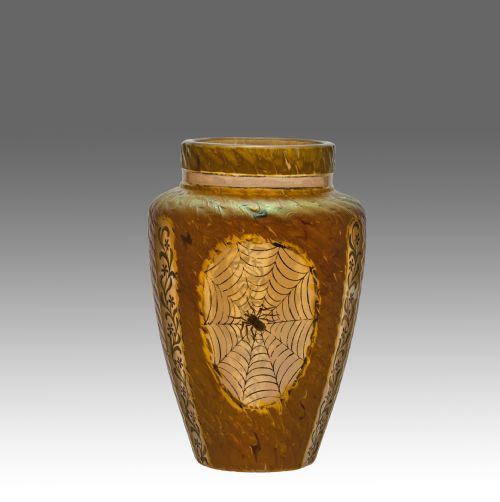
When you search for a painted enamel glass urn, you find decorative vessels shaped as vases, trios, and garniture sets from the nineteenth and early twentieth centuries. These pieces appear in periods spanning Victorian and Art Nouveau, often displaying opaque glass, cranberry glass, or iridescent finishes.
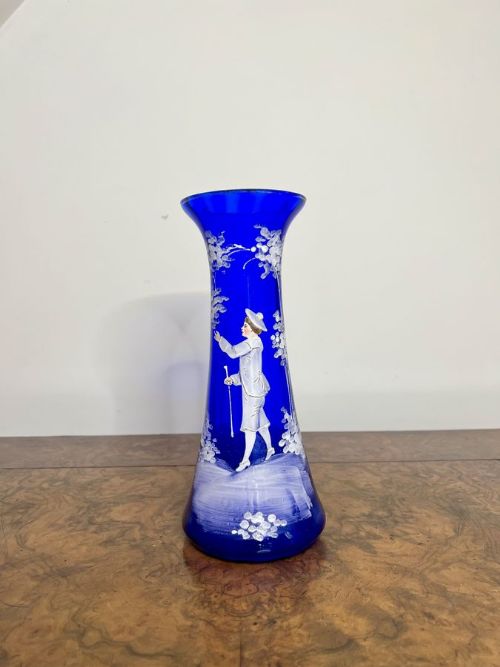
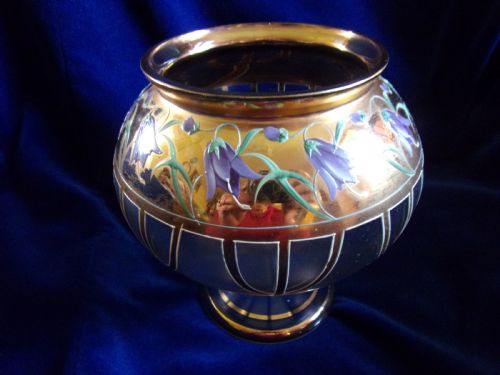
The most common examples on this page are Victorian pieces, including Mary Gregory styles featuring white enamel silhouettes of children in natural settings. You also encounter Bohemian and English vessels adorned with polychromatic enamels and gold leaf.
Forms range from small cabinet vases to tall decorative vases and pairs, showing influences from the Victorian Aesthetic Movement and Japonisme. Each piece relies on the contrast between translucent or coloured glass grounds and opaque, textured enamel paint.
How they were made
Makers formed these vessels using glassblowing techniques, shaping cranberry, green, amber, or opaque glass into classical urn and vase silhouettes. Overlay techniques were applied to create layered colours, sometimes incorporating gold leaf gilding across the surface.
Designers then decorated the cooled glass using enamel paint, which was hand-painted onto the exterior to depict figures, fish, water plants, and floral motifs. Firing fixed the enamels permanently to the glass body, creating a raised, durable finish.
Materials recorded across the inventory include cranberry glass, iridescent glass, gold leaf, and opaque glass.
What varies in quality
The distinction between standard and superior pieces rests on the precision and complexity of the enamel work. Finer examples display meticulous brushwork, multi-coloured polychromatic palettes, and applied gold leaf that remains crisp and vibrant.
The quality of the underlying glass also determines the piece, with heavy, well-balanced forms and rich ground colours such as deep cranberry or controlled iridescence ranking above simple, thin-walled vessels.
Kralik Glass·Mary Gregory·Moser·Harrach
The Painted Enamel Glass Urn Glossary
- Enamel paint
- A glossy, opaque paint fused to glass through firing. It sits slightly raised on the surface and provides durable colour.
- Cranberry glass
- A rich red glass coloured with gold chloride during production. It is frequently seen in Victorian decorative wares.
- Garniture set
- A matched group of three or more vases designed to sit together on a mantelpiece. These sets share decorative motifs and forms.
- Iridescent glass
- Glass treated with metallic oxides while hot to produce a rainbow sheen. This effect became popular during the Art Nouveau period.
- Overlay glass
- A technique involving layers of different coloured glass fused together. Part of the outer layer is often cut away to reveal the contrasting colour beneath.
Painted Enamel Glass Urn: Frequently Asked Questions
What is Mary Gregory glass?
Mary Gregory glass refers to Victorian glassware decorated with white enamel silhouettes of children playing or interacting with nature. The attribution often covers a broader style of white enamelling produced in Bohemia and England.
These pieces typically feature cranberry, green, or blue glass grounds that make the white enamel figures stand out clearly.
How do I clean a painted enamel glass urn?
Clean these vessels gently using a soft, dry cloth to remove dust from the surface. Avoid submerging them in water or using chemical cleaners, as moisture can harm the enamel paint and gold leaf.
If the interior requires cleaning, use a dry bottle brush and take care not to touch the exterior painted decoration.
How do I tell Victorian pieces from Art Nouveau ones?
Victorian pieces often feature structured floral motifs, symmetrical shapes, and opaque glass backgrounds with white or polychromatic enamel figures. They feel grounded in traditional nineteenth-century decorative styles.
Art Nouveau examples lean towards organic forms, stylized floral patterns, and iridescent finishes that mimic natural phenomena. The lines are typically more flowing and asymmetrical.
Where were these glass urns displayed?
These decorative vessels were designed for prominent display in nineteenth-century drawing rooms and parlours. They sat upon mantelpieces, sideboards, or within glass-fronted cabinets to showcase the owner's taste.
Garniture sets were arranged symmetrically to anchor the centre of a fireplace mantel.