
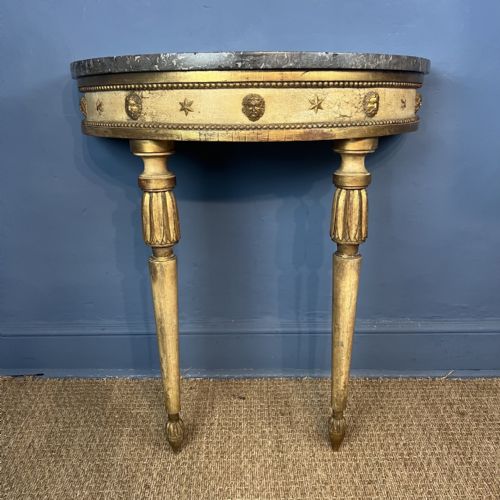
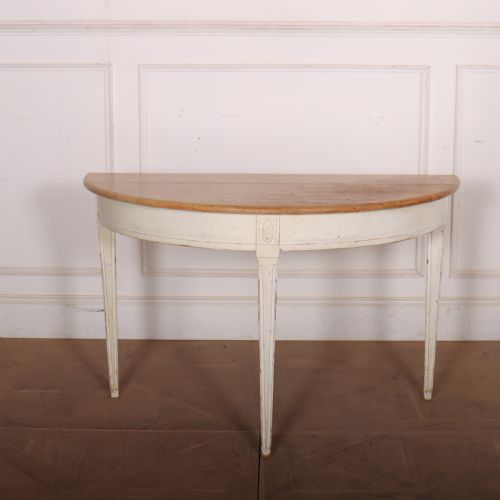


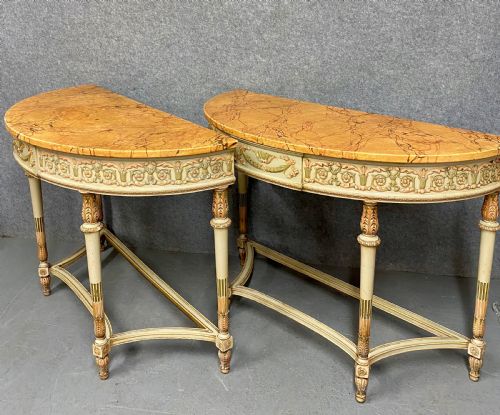

Painted Demilune Hall Table
These painted demilune hall tables offer a semicircular profile designed to sit flush against a wall in narrow spaces.
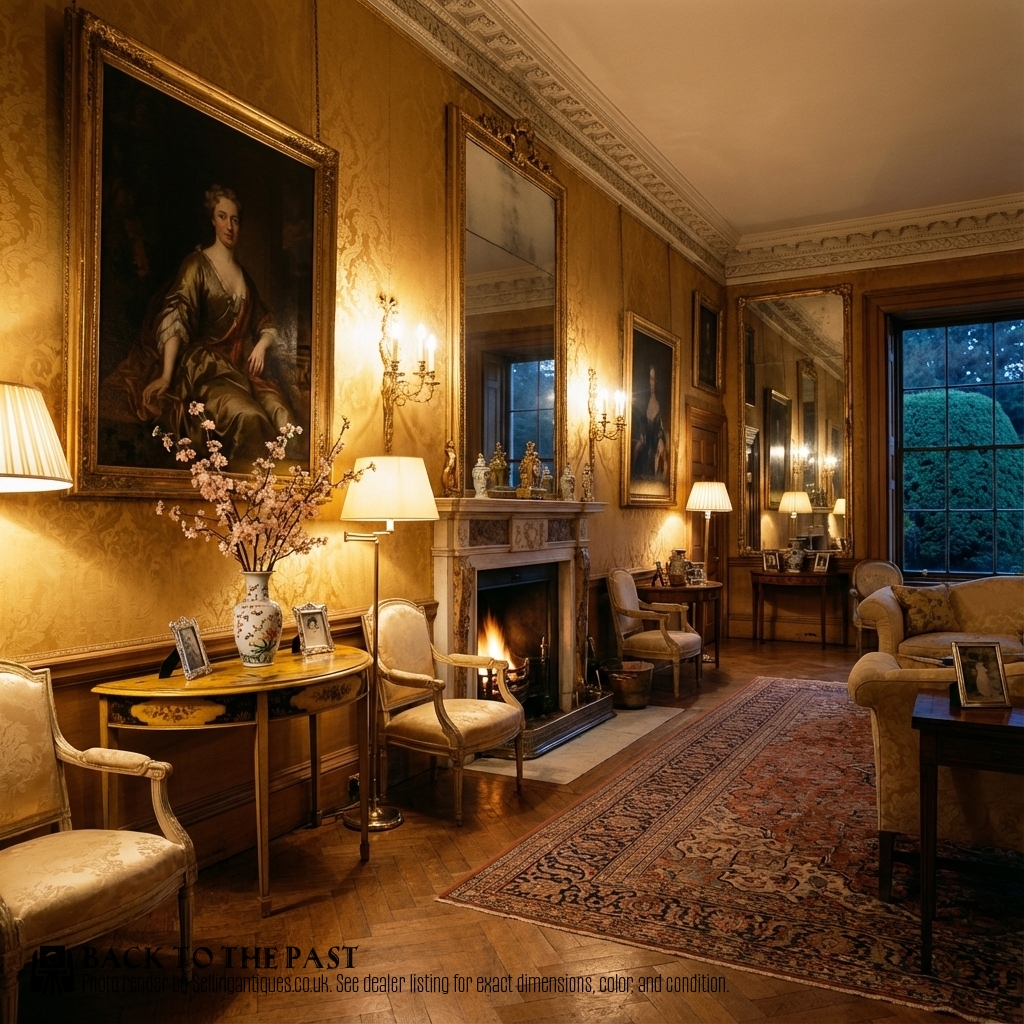
Painted Demilune Hall Table
A painted demilune hall table provides a distinctive semicircular surface shaped specifically to fit against entrance walls without obstructing movement. The selection brings together console and side tables spanning the eighteenth century through to the early twentieth century.
Origin points across the current selection stretch from England and France to Sweden and Italy. These half-moon tables function as practical hallway surfaces while displaying regional decorative painting traditions.
How they were made
Construction relies upon woods such as pine, mahogany, and satinwood, frequently shaped into D-end or demi-loon configurations. Artisans applied layers of paint, gesso, and occasional parcel gilt over wooden frames to achieve decorative surfaces.
Certain examples incorporate inset marble tops supported by wrought iron or carved wooden frames. Regional cabinetmakers combined traditional joinery with surface painting, creating polychrome or cream-painted finishes that define the aesthetic of these console tables.
Several tables appear under the spelling demi-loon, proving that even furniture geography bends to imagination.
What varies in quality
The refinement of the painted surface determines visual distinction across the range, separating simple folk interpretations from polished neoclassical execution. Surface decoration shifts from plain cream paint to intricate polychrome details and parcel gilding.
Structural complexity creates further distinction, visible in whether a piece utilises carved wooden frames or heavy marble inserts. The integrity of the original timber beneath the painted skin influences overall character.
The Painted Demilune Hall Table Glossary
- Demilune
- A half-moon shape or semicircular form. This profile allows the table to stand flat against a wall.
- Console table
- A table designed to be fixed against a wall, often supported by brackets or front legs. These pieces traditionally serve display functions in hallways and reception rooms.
- Polychrome
- Decorated in multiple colours. This technique appears across various painted surfaces in the collection.
- Parcel gilt
- Partially gilded with gold leaf or a gold-coloured substitute. This highlights specific carved details on the woodwork.
- Satinwood
- A durable, yellow-brown timber with a lustrous grain. Cabinetmakers utilised this wood for fine eighteenth-century furniture.
Painted Demilune Hall Table: Frequently Asked Questions
Where do I put a demilune table?
These semicircular tables fit neatly against walls in narrow hallways, entrance passages, and reception spaces. Their flat back allows them to occupy minimal floor depth.
They serve as surfaces for lamps, bowls, or decorative objects while maintaining clear walkway space.
What is the difference between a console and a side table?
Console tables traditionally anchor against a wall, sometimes relying on the structure for stability or featuring front legs only. Side tables are freestanding pieces designed to be placed beside seating or walls.
In historical listings, these terms often overlap for semicircular hall furniture.
How do I identify a Gustavian style table?
Gustavian pieces from Sweden typically exhibit lighter painted finishes, often in cream or soft grey. Their decoration draws inspiration from French neoclassical design but remains more restrained.
Carved details tend to be subtle, focusing on fluting and simple geometric motifs.
What materials make up these tables?
Construction materials include foundational woods like pine, mahogany, and satinwood. Surfaces feature paint, gesso, and occasionally marble tops.
Some examples incorporate wrought iron frames beneath stone surfaces.
Are these tables from the eighteenth or nineteenth century?
The selection spans multiple periods, ranging from eighteenth-century Sheraton and D-end formats to nineteenth-century English and Victorian pieces. Twentieth-century examples from 1900 to 1920 also appear.
Stylistic cues and wood types help distinguish between earlier craftsmanship and later revivals.