



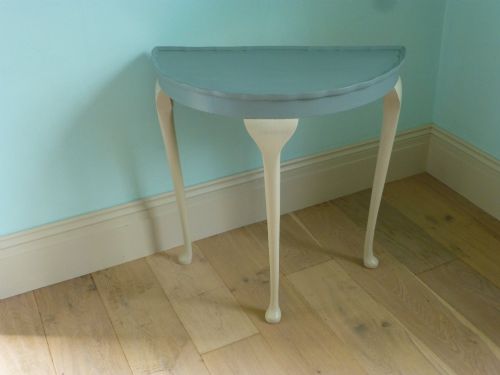


Painted Demi Lune Console Table
A painted demi lune console table brings half-round grace to a hallway, designed to hug a wall with quiet proportion.
Painted Demi Lune Console Table
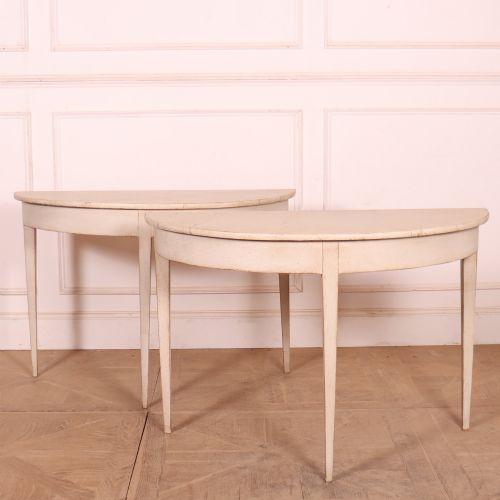
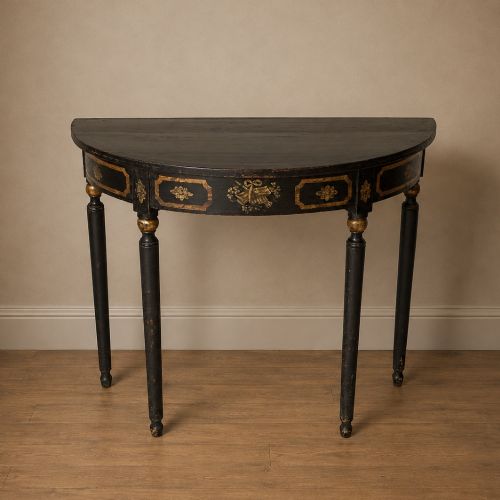
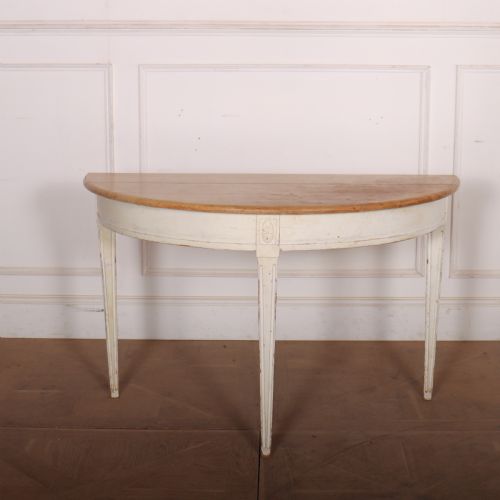
A painted demi lune console table takes a half-moon shape, built to stand flat against a wall in hallways and parlours. These tables appear across periods from the eighteenth century through to the Edwardian era and the nineteen-twenties.
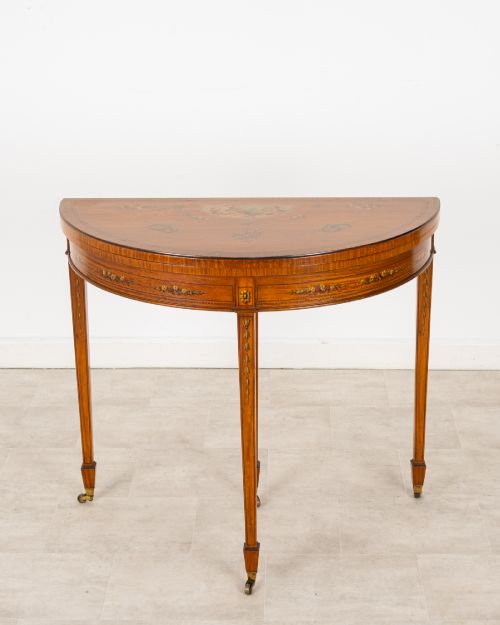
The selection here includes George III serving tables, Edwardian satinwood pieces, and Swedish painted forms. You will also find card tables and games tables sharing the same semicursal footprint, alongside pairs suited for symmetrical placement.
How they were made
Makers used pine and timber as a carcase, often surfacing them with satinwood veneers. Surfaces received layers of paint, sometimes finished with parcel gilt or gold leaf details.
Many examples incorporate hand-painted decoration upon the timber top, while others pair the painted wooden base with a marble slab.
Painted Demi Lune Console Table Retail Price Guide 2026
Typical asking prices for painted demi lune console table among the pieces listed under this phrase on Sellingantiques today, from the lower quarter to the upper quarter. They describe what is for sale here now, not the wider market.
Listings feature painted wood, satinwood, and giltwood across periods spanning from the early eighteenth century to nineteen-twenty.
What varies in quality
Quality rests in the crispness of the painted surface and the handling of the satinwood or timber beneath. Finer examples display deliberate brushwork and decorative motifs that integrate smoothly with the half-round form.
Proportion and the stability of the legs define the better specimens, distinguishing utilitarian pieces from those designed for formal reception rooms.
The Painted Demi Lune Console Table Glossary
- Demi-lune
- Half-moon shape. This describes tables constructed with a straight back edge for placement against a wall and a semicircular front.
- Satinwood
- A durable hardwood with a golden sheen. Makers used it for its fine grain and pale colour, often as a veneer.
- Giltwood
- Wood coated with gold leaf or gold paint. It highlights carved details on legs and aprons.
- Chinoiserie
- European interpretation of Chinese decorative arts. This style appears on painted surfaces with motifs of figures and landscapes.
- Parcel gilt
- Partially gilded. Artisans applied gold leaf to specific raised portions while leaving the painted base visible underneath.
Painted Demi Lune Console Table: Frequently Asked Questions
Where do you place a demi lune table?
These tables fit flat against a wall, making them suited for narrow hallways, landings, or entryways where depth is limited. Their half-round shape allows them to serve as a surface for lamps or decorative objects without obstructing passage.
They also function effectively in living rooms or dining spaces, particularly when paired symmetrically on either side of a fireplace or doorway.
How do I use a games table version?
Games table versions feature folding tops that open to reveal a baize-lined surface for card playing or board games. When closed, they occupy the same modest footprint as standard console tables.
In daily use, you keep the top folded flat against the wall as a display surface, opening it only when needed for entertaining.
How do I identify a George III piece?
George III pieces date from the eighteenth century and typically display refined proportions in mahogany or satinwood with painted decoration. They often feature tapered legs and restrained neoclassical motifs.
Examining the construction methods and the wear on the timber helps confirm the period.
Are Swedish painted tables different?
Swedish tables from the nineteenth century often exhibit a paler palette, favouring light greys, creams, and soft blues. Their painted surfaces reflect Scandinavian interpretations of continental neoclassical styles.
These pieces tend to have simpler lines compared to their French or English counterparts.