
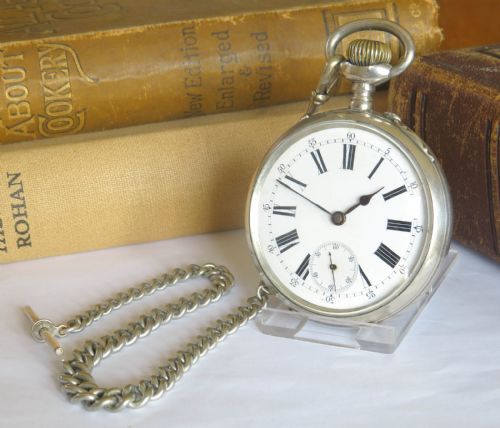
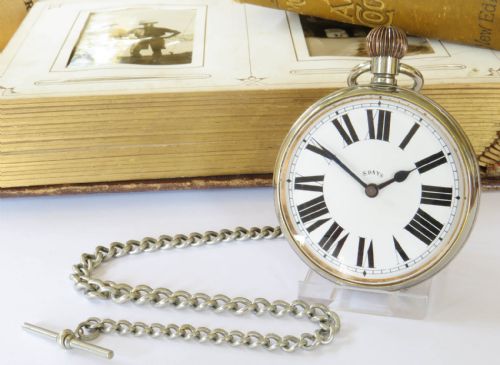


Oversized Pocket Watch
Oversized pocket watch pieces are substantial timepieces built for desk or travel use, prized for their imposing presence and mechanical reliability.
What an oversized pocket watch is
When you search for an oversized pocket watch, you encounter large-scale timepieces designed to sit on a desk, a bedside table, or within a dedicated travelling case rather than a waistcoat pocket. These domestic and travel instruments provide a clear, bold display of time through generous dials that make them practical for everyday interior use.
The versions you are most likely to meet on this page belong to the Edwardian period, specifically around nineteen hundred and nineteen ten. They typically take the form of goliath watches or massive silver-cased iterations that dominate their surroundings through sheer scale.
Makers such as Omega and H.W. Bedford of Regent Street London appear alongside unbranded goliath pieces, showing the variety of retailers and manufacturers who supplied these large instruments. These pieces demonstrate how Edwardian timekeeping scaled up for convenience beyond the pocket.
Materials and construction
These timepieces rely on robust metals including nickel, brass, steel, and solid silver for their substantial cases, which protect the internal mechanisms from knocks during travel or daily desk use. Enamel provides a bright, clean surface for the dials, allowing bold numerals to remain legible from a distance.
Glass protects the delicate dial faces and hands, held securely within heavy bezels that swing open for winding and hand-setting. The movements inside include specialised eight-day calibres that require less frequent winding than standard pocket watches.
Retail Price Guide 2026
Typical UK retail prices for oversized pocket watch, calculated from the Sellingantiques database of over a million retail prices indexed since 2003. This retail price guide relies exclusively on Sellingantiques data; no external sources or auction records are used, so the figures do not describe the wider market.
Listings feature Edwardian pieces from nineteen hundred to nineteen ten, utilising nickel, silver, brass, steel, enamel, and glass.
Judging quality
Quality in these large timepieces rests upon the sophistication of the movement and the integrity of the casing material. Solid silver cases and eight-day movements represent the upper tier of production, offering heavier weight and greater mechanical autonomy.
The clarity and condition of the enamel dial also dictate the standing of a piece, alongside the crispness of the retailer or maker signature inscribed upon the face. Pieces supplied by established firms like H.W. Bedford carry the reassurance of top-tier Edwardian retail standards.
Omega·H.W. Bedford
The Oversized Pocket Watch Glossary
- Goliath watch
- An oversized pocket watch, usually measuring around two and a half inches or more across, designed for desk stands or travel cases. These heavy pieces require specialised furniture to display them properly.
- Eight-day movement
- A mechanical watch movement capable of running for over a week on a single wind. This complication suits desk and carriage use where daily winding is less convenient.
- Enamel dial
- A fused glass powder surface applied to a metal base, providing a smooth and permanent white background for painted numerals. It resists fading over decades of light exposure.
- Silver-cased
- Enclosed in solid silver rather than plated base metal. This adds heft and value to the object.
Frequently Asked Questions
How were oversized pocket watches used?
These large timepieces served as portable clocks for travellers and desk accessories for offices or bedrooms. Their scale made them easier to read across a room than a standard waistcoat watch.
Owners often housed them in leather travelling cases or silver desk stands equipped with struts to prop them upright.
What periods do these watches come from?
The examples on this page date from the Edwardian era, specifically around nineteen hundred and nineteen ten. This period saw high demand for heavy domestic and travel timepieces.
Stylistic cues from this era include clear Arabic numerals and robust nickel or silver cases built to withstand regular handling.
Do these watches need special stands?
Because of their considerable weight and lack of a pendant bow suitable for standard chains, they often require dedicated folding leather travel cases or strutted frames.
Displaying them securely prevents accidental knocks while allowing the large dial to remain visible on a desk or table.
What is an eight-day movement?
An eight-day movement is a mechanical calibre engineered to run continuously for over a week before needing a fresh wind. This reduced the frequency of handling large cases.
Such movements required larger mainsprings and robust gear trains to deliver sustained torque over the extended period.