





Oval Leather Desk
An oval leather desk brings curved lines to a study, offering rich wood and supple hides suited for writing.
Oval Leather Desk
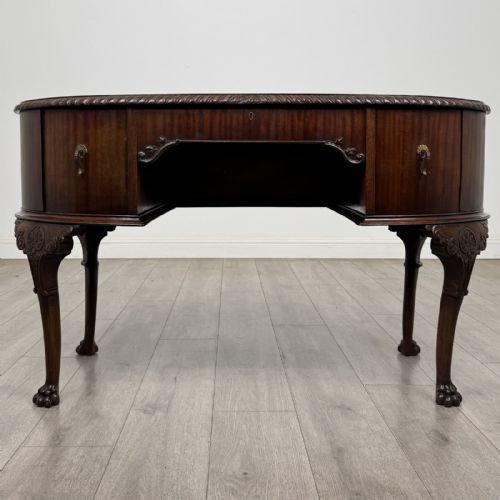
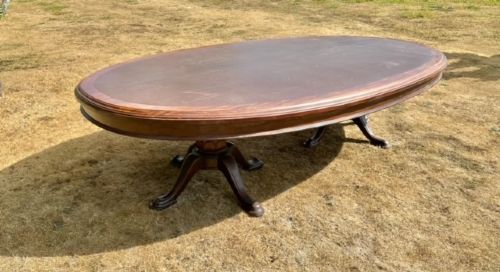
An oval leather desk presents a curved writing surface, appearing across Georgian, Victorian and Edwardian periods in forms such as library tables, drum tables and freestanding writing tables. These pieces combine practical workspace with distinctive shaped tops framed in timber.
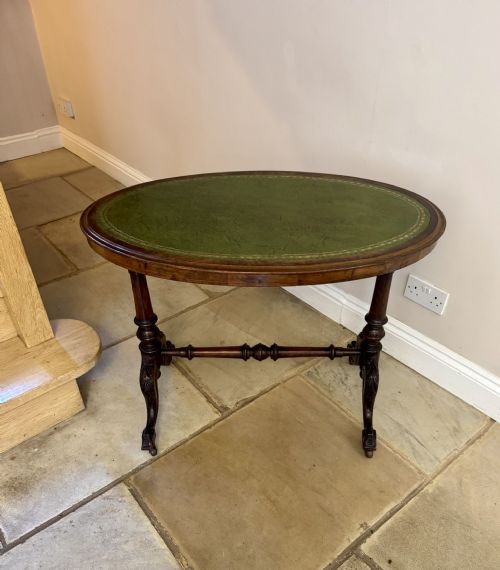
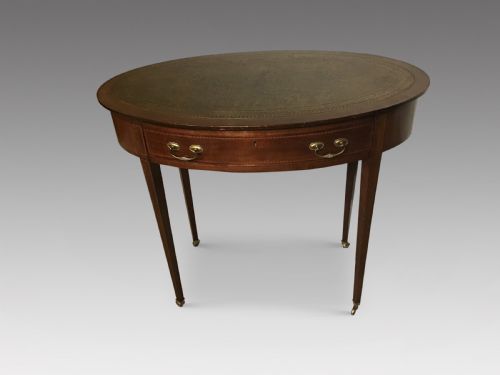
The versions most commonly met on this page span the nineteenth and early twentieth centuries, constructed from mahogany, walnut, burr walnut and satinwood. Many feature leather inserts surrounded by polished wood borders, serving as centre tables or library furnishings.
Materials and construction methods
Cabinet makers utilised solid and veneered timbers including mahogany, satinwood and burr walnut, often shaping the curved framework to form the characteristic oval silhouette. Inlaid details and brass fittings frequently complemented the timber structure.
Leather tops were set into recessed wooden channels and finished with blind or gilt tooling along the margins. The joinery reflects traditional table-making techniques designed to support daily writing use.
Oval Leather Desk Retail Price Guide 2026
Typical asking prices for oval leather desk among the pieces listed under this phrase on Sellingantiques today, from the lower quarter to the upper quarter. They describe what is for sale here now, not the wider market.
Among the tables and desks, a stray carriage clock and several library armchairs occasionally wander into the company.
Judging quality and craftsmanship
Quality rests upon the selection of timber figures, such as burr walnut or figured mahogany, and the precision of the inlay work. Finer examples display meticulous grain matching and well-executed curved woodwork.
The treatment of the leather insert and the crispness of the surrounding wood moulding distinguish superior pieces from simpler utilitarian tables. Original hardware and balanced proportions elevate a desk's standing.
The Oval Leather Desk Glossary
- Drum table
- A circular or oval library table with a deep top containing drawers, usually supported on a central pillar with branching feet. These tables stood in the centre of a room for easy access to stationery.
- Satinwood
- A pale, hard timber from tropical trees prized for its lustrous yellow sheen. It found favour in fine furniture production during the eighteenth and nineteenth centuries.
- Burr walnut
- Timber taken from the warted growths on walnut trees, yielding intricate, swirling grain patterns. Cabinet makers used veneers of this wood on prominent surfaces for decorative impact.
- Inlay
- The technique of embedding pieces of contrasting wood, shell or metal into a solid timber base to form patterns. It demands high precision from the maker.
- Tooling
- The decorative pressing or gilding applied to the edges of leather desk inserts using heated brass rolls or stamps. This finish frames the writing surface.
Oval Leather Desk: Frequently Asked Questions
What is an oval leather desk?
An oval leather desk is a freestanding table with a curved writing surface inset with leather, produced in various period styles including Georgian, Victorian and Edwardian.
They were designed to sit in the centre of a room rather than against a wall, offering access from multiple sides.
How do I date an oval desk?
Dating relies on timber choices, construction techniques and stylistic details such as satinwood inlay or heavy Victorian mouldings. Georgian pieces often show simpler classical lines, while Edwardian examples revive earlier Sheraton aesthetics.
Examining secondary woods and joinery methods helps confirm the era of manufacture.
Were these desks used in libraries?
Many oval leather tables served as library tables or drum tables, providing a stable surface for reading and correspondence. Their freestanding nature suited large rooms where books and papers were consulted.
They also appeared in private studies and boardrooms as central fixtures.
How should I care for the leather top?
The leather inset benefits from occasional light cleaning and conditioning to keep the hide supple and prevent cracking. Gentle maintenance preserves the gold tooling and the smooth writing surface.
Avoiding direct sunlight protects both the leather and the surrounding wood veneers from fading.