


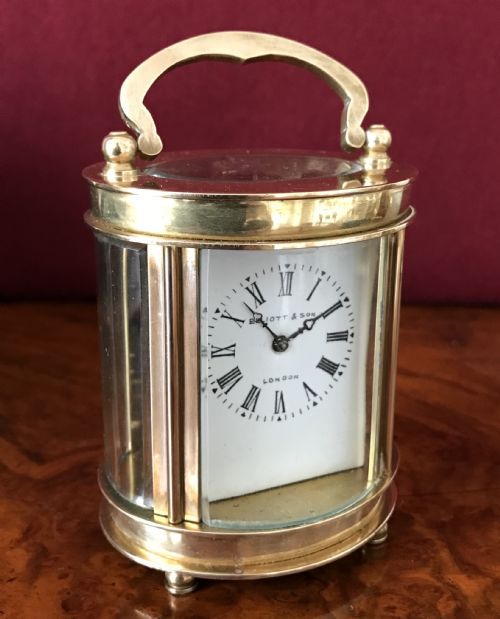
Oval Brass Desk Clock
An oval brass desk clock brings refined timekeeping to a study, combining brass and glass within distinctive curved frames.
Oval Brass Desk Clock
An oval brass desk clock is a compact timepiece designed for domestic or professional surfaces, utilising brass framing and bevelled glass panels. The selection on this page spans the nineteenth century through the early twentieth century, encompassing Victorian, Edwardian, and Art Deco eras.
Most examples originate from French workshops or English makers, frequently taking the form of miniature carriage clocks or strut clocks. Pieces range from simple brass housings to elaborate designs featuring enamel dials and gilt brass finishes.
Materials and construction
These clocks rely on substantial brass or gilt brass cases that provide structural integrity while housing intricate mechanical movements. Bevelled glass windows are typically fitted around the perimeter, allowing visibility into the gear trains and escapements.
Dials are frequently constructed from white enamel with painted Arabic or Roman numerals, sometimes accented by silvered metal chapter rings or decorative diamontes. Leather travel cases occasionally accompany miniature variants designed for portability.
Oval Brass Desk Clock Retail Price Guide 2026
Typical asking prices for oval brass desk clock among the pieces listed under this phrase on Sellingantiques today, from the lower quarter to the upper quarter. They describe what is for sale here now, not the wider market.
Listings feature periods spanning from the Victorian era through to Art Deco designs in nineteen thirty.
Distinctions in quality
Quality rests upon the crispness of the brass casting, the depth of the gilding, and the precision of the mechanical movement within. Superior examples exhibit finely polished bevelled glass and unblemished enamel dials without hairline fractures.
Attribution to notable makers or specific Parisian workshops elevates a piece, as does the integration of complications such as alarm mechanisms or striking trains housed within the miniature oval frame.
Howell & James London·Drocourt
The Oval Brass Desk Clock Glossary
- Strut clock
- A timepiece supported by a hinged rear leg allowing it to stand at an angle on a desk or table. This support mechanism is typically secured to the rear brass backplate.
- Carriage clock
- A small, spring-driven clock originally designed for travel during the nineteenth century. These pieces usually feature a carrying handle above the brass and glass case.
- Crystal regulator
- A clock constructed with glass panels on all four sides, offering an unobstructed view of the mechanical movement. The brass framework holds the transparent panels securely in place.
- Enamel dial
- A metal dial face fused with powdered glass through high-heat firing to create a smooth, glossy white surface. Numerals are subsequently painted and fired onto the finished plate.
Oval Brass Desk Clock: Frequently Asked Questions
How do I wind an oval brass desk clock?
Winding typically requires a dedicated key inserted into the arbours located on the rear backplate of the movement. Care must be taken not to overwind the mainspring.
Most mechanical examples require winding at regular intervals, usually every week or thirty hours depending on the specific movement type.
Where should I place a desk clock?
These timepieces suit stable flat surfaces such as writing desks, mantelpieces, or bedside tables where vibrations are minimal. Direct sunlight and damp environments should be avoided to protect the brass finish and enamel.
Positioning the clock away from draughts helps maintain consistent timekeeping for mechanical movements lacking modern temperature compensation.
How do I date an antique clock?
Dating relies upon stylistic cues, materials, dial typography, and maker signatures engraved on the backplate. Victorian and Edwardian examples often display characteristic case proportions and escapement designs.
Comparing the movement architecture against established maker records provides further chronological context for pieces from the nineteenth and early twentieth centuries.
What maintenance do these clocks need?
Routine care involves gentle dusting of the brass case using a soft dry cloth without abrasive polishes. Glass panels can be cleaned with standard glass cleaner applied to a cloth first.
Periodic professional servicing ensures the mechanical gears remain properly lubricated and free from accumulated dust over decades of use.