



Ornate Writing Desk Set
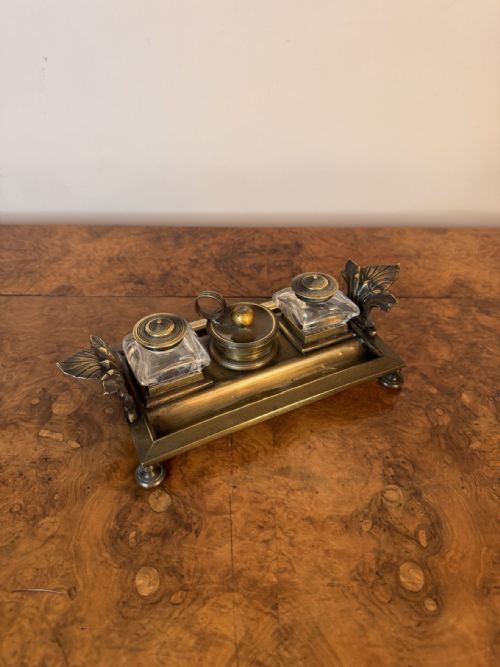
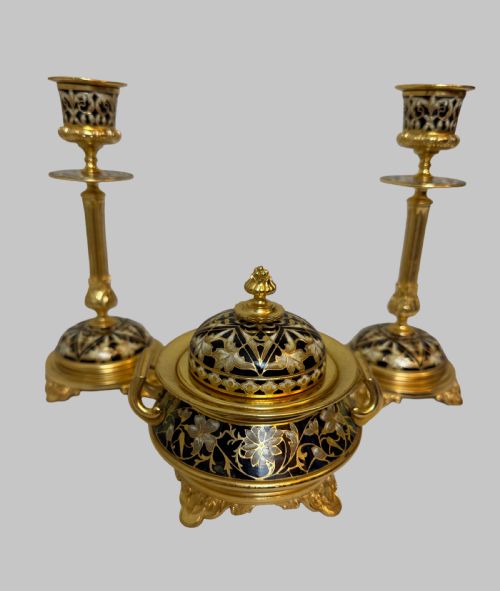
An ornate writing desk set brings distinct nineteenth-century craftsmanship to a modern desk, offering functional compartments and inkwells dressed in brass, enamel, and gilt bronze.
Ornate Writing Desk Set
An ornate writing desk set comprises coordinated desk accessories designed to hold writing instruments, ink, and blotting paper. These groupings turn a utilitarian writing surface into a decorated focal point.
The versions met most often on this page date from the Victorian and Edwardian periods, stretching from the middle of the nineteenth century into the early twentieth century. They draw on styles such as French Rococo Revival, Art Nouveau, and Chinoiserie.
Forms range from simple brass inkwells to comprehensive desk sets that include candlesticks, letter holders, and rocker ink blotters. Materials lean heavily towards cast brass, gilt bronze, and cut glass mounted in metal frames.
How they were made
Metalwork forms the backbone of these pieces, utilising cast brass and gilt bronze shaped through foundry casting and detailed hand-finishing. Champleve enamel adds coloured glass pastes into recessed metal channels before firing and polishing.
Wood and glass are integrated alongside the metal components, seen in turned wooden rocker blotters and heavy cut glass inkwells designed to fit securely into metal stands.
Ornate Writing Desk Set Retail Price Guide 2026
Typical asking prices for ornate writing desk set among the pieces listed under this phrase on Sellingantiques today, from the lower quarter to the upper quarter. They describe what is for sale here now, not the wider market.
A desk set featuring a chaff-cutter escapement clock proves that nineteenth-century manufacturers were willing to add clockwork engineering directly into an inkwell.
What varies in quality
The crispness of the casting separates standard production from finer work, visible in the depth of relief on floral scrolls and figural mounts. Sharper detailing requires careful hand-chasing after the metal leaves the mould.
Material integration also dictates the standard of a set, where heavy cut glass liners fit flush into solid brass frames and enamel work remains vibrant without loss or crude repair.
James Cartland & Sons·Moser·Elkington
The Ornate Writing Desk Set Glossary
- Inkstand
- A tray or stand holding one or more inkwells, and often pen grooves or matching bell components. These central desk pieces coordinate the writing materials.
- Champleve
- An enamelling technique where troughs are dug into a metal surface and filled with coloured glass powder before firing. The resulting surface displays smooth colour fields bounded by thin metal lines.
- Ormolu
- Gilded bronze used extensively for decorative mounts on nineteenth-century desk accessories. The technique applies a gold amalgam to a bronze base.
- Rocker ink blotter
- A curved wooden or metal tool fitted with blotting paper, rocked across fresh ink to speed drying. They form part of larger desk sets from the Edwardian period.
Ornate Writing Desk Set: Frequently Asked Questions
What is included in an ornate writing desk set?
These sets typically group together an inkwell, a pen tray, and sometimes matching letter holders or candlesticks.
Larger configurations may also incorporate small desk clocks or rocker blotters to handle daily correspondence.
How do I care for brass desk accessories?
Brass and gilt bronze components require gentle dusting with a dry microfibre cloth to prevent dust accumulation.
Avoid chemical polishes which can strip original patination or damage surrounding enamel and glass elements.
How can I tell Victorian pieces from Edwardian ones?
Victorian sets often favour heavier, ornate cast-brass or champleve enamel designs inspired by French Rococo revival styles.
Edwardian pieces tend toward lighter constructions, sometimes pairing brass with polished wood for simpler desk accessories.
Were these desk sets used for everyday writing?
They served as functional desk furniture in studies and offices during the nineteenth and early twentieth centuries.
Inkwells held liquid ink for dip pens, while blotters dried handwritten letters before folding.