

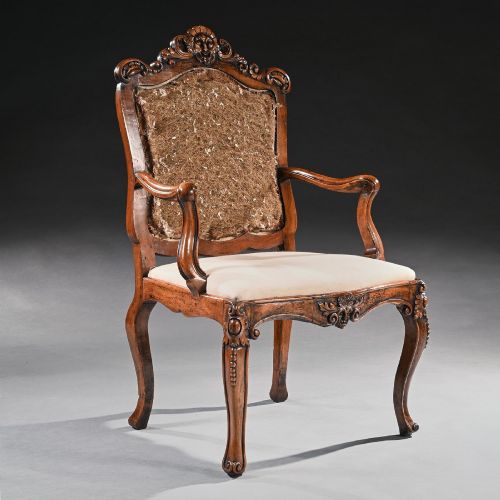
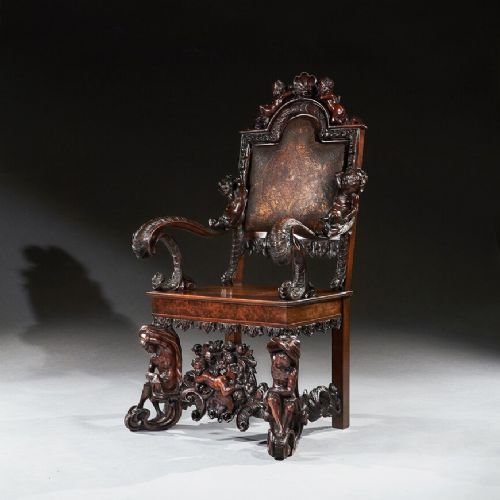
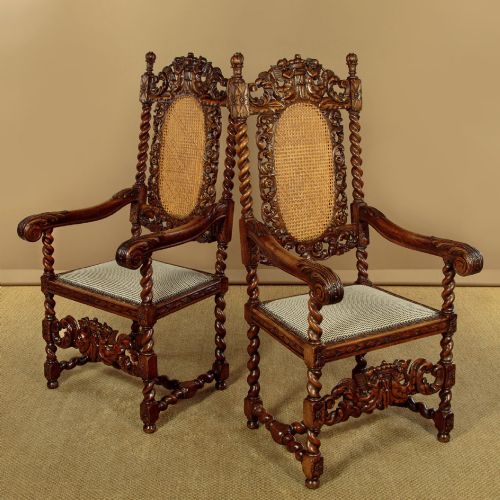


Ornate Walnut Seating
Ornate walnut seating brings heavy nineteenth-century revival carving and rich timber into a room, offering robust historical character.
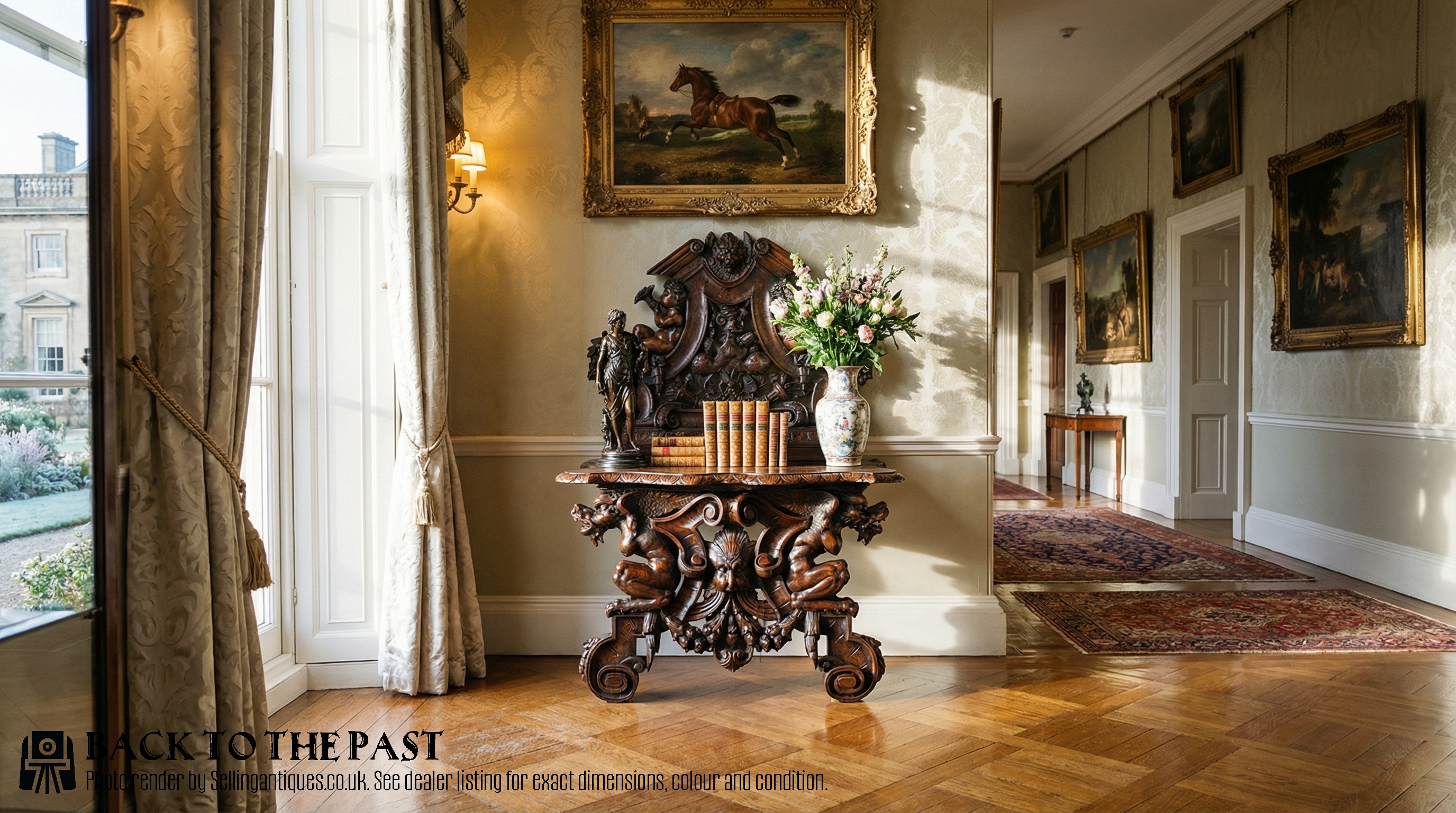
Ornate Walnut Seating
Ornate walnut seating spans armchairs, side chairs, hall chairs, accent chairs, sofas, settees, and hall benches dating from the nineteenth century, including Victorian examples. These pieces draw on Renaissance Revival, Rococo Revival, Italian Baroque Revival, Swiss, and Flemish decorative styles.
Buyers meet heavily carved frames, marquetry inlay, wood inlay, and bone inlay across continental and British forms. Examples range from exhibition quality armchairs to musical chairs and sgabello chairs.
Materials and construction
Walnut forms the structural timber of these pieces, providing a dense base for deep, sculptural carving. Artisans embellished these wooden frames with contrasting bone inlay, wood inlay, and detailed marquetry work.
Upholstered versions incorporate textiles, leather, fabric, and cane seating panels. Certain functional forms integrate metal mechanisms to support their physical structure and movable parts.
Ornate Walnut Seating Retail Price Guide 2026
Typical asking prices for ornate walnut seating among the pieces listed under this phrase on Sellingantiques today, from the lower quarter to the upper quarter. They describe what is for sale here now, not the wider market.
Current listings demonstrate nineteenth-century revival styles executed in walnut, combined with textiles, cane, and bone inlay.
Distinctions in quality
Quality depends on the depth and precision of the walnut carving, distinguishing straightforward production from exhibition quality pieces modelled after specific historical makers. The intricacy of bone and wood inlay similarly separates standard regional work from finer decorative examples.
Structural integrity of the timber frame and the preservation of original cane, textile, or leather elements dictate the overall standard. Pieces with integrated musical movements or complex metal mechanisms demonstrate higher ambition in their manufacturing.
Andrea Brustolon
The Ornate Walnut Seating Glossary
- Sgabello chair
- A traditional Italian Renaissance wooden chair featuring a high carved back and solid trestle supports instead of legs. These early forms often display rich carving along the central panel.
- Marquetry
- Decorative veneer work arranged in pictorial patterns on the wooden surface. Artisans cut different coloured woods to create detailed imagery across the backrests and seats.
- Renaissance Revival
- A nineteenth-century design movement inspired by sixteenth-century classical motifs. Pieces in this style utilise heavy walnut framing, dense foliage carving, and architectural lines.
- Bone inlay
- The technique of embedding small carved pieces of bone into channels within the walnut wood. This creates pale, high-contrast geometric or floral patterns against the dark timber.
Ornate Walnut Seating: Frequently Asked Questions
What periods do these chairs represent?
These items predominantly date from the nineteenth century, encompassing the Victorian era and specific decades like eighteen-eighty and nineteen-hundred. Their designs reference earlier epochs such as the Italian Renaissance and Baroque.
Craftsmen drew on historical pattern books to recreate these revival styles for nineteenth-century interiors. Dating relies on stylistic cues, construction methods, and material handling.
How were sgabello chairs used?
Sgabello chairs served as hall seating and decorative statements in grand Italian interiors. Their rigid wooden construction suited formal reception areas rather than prolonged lounging.
Visitors would sit briefly while waiting in entryways, admiring the carved crests and solid trestle bases. These pieces functioned primarily as visual symbols of status.
How do I care for antique walnut?
Antique walnut requires stable indoor humidity levels to prevent the timber from drying or cracking. Regular dusting with a soft, dry cloth protects the carved surfaces and delicate inlay.
Harsh chemical polishes should be avoided to preserve the original patina of the wood. Upholstered sections benefit from professional textile conservation when cleaning is necessary.