
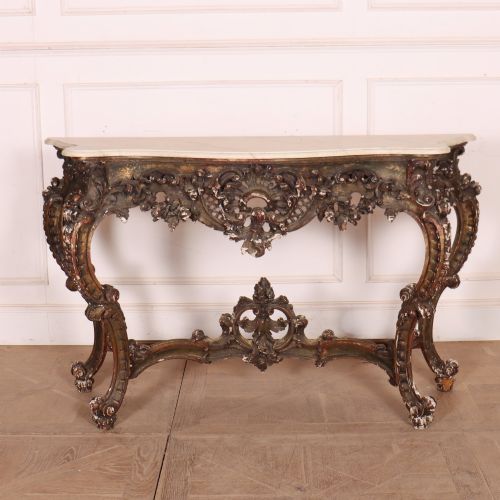


Ornate Hallway Table
An ornate hallway table delivers immediate grandeur to an entrance hall, combining sculptural carved wood or giltwork with cool marble tops.
Ornate Hallway Table
An ornate hallway table usually takes the form of a console table designed to sit flat against a wall, frequently accompanied by a matching wall mirror. These pieces serve as the primary focal point of an entrance hall or reception space, offering a surface for display while establishing the decorative tone of the interior.
The selections available here span from the mid-nineteenth century through to the early twentieth century, encompassing varied aesthetic movements such as French Rococo, Victorian, and Art Deco. Buyers most frequently encounter console tables and side tables fashioned in walnut, carved wood, or giltwood, often topped with fitted marble.
Origin points across the listings include French, English, Italian, and Anglo-Indian workshops, showing diverse regional interpretations of grand entertaining spaces. Forms range from serpentine fronts to pier lamp tables and painted parcel gilt designs.
How they were made
Cabinetmakers and carvers utilised dense timbers such as walnut, mahogany, and oak as the foundational structure for these tables. Woods were frequently carved with deep relief details, painted, or finished with parcel gilt and gold leaf applications.
Marble slabs were meticulously cut and polished to fit precisely onto the wooden console bases, providing a durable and cool surface resistant to daily use. Giltwood frames and carved wood elements relied on traditional joinery and hand-finishing techniques typical of nineteenth and early twentieth-century workshops.
Some tables double as lighting stations, quietly doubling as pier lamp tables to guide guests down dimly lit corridors.
What varies in quality
The depth and crispness of the hand-carving separate standard production from exceptional examples, as skilled carvers achieved deep undercut details in walnut and giltwood. The quality of the original gilding and the figuring of the wood grain also dictate the visual weight and refinement of the piece.
The selection of the marble top impacts the overall standard, with thicker, well-figured stone slabs representing finer craftsmanship. Furthermore, the integration of matching mirrors and the precision of serpentine curves demonstrate the maker's technical capability.
The Ornate Hallway Table Glossary
- Console table
- A table designed to be fixed against a wall, often supported by ornate front legs or brackets because the rear relies on wall attachment.
- Parcel gilt
- A decorative technique where selected portions of a wood or painted surface are highlighted with gold leaf while the rest remains exposed wood or paint.
- Serpentine
- A furniture front or top curving inward centrally and outward at the ends in a continuous undulating line.
- Giltwood
- Timber that has been coated with gold leaf or gold paint, frequently seen on elaborate nineteenth-century frames and furniture.
- Pier table
- A table designed specifically to stand against the wall space between two windows, often paired with a tall mirror above.
Ornate Hallway Table: Frequently Asked Questions
Where should I place a console table?
These tables are traditionally positioned in an entrance hall or hallway to create a striking first impression for visitors.
They also work effectively in reception rooms against empty wall spaces, particularly when paired with a matching wall mirror.
Can these tables hold heavy items?
Marble-topped tables provide a solid and durable surface suitable for lamps, decorative bowls, and heavy objects.
However, because many historical console tables rely partly on wall fixings for stability, checking the structural support is essential for everyday use.
How do I identify a French Rococo table?
French Rococo pieces feature asymmetrical scrolls, floral carvings, and curving lines that mimic natural organic forms.
They often incorporate giltwood finishes and serpentine fronts characteristic of mid-nineteenth-century revivals of earlier court styles.
What is the difference between a console and a side table?
A console table is specifically designed to stand against a wall and traditionally requires wall attachment for complete stability.
A side table is a freestanding piece of furniture that can be moved around a room independently.
How do I care for marble tops?
Marble surfaces require gentle cleaning with a damp cloth and mild soap, avoiding acidic cleaners that can etch the polished stone.
Using coasters and placemats helps protect the historical finish from moisture rings and scratches.