
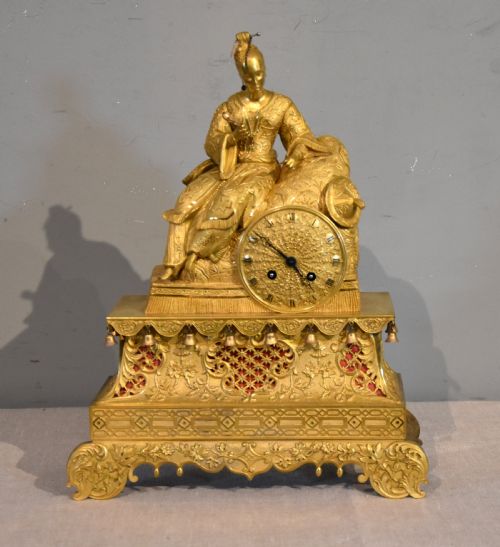


Ornate Gilt Bronze Timepiece
An ornate gilt bronze timepiece brings French metalwork and precision movement together on a mantelpiece.
Ornate Gilt Bronze Timepiece
An ornate gilt bronze timepiece is a domestic clock housed in a cast metal case, often finished with mercury gilding or modern electroplating to create a bright golden surface. The pieces on this page are predominantly French in origin, dating from the nineteenth century during the Victorian era and spanning revivals of the Rococo and Louis XVI styles.
Makers and casters produced these clocks in various formats, ranging from large portico and mantel models incorporating marble or porcelain panels to smaller carriage clocks, crystal regulators, and boudoir pieces. Enamel dials, cherub figures, and detailed floral cast work frequently decorate the cases, reflecting the decorative tastes of the mid to late nineteenth century.
How they were made
Foundries manufactured the metal cases by casting bronze, brass, or gilt metal into intricate moulds, subsequently finishing the surfaces through hand chasing and applying a layer of gold amalgam known as ormolu. Clockmakers then fitted mechanical movements, including chain fusee mechanisms and platform escapements, into these heavy bronze housings.
Secondary materials such as white and red marble, crystal glass panels, alabaster, and hand-painted Sevres porcelain plaques were integrated into the metal frames to provide contrast and colour. Enamel numerical chapters were fired onto copper dial plates, while subsidiary bronze castings added figurative elements like lions' masks and cherubs.
Listings on this page span the Victorian period and feature materials including gilt bronze, ormolu, white and red marble, and Sevres porcelain.
What varies in quality
The crispness of the bronze casting determines the visual success of the piece, as sharp, hand-chased relief work retains depth in foliage and scroll motifs where inferior castings appear soft. The preservation of the original ormolu surface, showing distinct matte and burnished areas rather than flat modern replating, indicates superior production standards.
The integration of the movement within the case and the complexity of the mechanism, such as a signed movement by a known maker or a specialised chain fusee gear train, separate standard decorative clocks from finer horological examples. The quality of supplementary materials, including undamaged hand-painted porcelain panels and heavy bevelled glass, further elevates the piece.
Samuel Marti·Henri Jacot·FB Adams London·Farcot
The Ornate Gilt Bronze Timepiece Glossary
- Ormolu
- A technique of applying finely ground high-carat gold amalgam to a bronze object, followed by firing to drive off the mercury. This leaves a durable, golden finish characteristic of French decorative metalwork.
- Chain Fusee
- A mechanism utilising a conical pulley and a fine steel chain to maintain equal tension on the clock's mainspring as it unwinds. This device improves the timekeeping accuracy of the movement.
- Crystal Regulator
- A mantel clock enclosed in glass panels on all sides with a visible mercury or compensated pendulum. This style gained popularity during the late nineteenth century.
- Champlevé
- An enamelling technique where troughs are dug into the surface of the base metal and filled with vitreous enamel paste before firing. The resulting surface displays coloured patterns flush with the metal dividers.
Ornate Gilt Bronze Timepiece: Frequently Asked Questions
How do I wind my timepiece?
Most nineteenth-century mechanical clocks require a matching key inserted into the winding squares on the dial face to tension the mainspring barrels. Care should be taken not to overwind the mechanism.
For clocks featuring chain fusee movements, a slower and steadier turn is required to engage the chain correctly around the conical pulley without slipping.
Where should I place a bronze clock?
A stable, level mantelpiece or surface away from direct sunlight, extreme temperature fluctuations, and damp walls provides the ideal environment for a heavy metal timepiece. Stability ensures the pendulum swings evenly and the escapement ticks without stopping.
Because many examples incorporate delicate marble or glass components, positioning them where they will not be accidentally nudged protects the structural integrity of the case.
How do I identify the period?
Stylistic indicators such as asymmetrical Rococo scrollwork point towards the mid-nineteenth century, while cleaner Louis XVI revival lines or crystal regulators typically date towards the final decades of the 1800s. Maker signatures stamped on the backplate or dial also help narrow the production window.
Examining the casting methods, dial construction, and choice of secondary materials like red or white marble provides further clues to the exact manufacturing decade.