




Ornate French Bureau
An ornate french bureau brings together rich timber and chased metal mounts to create a working desk of significant decorative presence.
Ornate French Bureau
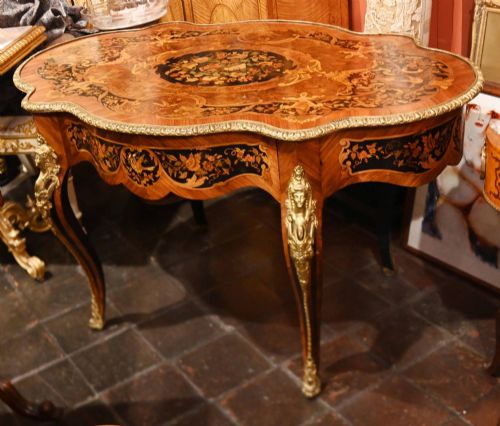
An ornate french bureau encompasses writing desks, secretaires, and bureau plat tables rooted in nineteenth-century revivals of Louis XV and French Rococo styles. These pieces combine functional writing surfaces with elaborate aesthetic flourishes, designed to serve as both practical furniture and grand decorative statements.
The versions most commonly encountered on this page date from the nineteenth century, including specific decades such as the eighteen-eighties, eighteen-nineties, and nineteen-tens. They typically manifest as bureau plat tables or secretaires, reflecting the enduring popularity of French revival designs throughout the Victorian era and beyond.
Materials and construction
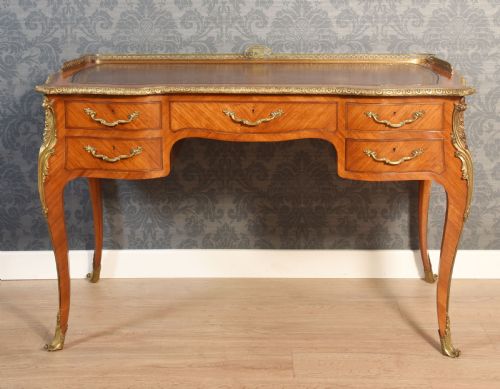
These pieces are built using substantial woods like walnut, oak, and exotic kingwood, often enhanced with intricate marquetry and parquetry patterns. Surfaces are frequently fitted with inset leather writing panels to provide a traditional, durable writing surface.
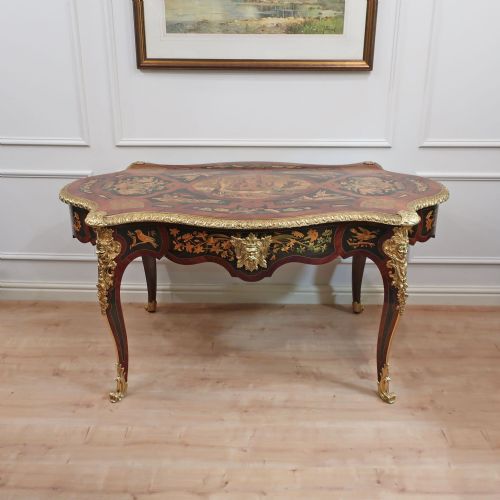
Decoration relies heavily on cast metal elements, utilising ormolu, gilt bronze, and brass mounts to accentuate the curves and corners of the framework. Black lacquer and ebonised finishes also appear, providing a contrasting backdrop for the metallic ornamentation.
One unexpected desk on the site carries an ambiguous provenance, noted simply as being either French or Russian.
Factors of quality
Quality rests significantly on the precision of the timber inlay and the crispness of the metal mounts. Finer examples display meticulous marquetry and crisply chased ormolu or gilt bronze that integrates seamlessly with the underlying woodwork.
The choice of primary timbers and secondary veneers dictates the overall heft and visual depth of the desk. Superior construction ensures that structural joints and decorative mounts remain tightly fitted, maintaining the integrity of the revival style.
The Ornate French Bureau Glossary
- Bureau plat
- A flat-topped writing table, typically free-standing, featuring drawers beneath the surface and styled after eighteenth-century French forms.
- Ormolu
- Gilded bronze used for decorative mounts and furniture embellishments, highly characteristic of nineteenth-century revival pieces.
- Marquetry
- Decorative veneer work arranged in detailed pictorial or geometric patterns across the wooden surfaces of the desk.
- Secretaire
- A specialised writing cabinet containing a drop-front or pull-down writing flap concealing internal compartments and small drawers.
- Parquetry
- Geometric wood mosaic work used for floors and furniture surfaces, creating repetitive patterns across the top of a table.
Ornate French Bureau: Frequently Asked Questions
Where should I place an ornate french bureau?
These desks are often designed as free-standing pieces, such as the bureau plat, making them suitable for placement in the centre of a room rather than pushed exclusively against a wall. Their finished backs and elaborate mounts allow them to be viewed from all angles.
Consider natural light levels in the room to protect inset leather writing surfaces and polished wood veneers from direct, prolonged sunlight. Positioning the desk away from direct heat sources helps preserve the stability of the timber and veneer.
How do I care for the wood and metal mounts?
Dusting regularly with a soft, dry cloth prevents the accumulation of dirt in the intricate crevices of the marquetry and ormolu mounts. Avoid silicone-based polishes, which can build up on the finish and attract dust over time.
Leather writing panels benefit from occasional gentle cleaning and conditioning appropriate for antique leather. Keep the humidity in the room stable to prevent the wood from expanding or contracting, which can stress veneers and joints.
What defines the Louis XV revival style?
The Louis XV revival style draws inspiration from the mid-eighteenth-century French Rococo aesthetic, characterised by asymmetrical curves, cabriole legs, and naturalistic motifs. Nineteenth-century makers reinterpreted these flowing lines using contemporary cabinet-making techniques and rich veneers.
This style emphasises decorative movement and theatricality, utilising gilt bronze and ormolu mounts to highlight the sweeping contours of the woodwork. It stands distinct from stricter geometric neoclassical revivals by embracing ornamentation and organic shapes.
How do I identify a bureau plat?
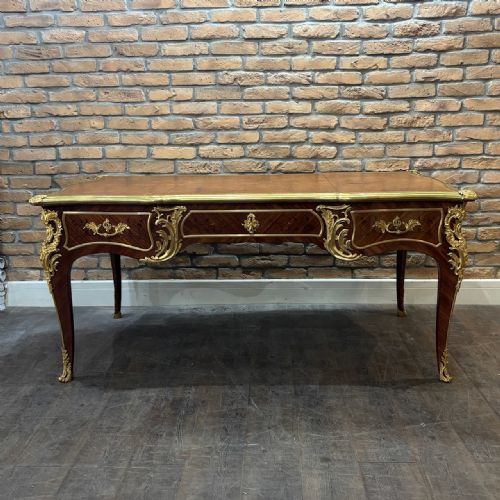
A bureau plat is characterised by its broad, flat writing surface, typically bordered with leather, and supported by slender cabriole or tapered legs. Unlike upright secretaires, it functions primarily as a table desk with drawers built into the frieze.
These tables are finished on all sides so they can float in the middle of a study or salon. They frequently feature bronze or ormolu mounts on the corners, knees, and sabots of the legs.