
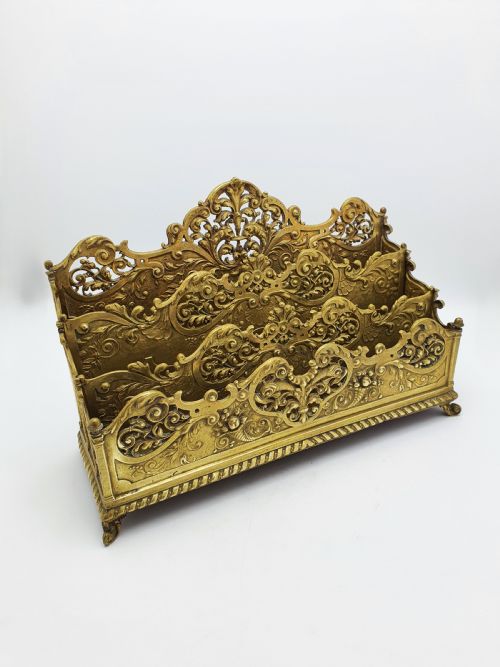


Ornate Brass Desk Tidy
An ornate brass desk tidy commands the centre of a writing table, gathering inkstands and letter racks into one heavy, purposeful arrangement.

Ornate Brass Desk Tidy
An ornate brass desk tidy is a functional accessory designed to organise correspondence and writing implements on a nineteenth or early twentieth-century desk. These pieces bring together inkwells, pen rests, and letter racks into a single cohesive unit cast in heavy metal.
The versions most commonly met on this page span the Victorian and Edwardian periods, including French cast-brass models and Anglo-Indian designs. They range from simple twin ink stands with bronze liners to elaborate letter racks and comprehensive desk sets.
Makers drew on a rich vocabulary of styles, incorporating Rococo Revival scrolls, Art Nouveau curves, and Chinoiserie motifs. Each object reflects the formal writing habits of an era when letters required dedicated vessels for ink and paper.
How they were made
Foundries produced these items primarily through metal casting, using brass and cast brass as the principal structural materials. Gilt bronze appeared on finer French pieces, while internal liners were occasionally forged in bronze or fitted with glass.
Artisans enhanced the raw metalwork through surface decoration and applied media, integrating champlevé enamel panels or coloured glass inserts such as opaline. Ceramic components and blue and gold glazes also supplemented the brass framework in specific Edwardian variants.
Some desk tidies include built-in bronze liners specifically shaped to catch stray ink drips before they reach the polished wood.
What varies in quality
The distinction between ordinary and exceptional examples rests upon the crispness of the casting and the depth of the ornamentation. Heavier gauge metal and deeply chiselled Rococo scrolls signal a workshop that invested significant labour into the initial form.
Quality also declares itself in the integration of secondary materials like champlevé enamel or opaline glass. When glass inserts survive intact and enamel work shows precise cloisonné or champlevé cells, the piece represents a higher order of nineteenth-century manufacture.
The Ornate Brass Desk Tidy Glossary
- Desk tidy
- A desk tidy is a combined desktop accessory intended to hold inkwells, pens, and letters in a single frame. It keeps loose writing materials orderly.
- Inkstand
- An inkstand is a stationary tray or stand holding one or more inkwells alongside pen grooves. It forms the central component of many desk sets.
- Champlevé enamel
- Champlevé enamel is a technique where troughs are dug into a metal surface and filled with vitreous enamel before firing. This adds rich colour and pattern to the brass framework.
- Opaline glass
- Opaline glass is an opaque or translucent pale glass used frequently for interior inkwell inserts. It provides a smooth, contrasting texture against the heavy metal exterior.
- Rococo Revival
- Rococo Revival is a nineteenth-century design style defined by C-scrolls, asymmetric cartouches, and naturalistic shell motifs. It heavily influences the decorative language of these desk pieces.
Ornate Brass Desk Tidy: Frequently Asked Questions
What is an ornate brass desk tidy?
An ornate brass desk tidy is a collective term for nineteenth and early twentieth-century desk accessories that combine inkwells, letter racks, and pen trays into one heavy metal object.
These pieces were standard fixtures on writing tables, designed to keep correspondence and writing tools neatly gathered in a single decorative frame.
How were brass desk sets used?
Users placed them on top of a writing desk to house wet ink, nibs, and incoming letters within arm's reach. The inkwells held the ink supply, while the attached racks sorted daily post.
They served both a strictly utilitarian function and a decorative purpose in period studies and parlours.
How do I date a brass desk tidy?
Dating relies on stylistic clues, such as the exuberant curves of Victorian Rococo Revival or the distinct decorative vocabulary of Edwardian manufacturing. Materials like champlevé enamel and opaline glass also point toward specific nineteenth-century French or English workshops.
Examining the weight of the cast brass and the construction of any liner helps place the object within its proper decade.
Where were these desk accessories made?
Production centred in European and British workshops, with notable contributions from French foundries in Paris and Anglo-Indian makers. Each region applied distinct stylistic preferences to the cast brass framework.
French pieces frequently utilised champlevé enamel, while English and colonial workshops favoured heavy cast brass and regional decorative motifs.