


Ormolu Vanity Mirror
An ormolu vanity mirror brings cast bronze mounts and polished glass to a dressing table.
Ormolu Vanity Mirror
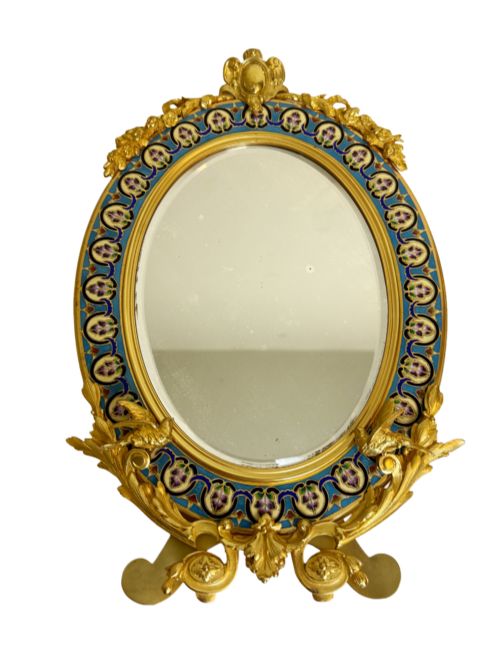
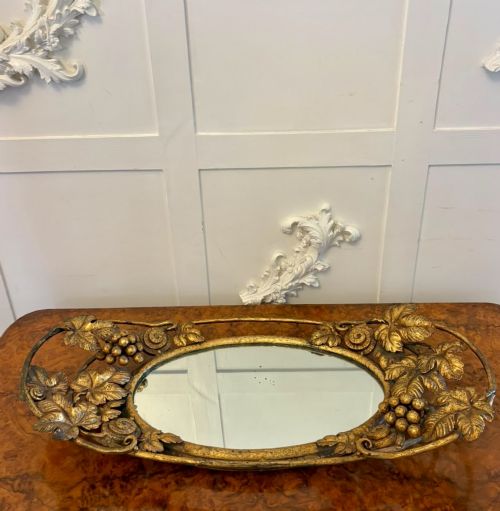
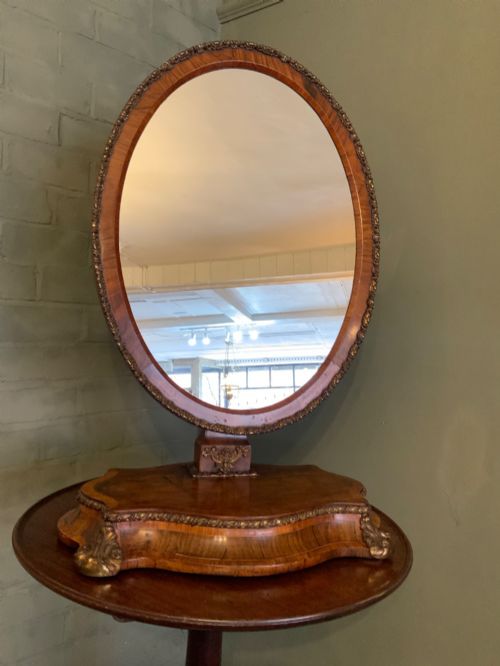
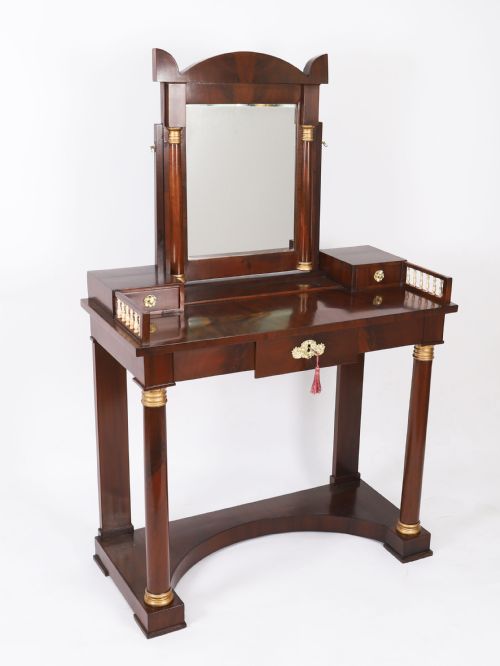
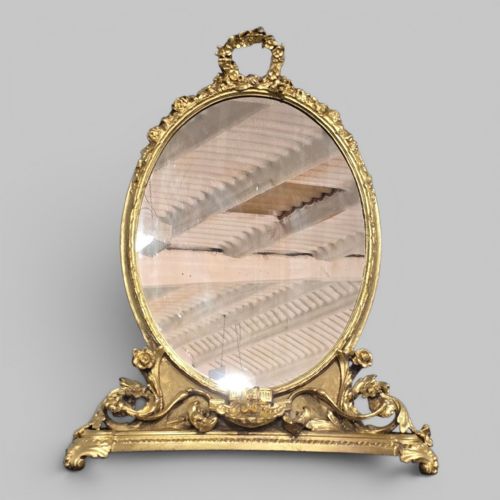
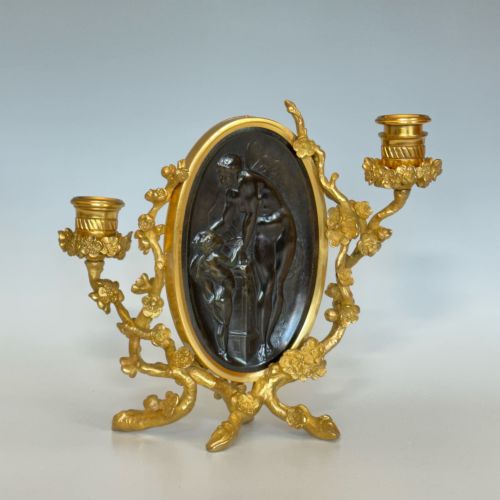
An ormolu vanity mirror sits on a dressing table or tabletop, framed by cast and gilded bronze mounts.
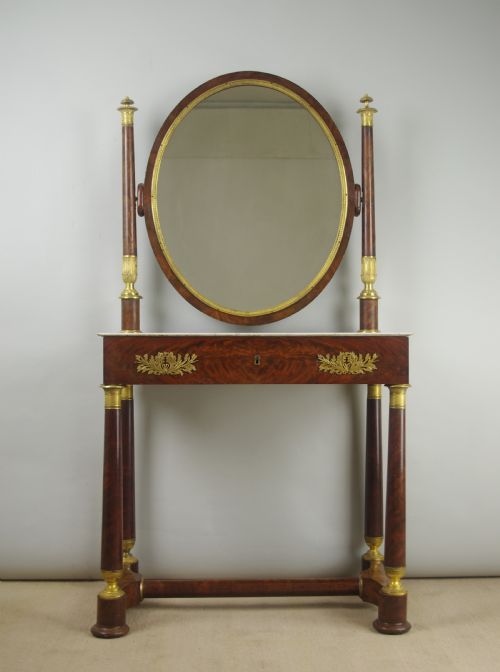
The pieces seen here date from the nineteenth century, including Victorian and Edwardian examples alongside French Empire and Rococo Revival forms.
Makers and workshops across France and Britain produced these mirrors in oval and upright shapes, often paired with mahogany, marble, champleve enamel, or porcelain.
How they were made
The foundation structures rely on hardwoods like mahogany and walnut, or cast metals shaped into ornate frames and stands.
Ormolu work involves applying finely ground gold to bronze through a mercury amalgamation process, or through electrogilding on gilt metal and gilt bronze.
Additional decorative elements incorporate hand-painted Limoges enamel, Sevres porcelain plaques, and champleve enamel detailing set directly into the metalwork.
Some nineteenth-century dressing items doubled as drinks serving trays, proving that morning routines occasionally required liquid reinforcement.
What varies in quality
The depth and crispness of the bronze casting define the work, distinguishing sharp, hand-chased mounts from softer secondary production.
The quality of the gilding itself alters the appearance, ranging from rich gold patination to worn surfaces where the underlying bronze shows through.
The integration of materials such as matched marble bases, intact porcelain inserts, and clear bevelled mirror glass determines the overall cohesion of the piece.
Thiebaut Freres·Joseph Meissonnier·F.Bienvue
The Ormolu Vanity Mirror Glossary
- Ormolu
- Gilt bronze created by applying a gold amalgam to a bronze base and heating it. The technique produces a durable, warm metallic lustre characteristic of nineteenth-century decorative arts.
- Champleve
- An enamelling technique where troughs are dug into a metal surface and filled with vitreous enamel powder before firing. It creates vibrant, patterned colour sections across frames and mounts.
- Empire
- A neoclassical design style spanning the late eighteenth and nineteenth centuries, defined by military motifs, symmetry, and classical restraint. It draws heavily on ancient Roman and Greek forms.
- Toilet Mirror
- A period term for a dressing table mirror designed to sit atop a chest or table for grooming. These mirrors frequently incorporate small drawers or pivoting stands.
Ormolu Vanity Mirror: Frequently Asked Questions
How do I clean an ormolu vanity mirror?
Dust the gilt bronze gently with a dry microfibre cloth to remove surface particles without disturbing the finish.
Avoid chemical polishes and abrasive cleaners, as these strip the historic gilding and damage the bronze underneath.
Are these mirrors meant to be wall-mounted?
These pieces are designed specifically as tabletop or dressing table mirrors, supported by integrated stands or easel backs.
Hanging them on a wall strains the original nineteenth-century pivoting hardware and hinges.
How can I tell an Empire mirror from a Rococo Revival piece?
Empire mirrors display strict symmetry, architectural lines, and classical motifs like columns and wreaths.
Rococo Revival mirrors favour asymmetrical scrolls, floral curves, and whimsical natural forms.
What is the difference between ormolu and gilt metal?
Ormolu consists specifically of mercury-gilded or fire-gilded bronze, valued for its deep, heavy metal quality and precise chasing.
Gilt metal typically uses a base of brass or a lighter alloy with modern or electroplated gold finishes.