
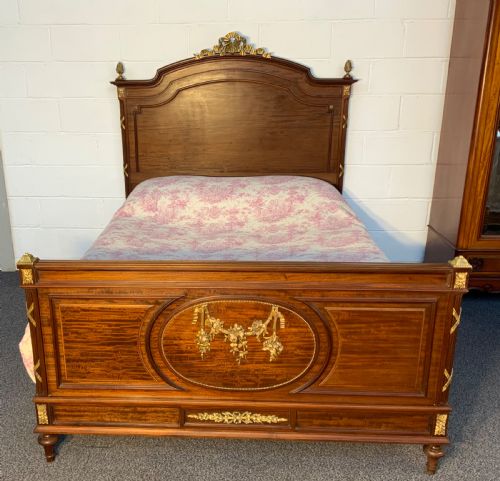


Ormolu Mounted Headboard
An ormolu mounted headboard delivers French refinement to a bedroom, bringing period woodwork and gilt bronze mounts together as a focal point.
Ormolu Mounted Headboard
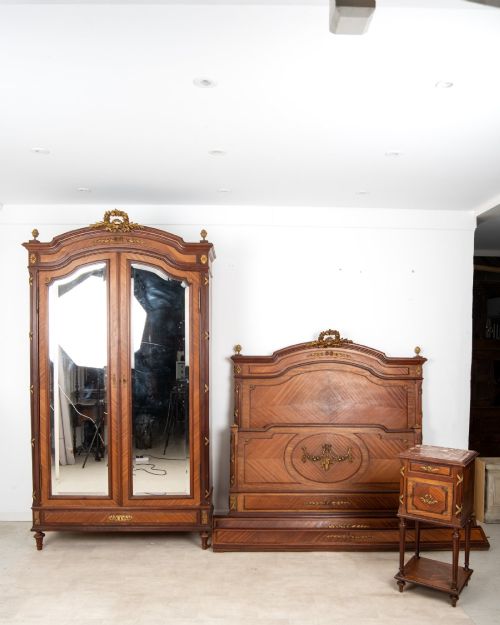
An ormolu mounted headboard is a substantial bedroom furnishing that anchors a sleeping space with period character. These pieces typically take the form of French beds, bedframes, and complete bedroom suites dating from the nineteenth and early twentieth centuries.
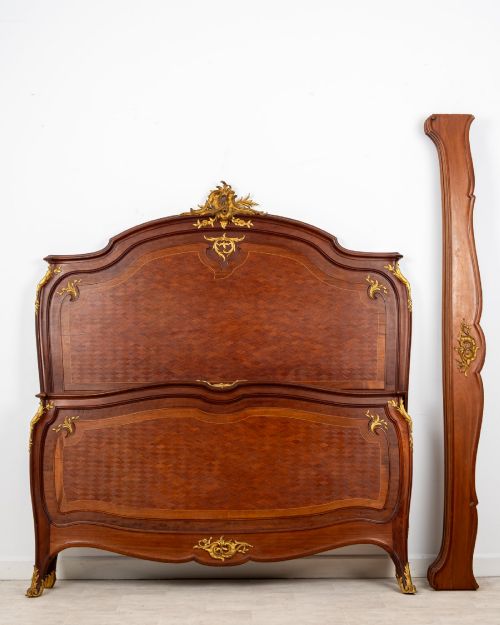
The versions most commonly met on this page originate from nineteenth century workshops and embrace revival aesthetics. Makers drew heavily on French Neoclassical, Louis XV, and Louis XVI styles to create these architectural furniture pieces.
Buyers encounter forms ranging from double beds to king sizes and emperor proportions. Many retain matching elements such as bedside cabinets or wardrobes from original bedroom suites.
How they were made
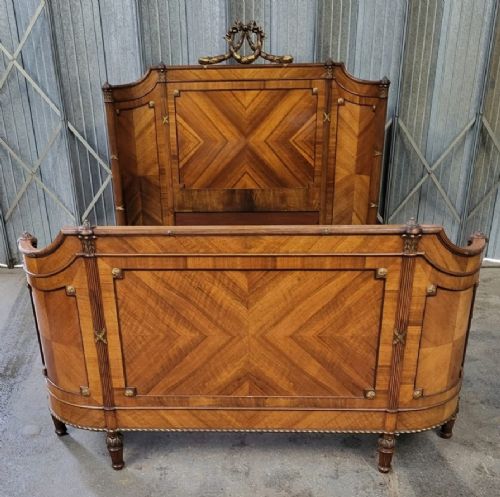
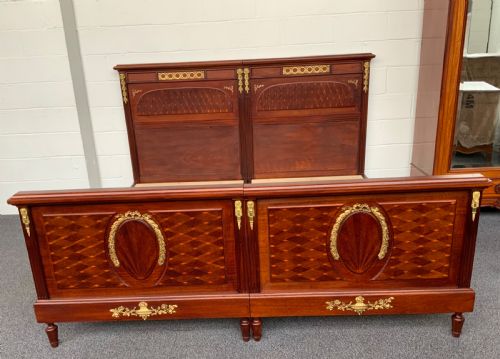
Carpenters constructed these frames using timber cores of mahogany, walnut, fruitwood, and kingwood. Artisans applied quarter veneers and intricate parquetry work to large surfaces to create geometric patterns and visual depth.
Gilt bronze ormolu mounts and brass embellishments were cast and chased before being fixed to the woodwork. These metallic details trace the borders and accentuate the classical motifs characteristic of revival furniture.
Listings span periods from 1870 to 1910, showing mahogany, walnut, fruitwood, and kingwood alongside brass and ormolu mounts.
What varies in quality
Quality separates through the crispness of the cast bronze mounts and the selection of timber veneers. Finer examples display deeply chased ormolu details and richly figured mahogany or walnut timbers that demonstrate superior cabinetmaking.
The architectural harmony of the proportions dictates the overall success of the piece. Superior bedframes integrate the metal mounts seamlessly with the underlying woodwork, whereas lesser versions rely on simpler brass detailing.
The Ormolu Mounted Headboard Glossary
- Ormolu
- Gilt bronze mounted decoration applied to furniture. This technique involves coating a bronze base with gold amalgam to create a bright metallic finish.
- Parquetry
- Geometric wood inlay work arranged in patterns. Cabinetmakers utilised contrasting timbers like kingwood and fruitwood to build these decorative surfaces.
- Neoclassical
- A revival style drawing on classical antiquity. Pieces from this tradition feature symmetrical lines and restrained ornamental motifs.
- Quarter Veneer
- Slices of timber applied to a core in four matching sections. This method produces symmetrical grain patterns across large headboard panels.
- Bedstead
- The structural framework of a bed supporting the mattress. These wooden structures carry the decorative headboards and footboards.
Ormolu Mounted Headboard: Frequently Asked Questions
How do I style a period headboard?
These large timber and metal pieces anchor a bedroom naturally. Pair them with neutral walls that allow the wood grain and bronze mounts to stand out without competing for attention.
Keep surrounding furniture simple to let the bed remain the primary focal point of the room. Crisp linens and understated bedding complement the ornate character of nineteenth century French woodwork.
Will an antique bed fit modern mattresses?
Many nineteenth century French beds accommodate standard modern mattress sizes with minor adjustments. King and double proportions often align closely with contemporary dimensions.
It remains wise to check the internal dimensions of the specific bedframe before purchasing a mattress. Modern slat systems can be integrated carefully to support contemporary bedding.
How do I care for ormolu mounts?
Ormolu mounts require gentle dusting with a soft dry cloth to prevent the accumulation of grime. Avoid abrasive cleaners or metal polishes that can strip the original gilding from the bronze.
Preserving the surface involves maintaining stable room humidity to protect both the metal and the underlying timber. Natural waxes applied sparingly keep the wood nourished without harming the adjacent mounts.
How do I distinguish Louis XV from Louis XVI styles?
Louis XV revival pieces tend to display flowing asymmetric lines and curved cabriole forms. The ornamentation often incorporates naturalistic motifs like foliage and scrolls.
Louis XVI style furniture favours straight lines, symmetry, and classical geometry. The mounts on these pieces frequently feature fluting, urns, and architectural motifs drawn from antiquity.