
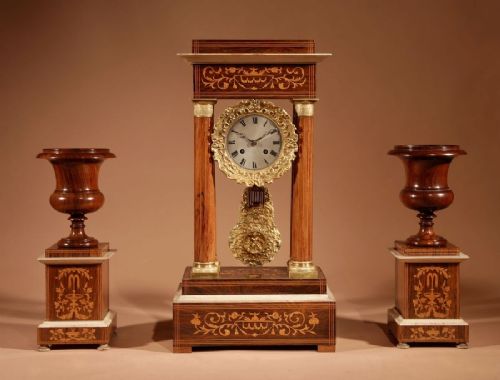
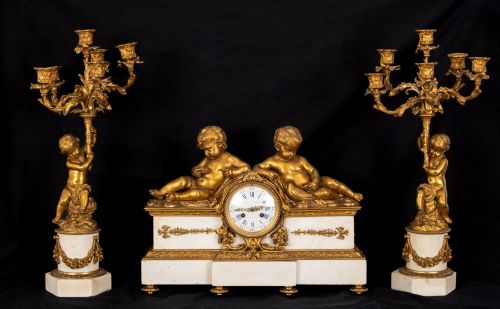
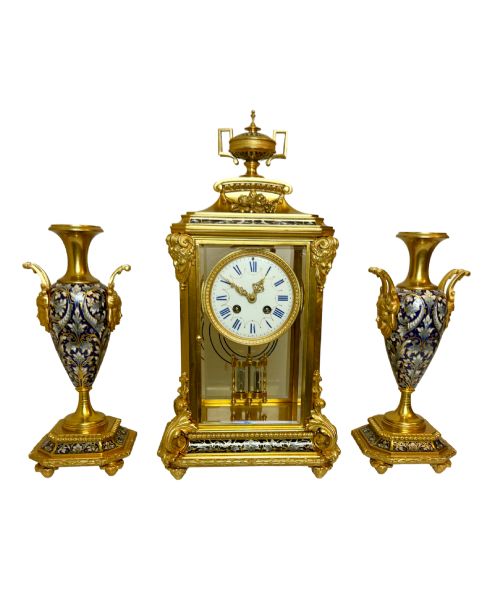
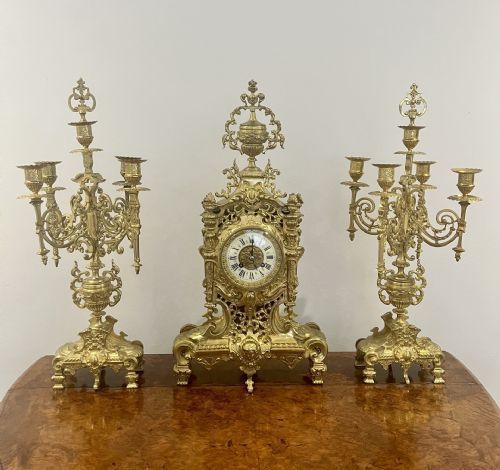

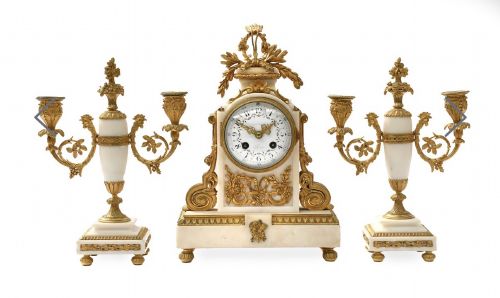
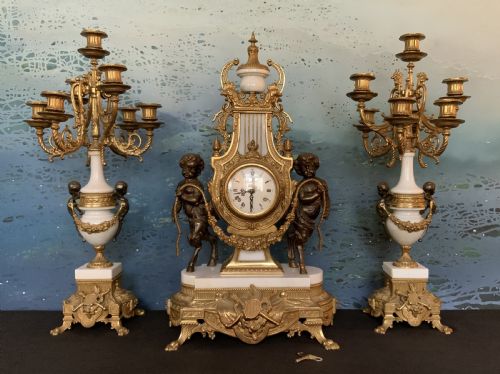


Ormolu Garniture Clock Set
An ormolu garniture clock set brings together a centrepiece mantel clock and matching side pieces like candelabras, offering a grand symmetrical display for a mantelpiece.
Ormolu Garniture Clock Set
When searching for an ormolu garniture clock set, you encounter three-piece configurations featuring a central clock flanked by matching urns or candelabras. The pieces date predominantly from the nineteenth century, reflecting periods such as the Victorian era and the Second Empire.
French workshops produced the majority of these arrangements, adopting styles from Louis XVI revival to French rococo and empire designs. White marble, bronze, and gilt metal form the common foundations for these matching mantel displays.
How they were made
Craftsmen cast bronze and brass into ornate mounts before applying fire gilding to create the characteristic ormolu surface. Stonemasons shaped white marble, onyx, and coloured porcelain to form the bodies of the clocks and matching garnitures.
Clockmakers fitted eight-day striking movements into these housings, whilst specialists decorated porcelain panels with hand-painted scenes or integrated champleve enamel details into the metalwork.
The inventory records mantel clocks paired with matching candelabras and urns across Louis XVI style and rococo revival designs.
What varies in quality
The precision of the bronze casting and the crispness of the chased detail dictate the distinction between standard production and masterwork pieces. Finer sets exhibit deep, even gilding on the ormolu alongside substantial marble or porcelain bodies without structural repairs.
Signed movements by renowned makers paired with matching numbered garniture components elevate the desirability and integrity of a set. The overall harmony and weight of the matching side pieces relative to the central clock measure the ambition of the original commission.
Henry Dasson·A D Mougin·H Luppens Paris·Vincenti of Paris
The Ormolu Garniture Clock Set Glossary
- Ormolu
- Gilt bronze produced by applying a mercury and gold amalgam to a bronze base and heating it to drive off the mercury. This technique creates a durable golden finish seen on nineteenth-century decorative objects.
- Garniture
- A set of matching ornamental vessels or candelabras designed to be displayed together with a central clock on a mantelpiece. These matched sets provide symmetrical balance to interior decoration.
- Champleve
- An enamelling technique where troughs or cells are hollowed out of a metal surface and filled with vitreous enamel powder before firing. The finished surface displays coloured patterns flush with the surrounding metal.
- Bleu de Roi
- A deep rich cobalt blue ceramic glaze developed at the Sevres porcelain factory in France. It frequently serves as a backdrop for gilded mounts on clock sets.
- Portico clock
- A mantel clock featuring an architectural case supported by four or more columns resembling a classical portico. These structures often incorporate marble and ormolu decoration.
Ormolu Garniture Clock Set: Frequently Asked Questions
How do I display an ormolu garniture clock set?
Place the central clock on the middle of the mantelpiece with the matching candelabras or urns positioned symmetrically on either side. Ensure the surface is stable and level to support the weight of the marble and bronze components.
Keep the set away from direct heat sources and sunlight to protect the enamel dials, painted porcelain panels, and the delicate ormolu surface finish over time.
What is a clock garniture?
A clock garniture is a decorative set comprising a main mantel clock accompanied by two matching side pieces, such as candelabras, vases, or urns. These pieces were designed to be arranged together as a unified decorative scheme.
The matching side ornaments echo the materials, style, and gilding of the central clock to create a balanced display on a fireplace mantel or sideboard.
How do I wind an antique French clock?
Use the correct sized winding key to turn the arbors on the clock face gently until you feel resistance. Most nineteenth-century movements are eight-day clocks requiring attention once a week.
Avoid overwinding the mainspring, as this can damage the internal mechanism. If the clock loses or gains time, adjust the pendulum regulation nut slowly.
How do I identify Louis XVI style pieces?
Louis XVI style items feature neoclassical design elements including straight lines, symmetry, classical architectural motifs, and restrained ornamentation. Look for urns, fluted columns, and laurel wreaths executed in ormolu and marble.
This aesthetic contrasts with the more asymmetrical and exuberant curves typical of earlier rococo revival pieces found in nineteenth-century decorative arts.