




Original Woodland Watercolour
An original woodland watercolour captures trees, paths and seasonal growth on paper through transparent pigment.
Original Woodland Watercolour
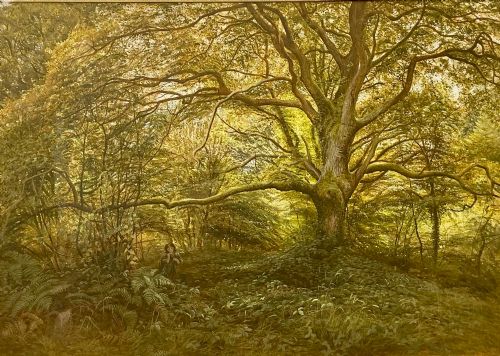
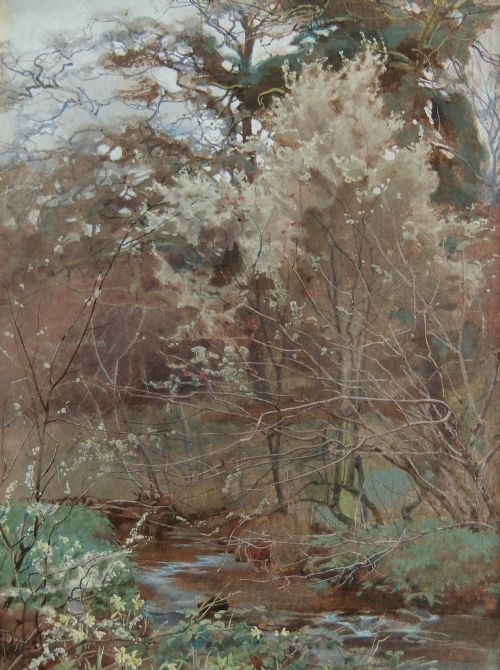
An original woodland watercolour presents trees, forest paths, bluebells and rural riverbanks rendered directly onto paper. Collectors seeking an original woodland watercolour encounter Victorian depictions alongside Edwardian and mid twentieth century examples.
The subjects range from quiet forest interiors and blossoming branches to figures camping beneath trees or cattle watering near wooded streams. These paintings span periods from the nineteenth century through to nineteen sixty.
British landscapes dominate the selection, often capturing specific regional settings such as Yorkshire, Cumbria and Hertfordshire. Works vary from detailed botanical observations to atmospheric British Impressionism and Barbizon inspired scenes.
How they were made
Artists apply watercolour pigment suspended in water directly onto paper, sometimes combining ink for definition or structure. The transparency of the wash allows the white of the paper to illuminate the composition.
Works are typically preserved behind glass within wood or gilt frames to protect the delicate pigment from moisture and light. Many pieces incorporate preparatory drawings and sketches executed en plein air before studio completion.
The archive records portrayals of gypsies, children with dogs, and stags inhabiting woodland paths.
What varies in quality
Quality rests in the sensitivity of light handling and the strength of draftsmanship within the tree structures and foliage. The confidence of the brushwork and the preservation of the paper tone distinguish superior examples.
Signed works by established painters command attention for their distinct provenance and exhibited technical skill. The subtlety of seasonal colouration, from autumn leaves to spring bluebells, dictates the visual impact of each composition.
Bonomi Edward Warren·William Hoggatt·Alfred Grey·Henri Joseph Harpignies·Walter Follen Bishop·Rowland Henry Hill·Edmund George Warren·Alfred W Parsons·Fred Lawson·Harold Swanwick·William Lucas·Charles James Adams·George Graham·Charles Edward Holloway·Beatrice Parsons·Charles Edward Wilson·Donald Watson·Florence F Wilmot·Taylor Ireland·A F Rolfe·Joyce Deighton Dixon·Garnet Ruskin Wolseley·Mahler·W Hastings·Thomas Dudley
The Original Woodland Watercolour Glossary
- Watercolour pigment
- Finely ground colour particles mixed with a water soluble binder, applied in translucent washes. This medium relies on the reflective quality of the underlying paper surface.
- Wash
- A thin, fluid layer of diluted pigment spread across the paper to create skies, foliage or shadows. Controlled washes form the foundation of atmospheric depth in landscape painting.
- Gilt frame
- A wooden moulding covered in a thin layer of gold leaf or metallic gilt paint. These frames provide traditional decorative borders that complement antique paintings.
- Plein air
- The practice of painting outdoors to capture natural light and direct environmental observations. This method informs many woodland scenes created on location.
Original Woodland Watercolour: Frequently Asked Questions
How do I date an antique woodland watercolour?
Examine the signature, framing methods and paper type for clues regarding the period of execution. Victorian and Edwardian works often display distinct stylistic conventions that align with the artist's active dates.
Compare the subject matter and costume of any figures present with historical records. Documentation on the reverse or exhibition labels also helps establish the timeline.
Where should I hang these watercolours?
Position paintings away from direct sunlight to prevent the watercolour pigments from fading over time. Stable indoor humidity levels protect both the paper support and the wooden frame.
Choose walls with gentle ambient light that allow the transparent washes and fine details to remain visible. Avoid damp spaces such as unventilated kitchens or bathrooms.
Are these paintings signed by the artist?
Many examples feature visible signatures or monograms applied by the artist within the lower corners of the composition. Others carry identifying inscriptions on the reverse of the paper or frame.
Unsigned works often originate from specific regional schools or anonymous creators working within documented historical periods.
What framing is typical for these pieces?
Period works frequently retain their original wood or gilt frames, sometimes complemented by card mounts. These housings reflect the aesthetic preferences of the Victorian, Edwardian or mid twentieth century eras.
Glass fronts protect the vulnerable paper surface from dust and physical contact while maintaining clear visibility of the brushwork.