

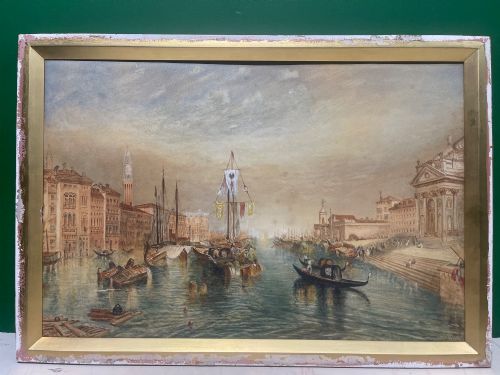


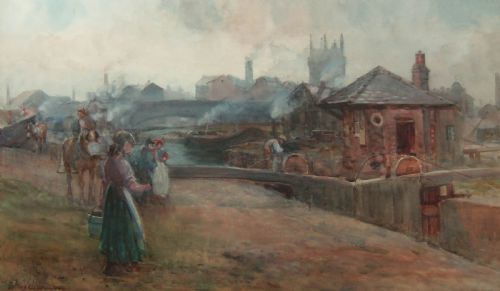


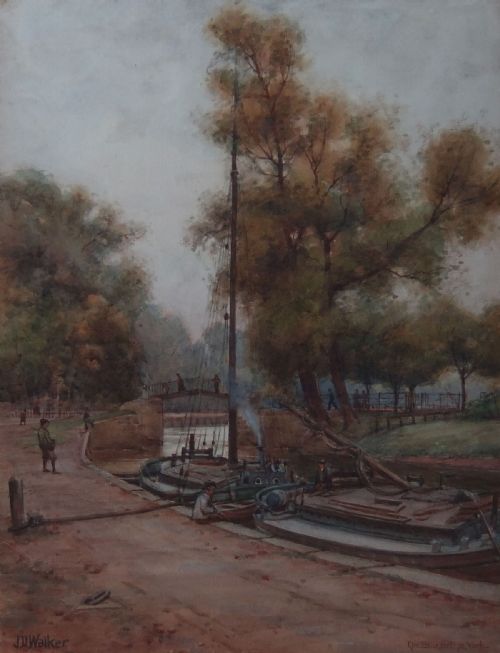


Original Watercolour Canal Scene
An original watercolour canal scene brings the quiet drift of water and historic architecture directly onto your wall.
Original Watercolour Canal Scene
An original watercolour canal scene captures waterways, locks, and urban canals through water-soluble pigments applied to paper. These paintings range from Victorian depictions of British docks to early twentieth-century Italian and Dutch vistas.
You are most likely to encounter works from the Victorian period through the mid twentieth century, often featuring Venice, British ports, and continental waterways. The subjects span bustling commercial docks and quiet rural locks.
Artists record these maritime and urban vistas using traditional watercolour paint on paper supports, frequently framed behind glass in wood or gilt wood frames. The scale generally suits domestic interiors, presenting navigable channels and moored boats.
How they were made
Painters applied water-soluble pigments onto paper sheets, utilising the white of the paper to create light and luminosity within the water and sky. Pigments were brushed in washes or precise strokes to render stone bridges, gondolas, and brick warehouses.
Framing typically involves wood or gilt wood surrounds fitted with glass to protect the delicate paper surface from moisture and atmospheric dust.
Original Watercolour Canal Scene Retail Price Guide 2026
Typical asking prices for original watercolour canal scene among the pieces listed under this phrase on Sellingantiques today, from the lower quarter to the upper quarter. They describe what is for sale here now, not the wider market.
Venetian gondolas steer past modest Yorkshire locks in this eclectic gathering of painted waterways.
What varies in quality
The sophistication of brushwork and the handling of light define the upper tier of these works, where artists capture atmospheric haze and the reflection of buildings on water with confidence. Lesser examples rely on rigid line work and flat washes that lack depth.
The fidelity of the perspective and the depiction of architectural detail distinguish accomplished hands from competent amateurs.
Fred Lawson·Jan van Couver·Vittore Zanetti Zilla·Frank Wasley·Thomas Pyne·William Knox·GH Thompson·Arthur Netherwood·John D Walker·R Goodhind
The Original Watercolour Canal Scene Glossary
- Watercolour paint
- Pigment suspended in a water-soluble binder, applied to paper to create transparent washes of colour.
- Gilt wood
- Wood frames coated with a thin layer of gold leaf or metallic gilt, commonly used to frame Victorian and Edwardian works.
- Grand Tour
- A cultural journey of Europe formerly undertaken by wealthy young men, which inspired many topographical paintings of Italian canals.
- Victorian Dutch School
- A stylistic grouping reflecting the influence of Dutch landscape traditions on nineteenth-century painters.
Original Watercolour Canal Scene: Frequently Asked Questions
How do I hang a watercolour?
Hang your painting away from direct sunlight to prevent the pigments and paper from fading over time. Ensure the room has stable humidity levels to protect the paper and wooden frame.
Use picture wire secured to sturdy wall fixings appropriate for the weight of the framed glass and wood construction.
Are these paintings unique?
Every piece is a hand-painted work created directly on paper by an artist, making each one entirely singular. Multiple works by the same hand will still display individual brushstrokes and composition choices.
Artists working outdoors often recorded specific light conditions at canals and docks that cannot be replicated.
What periods do these date from?
The available selection spans from the Victorian era through the Edwardian period and into the mid twentieth century. Dates within the titles often reference specific years from nineteen hundred to nineteen fifty-three.
Stylistic cues and framing materials frequently align with these production decades.