
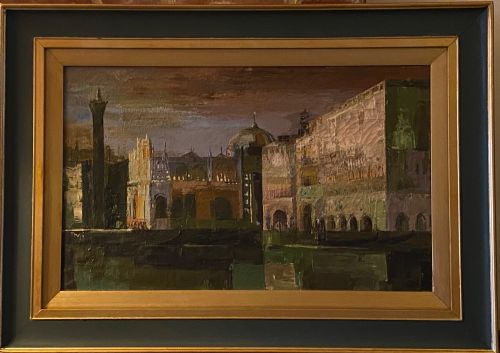
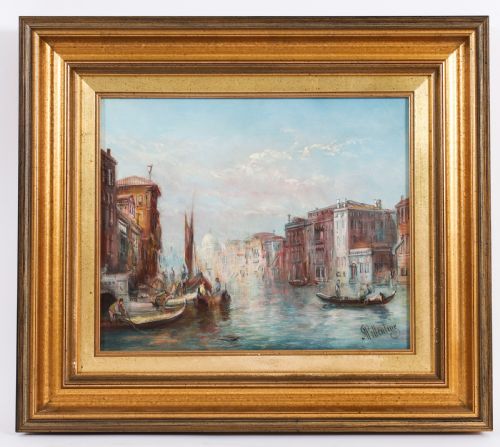
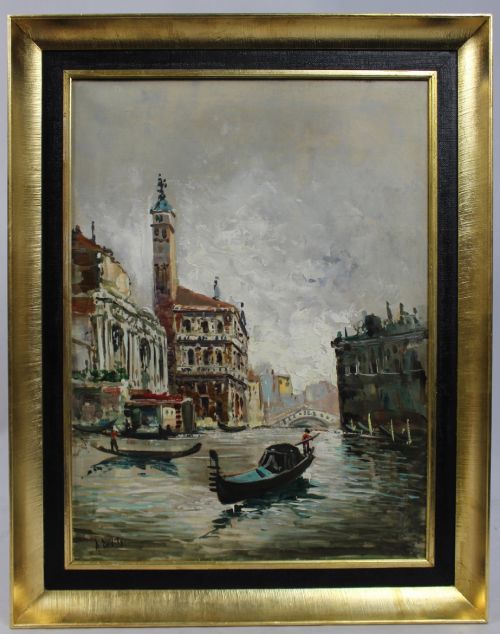
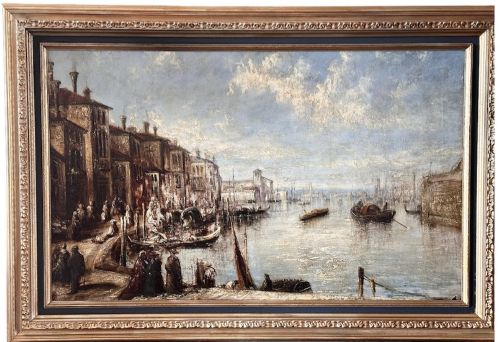


Original Venice Canal Artwork
Original venice canal artwork brings the romantic light and historic waterways of Italy directly into a room through period paintings and watercolours.
Original Venice Canal Artwork
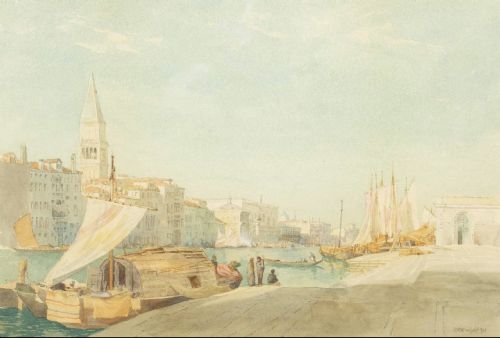
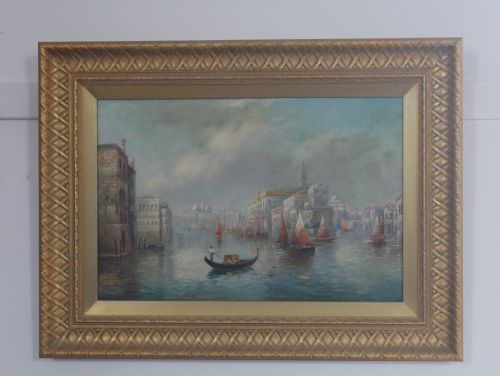
Original venice canal artwork comprises paintings and watercolours depicting the famous waterways, palazzos and lagoons of Venice. Collectors seeking original venice canal artwork will encounter depictions of the Grand Canal, the Doge's Palace and passing gondolas set against historic backdrops.
The selections span from nineteenth century Victorian fine art and romanticism through to mid-century impressionism and early twentieth century interpretations. Works range from detailed architectural oil paintings to looser watercolour studies of light upon the water.
Makers and artists working in these styles capture the shifting atmosphere of Venetian canals, using oil on canvas, paper, pastel and gouache to record the city's unique topography.
Materials and methods
Artists rendering original venice canal artwork typically utilised oil paint upon canvas or delicate watercolours on paper, framed in wood and gilded wood settings. Oil paintings allowed for rich textures and deep tones to capture twilight and moonlight scenes upon the water.
Watercolours and gouache provided transparency and speed, suited for recording bright Venetian light and rapid atmospheric changes across the lagoon. Framing often involved traditional gilded wood moulding that complemented the painterly subjects.
Several artists clearly spent hours watching gondoliers navigate narrow passages just to paint one lucky passenger drifting past a palace.
Factors determining quality
Quality in these paintings rests upon the artist's command of light, perspective and architectural proportion when rendering complex Venetian palazzos and bridges. Stronger examples display confident brushwork and a convincing atmospheric depth rather than stiff mechanical reproduction.
The choice of medium and the preservation of the canvas or paper surface also dictate the standing of a piece. Works by recorded nineteenth and twentieth century artists command greater attention through their established provenance and distinct stylistic execution.
Alfred Pollentine·Antonio DeVity·Francis Moltino·Claude Jousset·Marc Aldine·Vittore Zanetti Zilla·Hercules Brabazon Brabazon·Frank Wasley·David Law·William Knox·Wilfred Knox·Henry Wimbush·Charles Clement Calderon
The Original Venice Canal Artwork Glossary
- Oil on Canvas
- A painting technique using pigments bound in a drying oil applied to a stretched cloth surface. This method allows for rich blending of colour and varied surface textures.
- Watercolour
- A painting method where coloured pigments are suspended in a water-soluble vehicle on paper. It produces luminous washes that mimic the reflective quality of water.
- Gouache
- An opaque water-based paint that includes a white pigment binder to create solid areas of colour. Artists use it alongside watercolour to add highlights to canal scenes.
- Gilded Wood
- Timber frames treated with a thin layer of gold leaf or gilt powder. These frames enhance the visual presentation of historic paintings.
Original Venice Canal Artwork: Frequently Asked Questions
What periods do these paintings come from?
The available works span from the nineteenth century through the Victorian era and into the mid-twentieth century.
Creators from various European schools recorded the canals across these decades using traditional oils and watercolours.
How should I frame a watercolour?
Watercolours require conservation mounting behind glass to protect the paper from humidity and direct sunlight.
Traditional wood or gilded frames complement the period aesthetic of these Venetian views.
Are these works signed by the artists?
Many examples feature artist signatures, historical dates or inscriptions detailing specific locations like the Grand Canal.
Signed works provide a clearer link to the nineteenth and twentieth century painters who documented Italy.
What subjects are most common?
Frequent subjects include the Grand Canal, the Bridge of Sighs, Santa Maria della Salute and passing gondoliers.
Artists focused on historic palazzos, quiet lagoons and atmospheric effects of moonlight or sunset.