
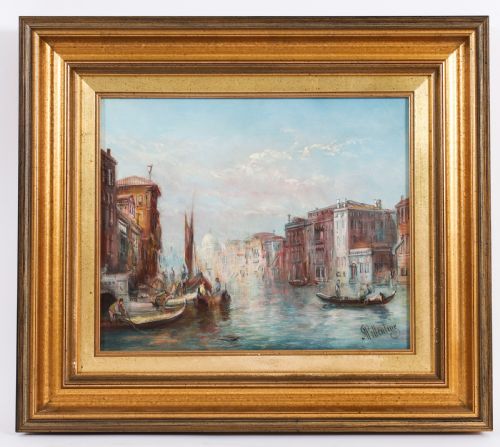
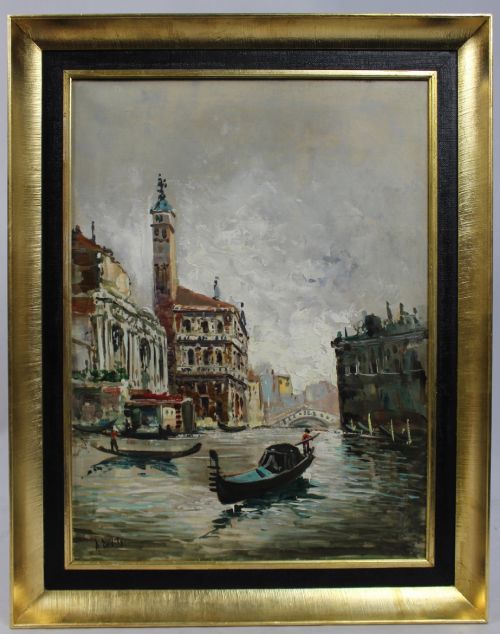


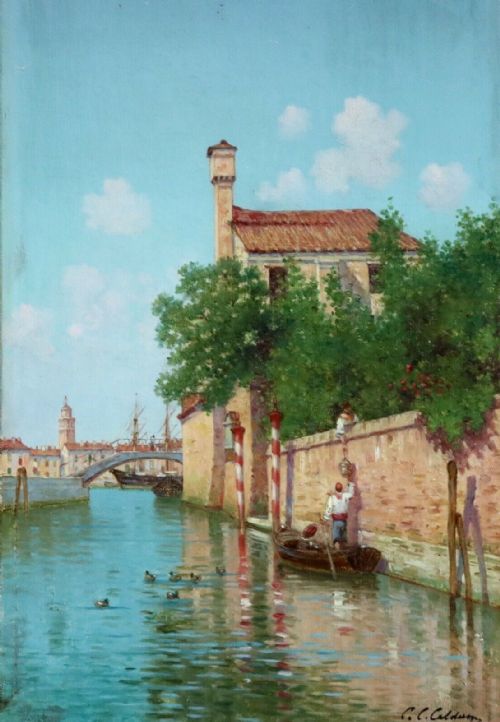
Gondola Canal Scene Artwork
These gondola canal scene artwork pieces capture the atmosphere of Venetian waterways through oils, watercolours and pastels.
Gondola Canal Scene Artwork
When you search for gondola canal scene artwork, you encounter depictions of Venetian waterways ranging from Victorian fine art to mid-century impressionism. The selections available on this page lean heavily towards oil on canvas and watercolour paintings created during the nineteenth and early twentieth centuries.
Most examples focus on iconic locations such as the Grand Canal and the Bridge of Sighs, rendered by artists working in styles from French post-impressionism to late nineteenth-century Italian traditions. You will find both framed oils and delicate paper works that capture the changing light on the water.
The periods represented stretch from the Victorian era through to the 1960s, offering a chronological view of how painters interpreted the lagoon. These works vary from detailed architectural studies to looser, atmospheric impressions of gondoliers at work.
Materials and technique
The works rely upon oil paint applied to canvas or wood panels, alongside watercolours, gouache and pastel on paper. Painters utilised these traditional mediums to build up the luminous atmospheric effects characteristic of lagoon scenes.
Many of the oil paintings and watercolours sit within original or period-appropriate gilded wood frames that complement the composition. The physical support often dictates the texture, with coarse canvas holding heavy impasto and smooth paper receiving delicate watercolour washes.
Several gondoliers captured in these scenes maintain their poised stance despite generations of shifting artistic styles.
Assessing quality and execution
Quality in these works rests upon the artist's handling of light, reflection and atmospheric depth across the water. Stronger pieces demonstrate confident brushwork that defines architecture and movement without relying solely on rigid detail.
The integration of the frame with the painting also influences the overall standard of the piece. Well-preserved surfaces free from excessive craquelure or fading separate superior examples from more routine decorative output.
Alfred Pollentine·Antonio DeVity·Marc Aldine·Vittore Zanetti Zilla·Charles Clement Calderon
The Gondola Canal Scene Artwork Glossary
- Impressionism
- A style of painting that focuses on the accurate depiction of light and its changing qualities. It often employs small, thin yet visible brush strokes.
- Gouache
- A method of painting using opaque watercolours mixed with a thickening preparation. It yields a denser, more matte surface than standard watercolour.
- Gilt
- A thin layer of gold applied to wood or other surfaces to create a decorative frame finish. It adds warmth and reflects light around the artwork.
- Pastel
- A dry drawing medium consisting of powdered pigment and a binder. It produces soft, velvety colours that require framing under glass for protection.
Gondola Canal Scene Artwork: Frequently Asked Questions
How do I date a Venetian canal painting?
Dating relies upon stylistic markers, canvas types, framing methods and artist signatures recorded in the inventory. Victorian and early twentieth-century works often show specific handling of pigment and support materials.
Examining the reverse of the canvas or paper can also reveal period stamps, dealer labels or handwritten inscriptions that narrow down the timeline.
Should I choose oil or watercolour?
Oil on canvas offers rich texture and durability, making it suitable for stronger visual impact in a room. Watercolours provide a lighter, more translucent quality that suits delicate paper pieces.
Both mediums require careful placement away from direct sunlight to preserve the integrity of the pigments.
How should I frame these artworks?
Original gilded wood frames enhance the historical character of nineteenth-century pieces and protect the edges of the canvas. If framing a watercolour or pastel, ensure acid-free mounts and glass are used to prevent paper deterioration.
Matching the frame style to the period of the artwork maintains historical coherence.
What subjects feature in these scenes?
The compositions frequently centre on gondoliers navigating beneath bridges such as the Bridge of Sighs or passing notable landmarks like the Grand Canal. Other views capture the open lagoon and quieter side canals.
The focus remains consistently on the interplay between Venetian architecture and water.