
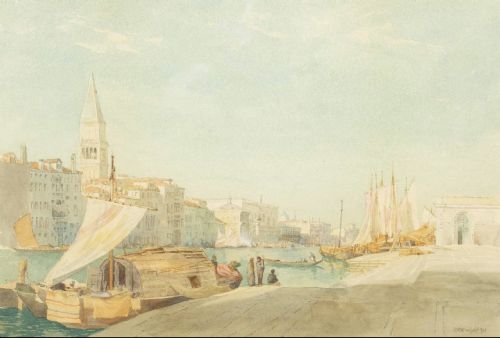


Blue Venetian Watercolour Painting
These blue venetian watercolour painting examples capture the lagoons, canals, and architecture of Venice through delicate pigment on paper.
Blue Venetian Watercolour Painting
A blue venetian watercolour painting portrays the distinctive light and water of Venice using fluid pigments on paper supports. These works range from late nineteenth-century Victorian pieces to mid-twentieth-century examples produced across several decades.
Subjects frequently centre on well-known Venetian landmarks such as the Grand Canal, the Guidecca Canal, and the Bridge of Sighs. The works appear under classifications including fine art and watercolour painting.
Most pieces date from the Victorian era through the early twentieth century, reflecting both late nineteenth-century Italian styles and early impressionism. Artists recorded atmospheric views from the lagoon and city steps.
Materials and execution
These works utilise watercolour paint and watercolour pigment applied directly to paper. Painters built up translucent washes to render the characteristic blue tones of the Venetian water and sky.
Framed behind glass within wooden surrounds, many pieces preserve the delicate pigment layers from environmental damage. The combination of paper supports and water-soluble pigments required precise brushwork to capture distant architectural detail.
Listings feature works spanning from eighteen eighty to nineteen forty, created using watercolour pigment on paper.
Factors of quality
Quality rests upon the artist's ability to capture atmospheric light and spatial depth within the limitations of pigment and paper. Works by established named artists demonstrate greater confidence in brush handling.
The preservation of the paper support and the vibrancy of the watercolour pigments dictate the visual strength of each composition. Finer examples maintain crisp architectural rendering alongside fluid washes of blue.
Richard Henry Wright·Vittore Zanetti Zilla·Benedetto Salviati·Frank Wasley·David Law·William Knox·George Stanfield Walters·Wilfred Knox·Henry Wimbush·John D. Walker·Arthur Severn
The Blue Venetian Watercolour Painting Glossary
- Watercolour pigment
- The finely ground colour particles suspended in a binder to create the paint used on these paper supports. These pigments respond to moisture and light over time.
- Impressionism
- An artistic style focusing on accurate depiction of light in its changing qualities, visible in several early twentieth-century examples.
- Victorian fine art
- The academic and traditional aesthetic framework defining many of the nineteenth-century pieces produced during that era.
- Paper support
- The foundational sheet receiving the watercolour paint, varying in weight, texture, and age-related toning across different periods.
Blue Venetian Watercolour Painting: Frequently Asked Questions
How old are these watercolours?
The pieces span from the late nineteenth century through to nineteen forty. They originate primarily from the Victorian and early twentieth-century periods.
Specific dates are often recorded by the artist or determined through stylistic analysis of the painting methods and framing materials.
Where were these scenes painted?
The subjects focus entirely on Venice, depicting locations such as the Grand Canal, the Guidecca Canal, and the Bridge of Sighs. Artists painted from the lagoons, city steps, and islands.
These viewpoints capture recognizable Venetian architecture rendered through atmospheric blue pigment washes.
How should I display them?
Watercolours on paper require protection from direct sunlight to prevent the pigments from fading over time. Glazing with glass helps shield the delicate paper surface from atmospheric moisture.
Keeping the works away from heat sources preserves both the wooden frames and the paper supports.
What defines Victorian examples?
Victorian pieces reflect the artistic conventions of the late nineteenth century, emphasising detailed architectural rendering and moody atmospheric conditions. They align with Victorian fine art and marine painting traditions.
These works often bear signatures or attribution to prominent watercolourists of the period.