




Original Livestock Canvas Painting
An original livestock canvas painting brings rural life into a room, showing animals in fields through oils from the nineteenth and twentieth centuries.
Original Livestock Canvas Painting
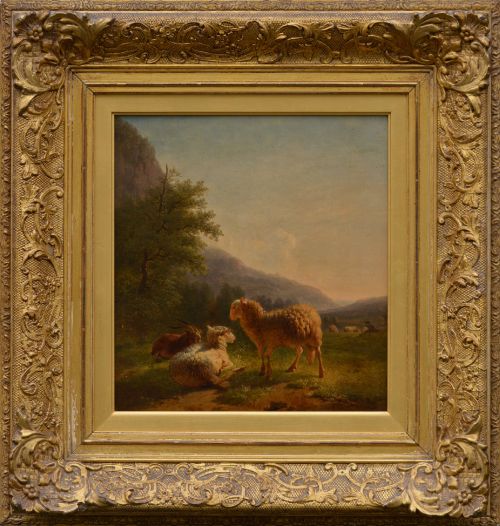
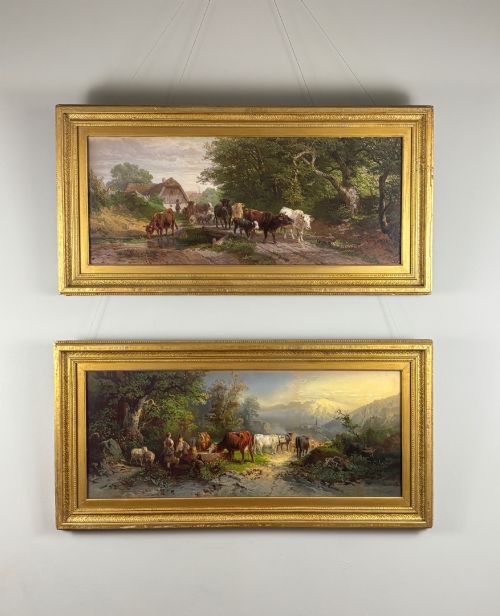
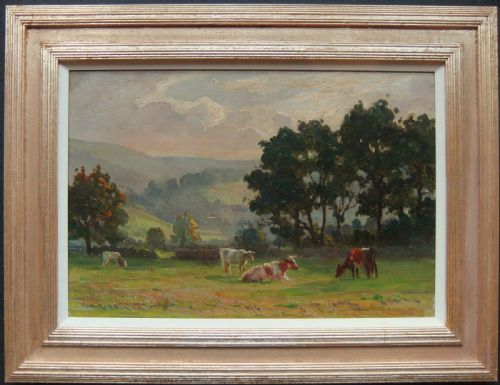
An original livestock canvas painting represents pastoral scenes involving sheep, cattle, calves, and horses rendered in oil paint on canvas supports. These works capture countryside subjects ranging from quiet river banks to open pastures.
The pieces available here emerge from the nineteenth century, the Edwardian period, and later twentieth-century moments like nineteen-sixty. Styles span Victorian pastoral, British impressionism, and English country school traditions.
Buyers meet works by named artists alongside unsigned examples simply titled as oil paintings. Most pieces retain their period frames formed of wood, gesso, gilt, and giltwood.
How they were made
Painters applied oil paint to stretched canvas surfaces using traditional bristle brushes to build up textures in animal coats and surrounding landscapes. Artists layered pigments to achieve depth in skies, water, and grassy pastures.
Makers framed these works using wood structures finished with gesso and gilt layers to create decorative giltwood borders. These frames protect the canvas edges and complement the pastoral subjects within.
Calves and ducks share riverbanks with attentive farm workers across several pastoral canvases.
What varies in quality
The skill of the brushwork defines the upper tier of these paintings, particularly in how accurately an artist renders the anatomy and expression of cattle, sheep, and horses. Finer works display subtle handling of light across pastoral landscapes rather than stiff application.
The integration of original framing also alters the character of a piece, with well-preserved giltwood and gesso frames adding presence. Condition of the underlying oil paint and canvas surface remains central to the integrity of each work.
Eugène Verboeckhoven·Johann Friedrich Voltz·Andre de Moller·Claude Cardon·Henry Cheadle·Ernest Higgins Rigg·Owen Bowen·A Davis
The Original Livestock Canvas Painting Glossary
- Oil on Canvas
- A traditional painting medium where coloured pigments are suspended in drying oils and applied to woven canvas stretched over a wooden frame. This combination allows for rich blending and textured brushwork.
- Giltwood
- Wood carved and coated with a thin layer of gold leaf or metallic powder to create a bright decorative surface. These frames often accompany nineteenth-century pastoral paintings.
- Gesso
- A plaster-like mixture applied to wooden frames as a smooth base before gilding or painting. It provides a crisp surface for detailed moulding work.
- British Impressionism
- A painting style focusing on light, brushwork, and everyday rural scenes rather than strict academic detail. Artists working in this manner captured transient effects in pastoral settings.
- Pastoral Realism
- An artistic approach depicting countryside life and farm animals with close attention to natural appearances. Works in this vein show genuine rural conditions without romantic exaggeration.
Original Livestock Canvas Painting: Frequently Asked Questions
What periods do these paintings come from?
The works span from the nineteenth century through the Edwardian era up to nineteen-sixty. They reflect shifting approaches to pastoral subjects across those decades.
Most pieces belong to Victorian pastoral and early twentieth-century British art movements. Dates appear across nineteenth-century styles as well as specific years like nineteen-hundred and nineteen-twenty.
How should I hang an oil painting?
Hang paintings away from direct sunlight and strong heat sources to protect the oil paint and canvas. Stable indoor humidity prevents warping in the wooden stretchers and frames.
Use secure picture hooks rated for the combined weight of the canvas and its giltwood frame. Ensure the wall structure supports the hanging hardware safely.
Are the frames original to the paintings?
Many period paintings retain frames made of wood, gesso, and gilt that match their era of creation. These frames often show age-appropriate wear that complements the canvas.
Inspect the joinery and surface finish of the giltwood to understand its history. Original frames enhance the overall character of a pastoral artwork.
What subjects appear in these pastoral scenes?
Cattle, sheep, horses, calves, and ducks feature prominently alongside figures tending to farm animals. Rivers, drinking pools, and open pastures set the rural stage.
Artists painted these animals in natural environments, capturing everyday rural life. The compositions range from quiet resting sheep to cattle gathered by water.