




Original 1950s Wall Art
Original 1950s wall art captures the dynamic shift in mid-century visual culture through authentic paintings, posters, and framed works.
Original 1950s Wall Art
When searching for original 1950s wall art, buyers encounter a diverse range of period pieces spanning maritime landscapes, industrial factory scenes, and abstract compositions. These works reflect the post-war artistic output across Britain, France, and America during a period of intense creative experimentation.
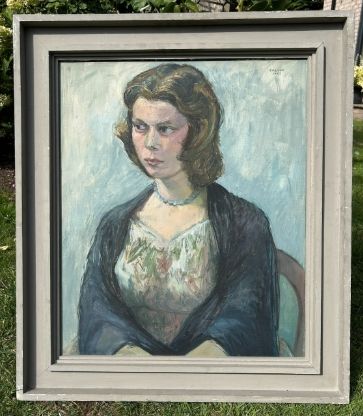
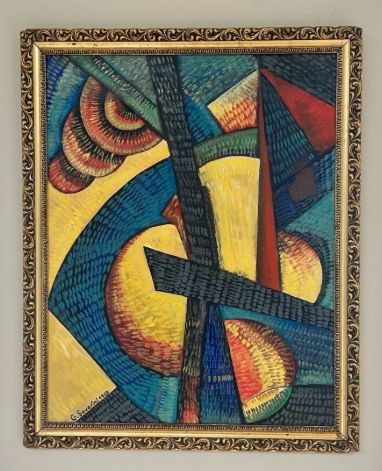
The most common pieces on this page are oil paintings on canvas or board, alongside gouache and watercolour paintings on paper. Mid-century modernist, abstract, and post-impressionist styles dominate the selection alongside figurative portraits and architectural studies.
Buyers also find framed prints, posters, and aeronautical sketches that capture the everyday and industrial subjects of the decade. Each medium provides a direct visual link to the aesthetic priorities of the mid-twentieth century.
Materials and techniques
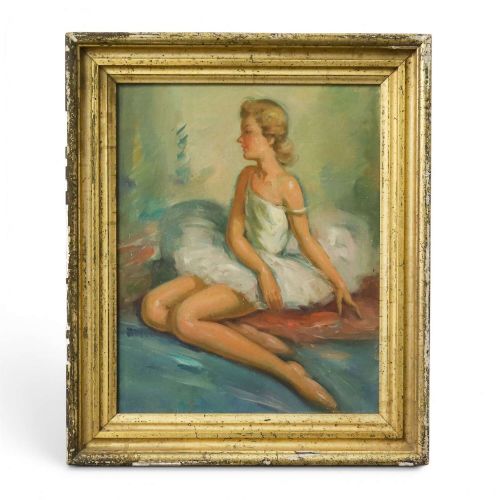
Artists of this era utilised traditional supports such as canvas, wooden board, and heavy paper, applying oil paint, gouache, watercolour, and mixed media. Oil paintings often display textured brushwork on board or stretched canvas, sometimes housed in period frames including worn gilt or ebonised wood.
Works on paper frequently employ gouache and ink to achieve vibrant colour palettes and graphic precision, as seen in French colourist landscapes and theatrical depictions. Mixed media constructions and pastel portraits demonstrate the period's willingness to combine drawing materials with liquid media for expressive depth.
At least one signed painting preserves the determined gaze of a steam locomotive engineer dismantling the roof of Cannon Street Station.
Factors of quality
Quality in these mid-century works rests upon the confidence of the brushwork, the cohesion of the composition, and the fidelity of the framing to the period. Superior pieces demonstrate a distinct personal hand and strong spatial control, whether executing a rigorous industrial constructivist scene or a fluid abstract landscape.
The relationship between the artist's handling of pigment and the chosen support dictates the visual impact. Works that retain their original pigments without excessive restoration offer a purer encounter with the mid-century aesthetic.
Kenneth Cozens·David Shepherd·Adrian Heath·Job de Vogel·Lester Epstein·Margaret Laing·Archille Zavatta·Henry J Neave
The Original 1950s Wall Art Glossary
- Constructivism
- An artistic movement focused on non-objective abstraction and industrial forms. Works in this style often incorporate geometric precision and structural motifs.
- Gouache
- An opaque water-based paint that dries to a matte finish. It allows artists to build rich, solid colour fields on paper supports.
- Post-Impressionism
- A style extending Impressionism while rejecting its limitations. These paintings emphasise vivid colours, distinct brushstrokes, and symbolic subject matter.
- Mid-Century Modern
- A design and art movement spanning roughly the middle decades of the twentieth century. It prioritises clean lines, simplified forms, and modern subject matter.
Original 1950s Wall Art: Frequently Asked Questions
How do I identify a genuine 1950s painting?
Examine the materials, stretcher frames, and backing boards for signs of mid-century manufacture, such as older nails, canvas types, and artist signatures.
Signatures should be cross-referenced with period records and stylistic markers characteristic of post-war European and British modernism.
Where should I hang mid-century wall art?
These works suit contemporary interiors as well as period-restored homes, particularly when paired with minimalist furniture or neutral wall colours.
Ensure the artwork is placed away from direct sunlight to protect sensitive oil paints, gouache pigments, and paper supports.
What is the difference between oil and gouache?
Oil paint utilises a slow-drying medium that allows artists to build thick textures and blend colours seamlessly over extended periods. Gouache dries quickly into an opaque, matte finish on paper, favouring graphic clarity and flat colour areas.
How do I care for framed vintage works on paper?
Keep framed watercolours and gouaches out of direct sunlight and high humidity environments to prevent paper degradation and fading. Professional framing with acid-free mounts ensures the paper remains stable over decades.