
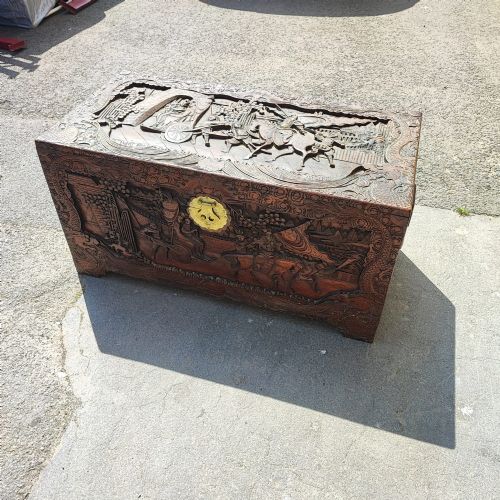


Oriental Carved Wooden Chest
An oriental carved wooden chest brings heavy regional timber and dense surface carving into a room, serving as a sturdy storage trunk.
Oriental Carved Wooden Chest
When you search for an oriental carved wooden chest, you encounter sturdy storage pieces spanning blanket boxes, travel trunks and coffer forms. The pieces appearing here originate from Chinese export workshops, Indian and African coastal trading hubs, and various eastern traditions across the nineteenth and early twentieth centuries.
The version you are most likely to meet on this page is the camphor wood trunk or blanket box, heavily carved with floral or figurative motifs. These storage pieces often date from the Victorian era up through the nineteen-thirties, reflecting decades of international trade and travelling furniture requirements.
Beyond standard blanket chests, the selection encompasses related storage formats such as lacquered cabinets, tall cupboards and smaller decorative boxes. These alternative forms share the characteristic heavy timber construction and detailed surface ornament seen across the trunk categories.
Materials and construction techniques
Makers utilised aromatic and dense timbers suited to long-distance transport and protection of contents, predominantly selecting camphor wood, teak and various regional hardwoods. These woods provide natural resilience against pests while offering a stable substrate for deep relief carving.
Surface embellishment relies on hand chiselling to create high-relief panels of foliage, landscapes or figurative scenes across the lids and sides. Many examples incorporate brass banding, corner mounts and swing handles fixed securely to the heavy timber carcass.
Listings span the seventeenth through the early twentieth centuries, featuring camphor wood, teak, rosewood and lacquer.
Distinctions in craftsmanship and condition
The standard of carving sets the superior examples apart from standard utility pieces, distinguishing crisp, undercut botanical details from flat or hastily executed surface scoring. Depth of relief and symmetry across the panels indicate the skill of the original artisan.
Structural integrity of the joints and the preservation of original brass fittings influence the standing of an individual chest. Pieces retaining their natural timber aroma, clean interior spaces and original lacquer or polish represent the higher tier of survival.
The Oriental Carved Wooden Chest Glossary
- Camphorwood
- An aromatic timber frequently utilised for storage trunks due to its natural insect-repellent properties and stability. It responds well to deep hand carving.
- Coffer
- A heavy wooden box used for holding valuables or textiles, typically fitted with a hinged lid. Historically employed for domestic storage and transport.
- Brass-bound
- A method of reinforcing chest corners, edges and seams with brass plates and straps fastened by pins. This protected the timber during maritime transit.
- Export ware
- Goods produced in Asian workshops specifically for Western markets, blending traditional local craftsmanship with European forms and preferences.
Oriental Carved Wooden Chest: Frequently Asked Questions
What were these chests used for?
These chests served primarily as durable luggage and storage trunks for merchants, sailors and travellers moving goods across maritime routes.
At home, families utilised them as blanket boxes, linen stores or strongboxes to protect valuable textiles from dampness and insects.
How do I care for camphor wood?
Keep the wood away from direct heat sources and strong sunlight to prevent the natural oils from drying out and causing timber splits.
Clean the surface gently with a dry or barely damp cloth, avoiding harsh chemical polishes that might damage the original finish.
How can I date a trunk?
Examine the construction methods of the joints, the style of the brass hardware, and the character of the wood grain and patina.
Nineteenth-century examples often display hand-beaten brass mounts and deep, organic carving styles compared to later twentieth-century production.
Are these chests heavy?
Solid hardwood and thick camphor construction make these trunks substantially heavy, particularly when fitted with metal hardware and thick panels.
Side carrying handles were integrated precisely because moving them unloaded required steady effort.