
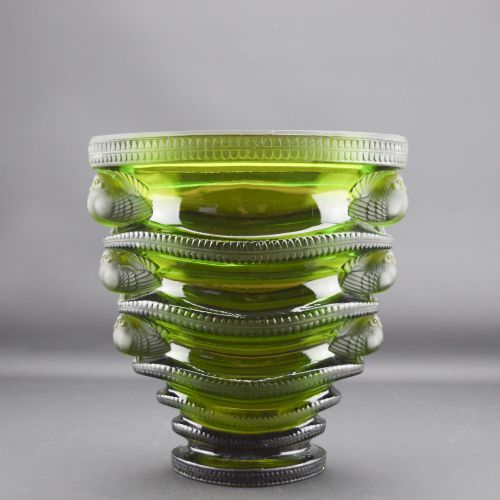


Olive Green Glass
Olive green glass brings depth and earthy tone to vessels ranging from Georgian decanters to Art Deco vases.
Olive Green Glass
Olive green glass encompasses an array of utilitarian and decorative items, from 18th-century wine bottles and pickling jars to refined Victorian decanters and early 20th-century vases. Buyers seeking olive green glass encounter vessels shaped by various historical movements, including Georgian, Victorian, Art Nouveau, Jugendstil, and Art Deco.
The objects span practical storage vessels like demijohns and carboys alongside delicate drinking vessels such as roemers and wine glasses. Makers and houses from Bohemia, France, and Britain contribute to the diverse range of forms available in this distinctive hue.
Materials and production
Many of the earlier vessels utilise hand-blown or optically blown glass techniques, showing the organic irregularities and bubbles characteristic of historical production. Moulded glass and frosted glass appear in later periods, alongside decorative applications such as polychrome enamel and silver plate mounts.
Makers shaped the molten material into heavy storage jars, slender scent bottles, and large display vases, occasionally employing iridescent finishes or surface engraving to enhance the natural coloration of the glass.
Tadpoles and pickling jars share space with fine scent bottles, proving that utility and art enjoy equal footing in green glass.
Assessing quality and character
Quality in olive green glass rests upon the purity of the metal, the balance of the form, and the crispness of any applied decoration or moulding. Pieces featuring hand-painted polychrome enamel or integrated silver plate demonstrate a higher degree of artisan skill than standard utilitarian containers.
The depth and consistency of the green tone also dictate value, with older 18th-century cylinder bottles showing rich natural variation while studio and factory pieces by named designers exhibit controlled, deliberate hues.
Rene Lalique·Loetz·James Powell·Frits Hechert·Richardson
The Olive Green Glass Glossary
- Roemer
- A traditional Germanic drinking glass featuring a large bowl atop a cylindrical, hollow stem decorated with prunts. These glasses frequently appear in pale green glass from Bohemian workshops.
- Demijohn
- A large, narrow-necked glass bottle used for storing liquids, often protected by wickerwork. These robust vessels date across the 18th, 19th, and early 20th centuries.
- Prunt
- A small lump or blob of applied glass melted onto the stem of a goblet or roemer to provide a secure grip. This traditional decorative and functional feature appears on historical drinking vessels.
- Bocal
- A traditional French term for a large glass jar used for food preservation and pickling. These heavy containers display utilitarian craftsmanship from earlier centuries.
Olive Green Glass: Frequently Asked Questions
What periods do these pieces date from?
The selection spans from the eighteenth century through the Georgian and Victorian eras into the early twentieth century, encompassing Art Nouveau, Jugendstil, and Art Deco movements.
Items range from utility pickling jars and wine bottles to decorative vases and complete decanter sets.
How do I distinguish older bottles from later reproductions?
Older pieces typically display pontil marks on the base where the glassblower's rod was detached, alongside natural bubbles and slight asymmetries in the metal.
Utilitarian items like carboys and demijohns often show heavy wear and deeper tonal variations characteristic of historical manufacturing methods.
How should I clean antique glass vessels?
Gentle washing with warm water and mild soap preserves the surface finish, avoiding harsh abrasives that might damage delicate enamel or frosted areas.
Utilitarian jars and decanters with internal residue require careful rinsing without sudden temperature changes to prevent cracking the old glass.
Were these items purely decorative?
Many objects began as functional containers, including wine roemers, spirit decanters, Calvados bottles, and food storage jars used in French country kitchens.
Over time, items such as carboys and demijohns transitioned from commercial storage to decorative interior accessories.