
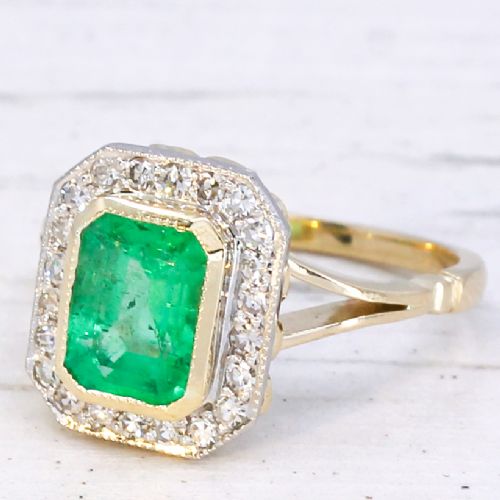


Octagonal Diamond Ring
An octagonal diamond ring brings geometric clarity to the hand, offering sharp lines and brilliant facets from the Georgian era to the mid-century.
Octagonal Diamond Ring
An octagonal diamond ring presents a distinct geometric silhouette, frequently appearing in cluster formations alongside emeralds, sapphires, and tanzanites. These pieces span from the Georgian period through Art Deco designs and into mid-century creations.
The most common examples on this page date from the Art Deco period and the 1950s and 1960s, reflecting shifts in geometric preference over several decades. Central stones are often framed by smaller accent diamonds or shaped shoulders.
Makers utilised platinum alongside yellow and white gold to construct these settings, pairing the metal tone with the central gemstone. The geometric outline remains the defining characteristic across all periods represented here.
How they were made
Platinum and 18ct white or yellow gold form the structural foundation of these rings, providing the necessary strength to secure multi-stone geometric clusters. Silver is also combined with gold in earlier Georgian examples.
Stone cutting techniques vary from old cut diamonds and rose cut diamonds to emerald cuts, tailored to fit within the multi-sided octagonal framework. Prong and bezel settings secure the central gems while accent stones line the shoulders or create surrounding halos.
Materials recorded across the inventory include platinum, white gold, yellow gold, and silver paired with diamonds and coloured gemstones.
What varies in quality
Quality rests in the precision of the geometric symmetry and the integration of the central stone with its surrounding cluster. Master jewellers achieved a seamless alignment where metalwork supports rather than overpowers the optical brilliance of the diamonds and coloured gems.
The weight, clarity, and treatment of centre stones - such as minor oil Colombian emeralds or Burmese sapphires - distinguish individual pieces. Proportion between the central octagonal focus and the shoulder details dictates the visual balance of the ring.
The Octagonal Diamond Ring Glossary
- Old cut
- A vintage diamond cutting style characterised by a smaller table, higher crown, and open culet, designed to catch candlelight.
- Cluster ring
- A ring design featuring a central gemstone surrounded by a group of smaller stones, often diamonds.
- Rose cut
- An antique diamond cut featuring a flat base and a domed crown covered in triangular facets, resembling an unopened rosebud.
- Solitaire ring
- A ring set with a single gemstone, typically a diamond, as the primary focal point.
Octagonal Diamond Ring: Frequently Asked Questions
What periods do these rings come from?
These rings span from the Georgian era through the Art Deco period and into the mid-century decades of the nineteen-fifties and sixties.
Each period brings distinct metal choices and geometric arrangements to the octagonal format.
Which gemstones appear alongside diamonds?
Emeralds, sapphires, tanzanites, and yellow sapphires frequently share the setting with diamonds in these cluster configurations.
Stones like Colombian emeralds and Burmese sapphires appear in historical and vintage pieces.
How do I care for an antique ring?
Regular gentle cleaning by a specialist helps maintain the security of stones set in platinum and gold.
Avoiding harsh ultrasonic cleaners protects treated gems like minor oil emeralds.
Are these rings suitable for daily wear?
Sturdy metals like platinum and 18ct gold provide durability for regular use when settings are checked periodically.
Consider the stone type, as emeralds require more mindful wear than diamonds.