
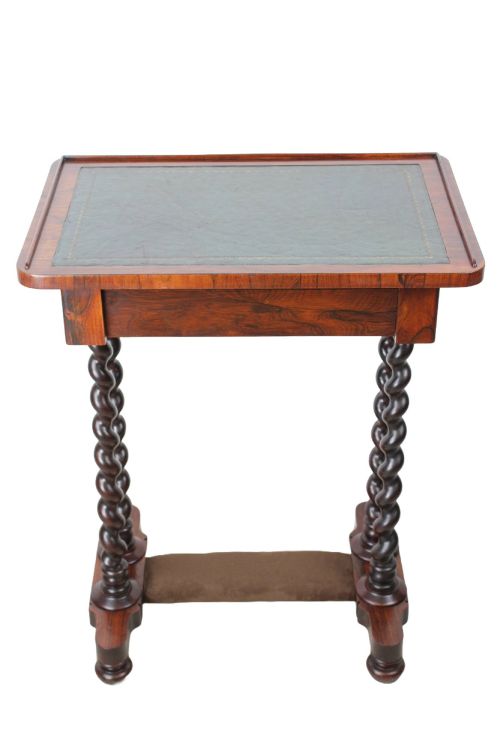

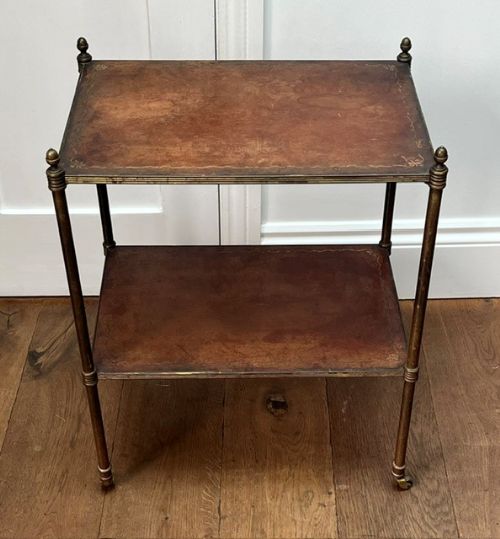
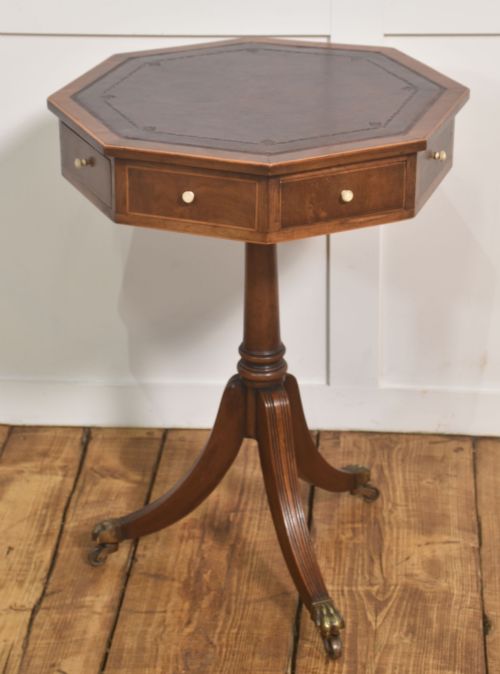
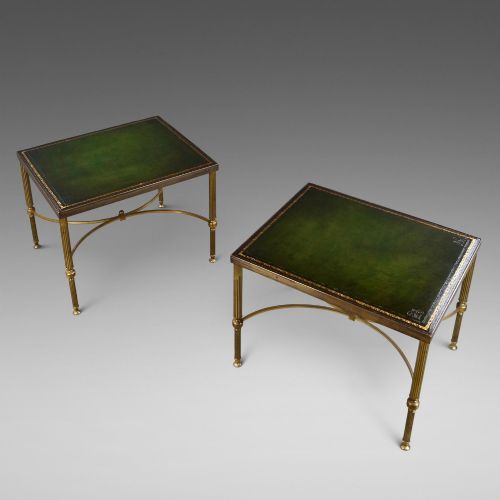



Occasional Table Leather
An occasional table leather selection brings together compact timber frames and inset writing surfaces for everyday placement beside seating.
Occasional Table Leather
When you search for an occasional table leather piece, you encounter movable side tables, drum tables, and small writing surfaces produced across the eighteenth, nineteenth, and early twentieth centuries. These pieces were designed to be shifted easily around a room for writing, reading, or serving.
The most common versions on this page are mahogany or rosewood side tables and twentieth-century brass-framed two-tier etageres featuring inset leather panels. You also find walnut and oak examples spanning Georgian, Regency, Victorian, and Edwardian periods.
Form follows function closely in these designs, ranging from circular pillar tables to octagonal drum tables with rotating tops and nested sets fitted with leather surfaces.
How they were made
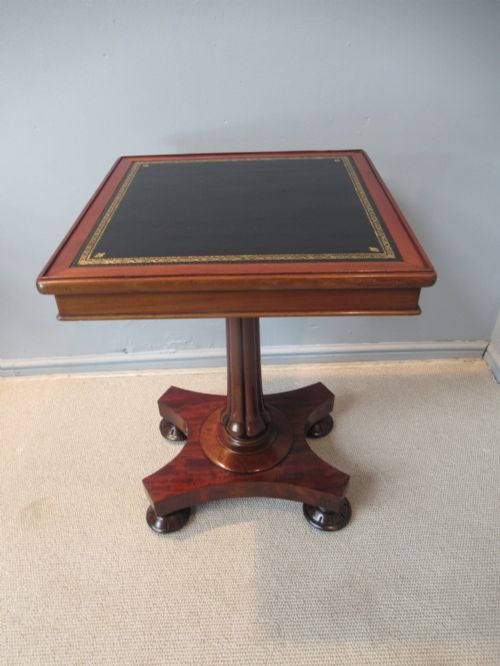
Cabinetmakers constructed the foundational frames from dense timbers such as mahogany, rosewood, satinwood, and walnut, frequently incorporating turned pillars, carved tripod legs, or bamboo supports.
Writing and table surfaces were inset with cattle hide or sheepskin, often decorated with blind or gold leaf tooled borders to frame the writing area.
Metal elements including lacquered brass frames, gilt-metal mounts, and brass castors were utilised in tandem with timber elements, particularly on later nineteenth and early twentieth-century examples.
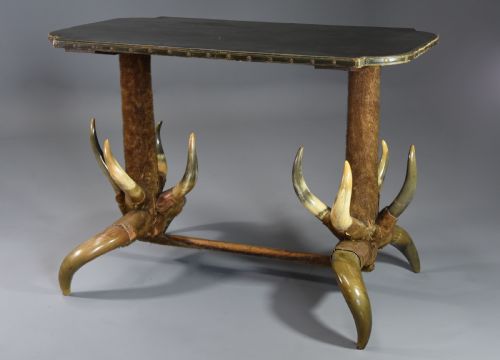
German cow horn furniture occasionally appears alongside traditional timber and brass work.
What varies in quality
The degree of refinement in the timber selection and cabinetry marks the distinction between standard production pieces and finer workshops, visible in the grain matching of mahogany or rosewood veneers.
Quality shows in the crispness of hand-tooling on the leather and the precision of the brass fittings, where heavier gauge metals and cleaner stamping indicate superior manufacture.
Proportion and structural integrity define the better examples, ensuring that smaller occasional tables remain stable and balanced on their tripod or four-pillar bases.
Liberty and Co·Whytock and Reid·Willmington and Cope
The Occasional Table Leather Glossary
- Drum table
- A circular library or occasional table with a deep frieze containing drawers, resembling the shape of a drum.
- Etagere
- A set of open shelves or tiers used for displaying small objects or holding books, frequently constructed in brass and timber.
- Marquetry
- Inlaid woodwork where different coloured veneers are fitted into a ground to form decorative patterns or pictures.
- Tripod table
- A small circular table supported by a pillar above three spreading legs, common in eighteenth and nineteenth-century parlours.
- Tooled leather
- Leather decorated by pressing heated metal tools into the surface to create blind or gilt patterns.
Occasional Table Leather: Frequently Asked Questions
What is an occasional table leather top used for?
These tables served primarily as convenient movable surfaces for writing letters, holding books, or placing lamps beside seating areas in reception rooms.
Their compact size allowed servants or residents to reposition them freely according to the day's activities.
How do I date a leather top occasional table?
Dating relies on combining the timber species, leg architecture, and the style of the brass hardware with the characteristics of the inset leather.
Earlier pieces from the Georgian and Regency eras show different framing techniques and finer turning compared to later Victorian and Edwardian examples.
Are these tables suitable for daily use?
The sturdy timber frames and durable leather writing surfaces make these small tables practical for placement beside armchairs or sofas.
Care should be taken with moisture and sharp objects to protect the leather panel and the polished wood surrounding it.