
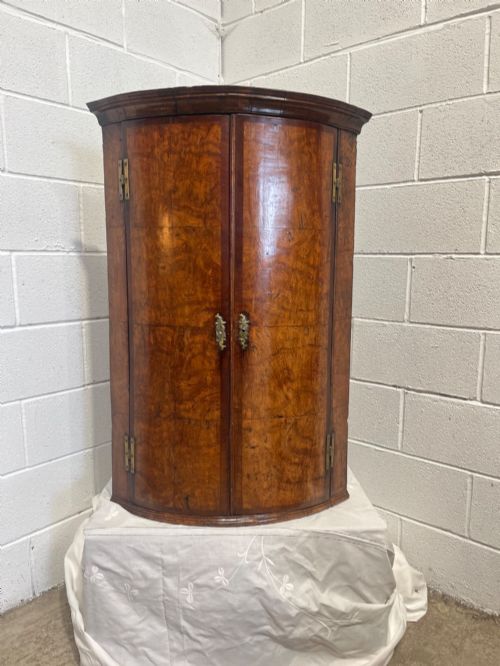
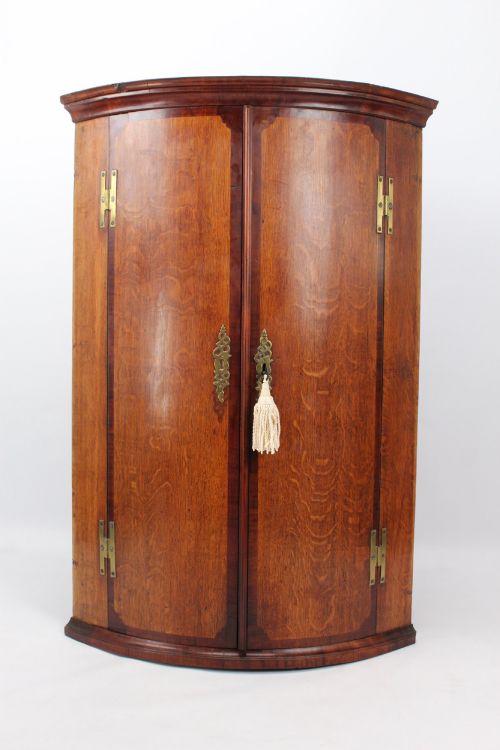
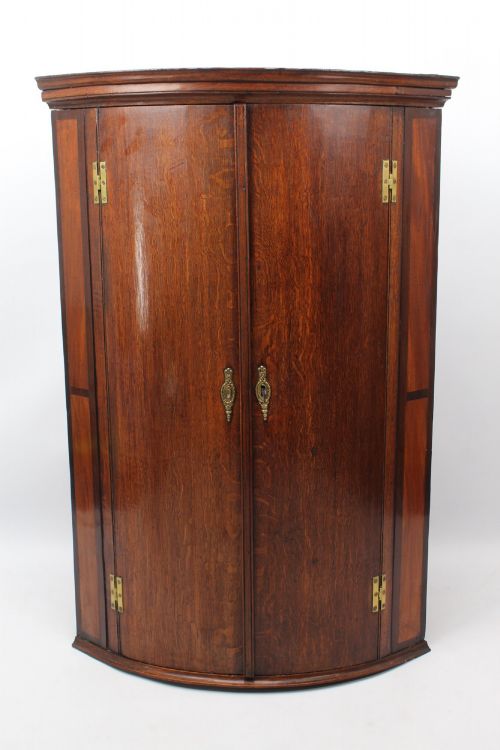


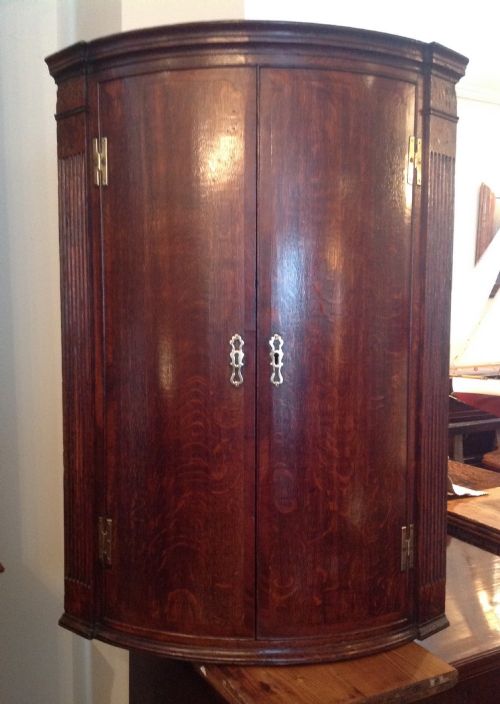


Oak Bowfront Corner Cupboard
These oak bowfront corner cupboard pieces turn awkward angles into storage, bringing eighteenth-century character straight into modern rooms.
Oak Bowfront Corner Cupboard
An oak bowfront corner cupboard makes clever use of unused room geometry by fitting snugly into any ninety-degree junction. This selection focuses entirely on pieces from the Georgian and eighteenth-century periods, showing the domestic forms of the era.
Most examples found here are hanging wall units, though standing floor-standing cabinets also appear in the record. The curved door front defines the group, softening the hard lines typical of traditional flat-fronted corner furniture.
How they were made
Joiners built these cabinets primarily using solid oak, frequently pairing it with mahogany for crossbanding or adding burr oak veneer to feature surfaces. Pine often served for internal secondary woods, while brass provided durable hinges and key escutcheons.
Construction relied on traditional framing techniques to accommodate the curved bow front, sometimes incorporating carved details or painted finishes directly onto the timber.
Several pieces feature barrel fronts designed to curve smoothly around the room, proving that eighteenth-century makers loved a good arc.
What varies in quality
The choice of timber creates the primary distinction between standard utility pieces and finer examples, particularly when burr oak or mahogany crossbanding is utilised. Cabinetmaking finesse shows in how neatly the curved door meets the frame and how well the brass hardware integrates with the wood.
Carved ornamentation and well-figured grain elevate certain pieces above plain utilitarian storage, reflecting the original workshop's skill and ambition.
The Oak Bowfront Corner Cupboard Glossary
- Bowfront
- A convex curving front facade that projects outward. This shape softens room corners and requires specialist joinery.
- Crossbanding
- A strip of veneer applied perpendicularly to the grain of the main surface. It frames panels with contrasting wood patterns.
- Escutcheon
- A protective plate surrounding a keyhole. Brass versions are typical on eighteenth-century furniture.
- Georgian
- The period spanning the reigns of the first four Georges. It encompasses classic proportions and regional vernacular interpretations.
- Vernacular
- Everyday domestic furniture made by regional craftsmen rather than metropolitan workshops. These pieces often utilise local timber traditions.
Oak Bowfront Corner Cupboard: Frequently Asked Questions
Where should I place a corner cupboard?
Position them in unused room angles to maximise floor space while adding period focal points to dining rooms or hallways. Their curved fronts prevent sharp corners jutting into walkways.
Keep them away from direct heat sources and strong sunlight to protect the timber and any veneer work from drying out.
How do I clean old oak furniture?
Dust regularly with a dry, soft cloth and feed the timber occasionally with traditional beeswax to maintain the finish. Avoid modern silicone sprays that build up and attract dirt.
Protect the brass hardware with gentle cleaning if tarnished, taking care not to let polish stain the surrounding wood.
How can I tell the age of these cupboards?
Examine the construction methods, timber patination, and secondary woods like pine found inside the cabinet. Eighteenth-century pieces typically show hand-planed surfaces and forged iron or early brass fittings.
Stylistic cues such as Georgian crossbanding and proportions also help distinguish earlier examples from later Victorian revivals.