

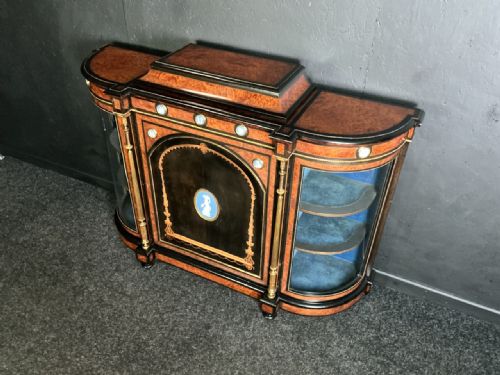
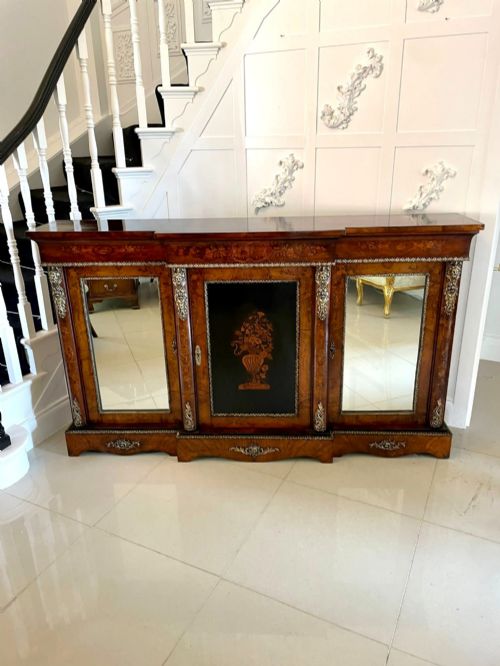
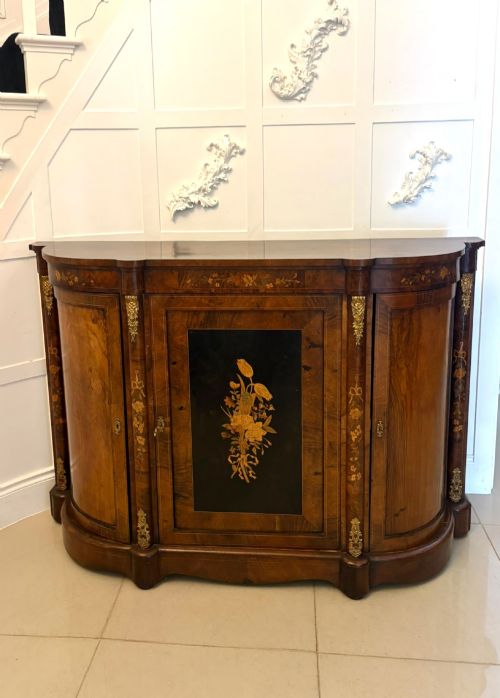
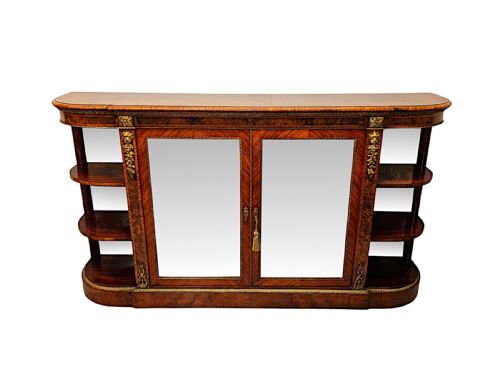


Nineteenth Century Walnut Sideboard
A nineteenth century walnut sideboard brings rich grain, figured veneers and formal presence into a room.
Nineteenth Century Walnut Sideboard
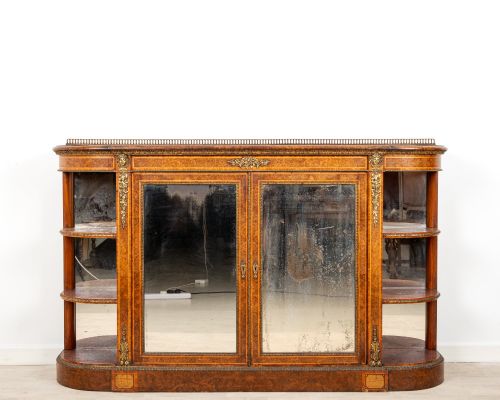
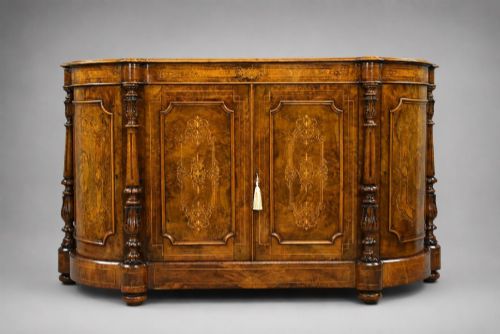
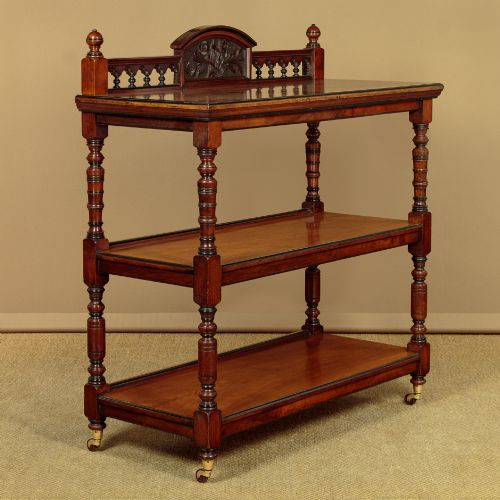
A nineteenth century walnut sideboard encompasses credenzas, display cabinets, and serving pieces produced across the Victorian era. These low-profile storage pieces frequently take the form of credenzas with glass doors, mirrored backs, or serpentine fronts designed for principal reception rooms.
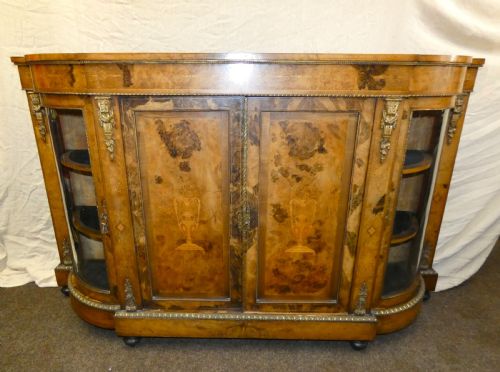
The versions most commonly met on this page are Victorian credenzas and side cabinets constructed from burr walnut. These often incorporate enclosed cupboards flanked by curved glass display sections, providing both surface display space and concealed storage.
Origins stretch from English workshops to French revival pieces, alongside specific iterations influenced by the Aesthetic Movement and Renaissance tastes. Pieces range from modest proportions suited to smaller spaces to exhibition quality examples with extensive marquetry.
Construction and Materials
Makers utilised figured walnut and burr walnut veneers applied over solid secondary timbers to create highly decorative surface patterns. Marquetry panels of boxwood inlay, floral motifs, and contrasting woods frequently decorate the central doors and friezes.
Cast ormolu mounts, brass details, and porcelain plaques adorn many of the finer examples, particularly those following French revival styles. Glass doors are common on credenzas and display cabinets, paired with internal shelving and mirrored backs to enhance light reflection.
Nineteenth Century Walnut Sideboard Retail Price Guide 2026
Typical asking prices for nineteenth century walnut sideboard among the pieces listed under this phrase on Sellingantiques today, from the lower quarter to the upper quarter. They describe what is for sale here now, not the wider market.
Listings feature Burr Walnut, Ebonised Wood, Ormolu, and Porcelain, alongside Victorian, Aesthetic Movement, and Renaissance Revival styles.
Judging Quality
Quality rests principally on the selection and matching of the walnut veneer, particularly the density and curl of the burr figures across the front doors. Superior pieces display continuous grain alignment and meticulous hand-cut marquetry rather than printed or superficial decoration.
The refinement of the cast ormolu mounts, the clarity of the mirrored glass, and the precision of the joinery on curved serpentine fronts separate standard production from exhibition pieces. Maker attribution, such as stamps by firms like Gillows, indicates workshops operating at the highest level of craftsmanship.
Gillows
The Nineteenth Century Walnut Sideboard Glossary
- Credenza
- A low cabinet or sideboard, frequently featuring glass-fronted side doors and a central cupboard, popular in formal Victorian interiors. These pieces often incorporate mirrored backs and ormolu mounts.
- Burr Walnut
- Timber taken from the abnormal growth of a walnut tree, yielding highly figured and swirling grain patterns. Cabinet makers prized this veneer for principal door panels and tabletops.
- Marquetry
- Decorative patterns formed by fitting together thin veneers of different coloured woods, ivory, or metal. Floral and geometric designs are common on nineteenth century walnut furniture.
- Ormolu
- Gilded bronze or brass mounts applied to furniture for decorative effect. It gained widespread use during revival periods influenced by French eighteenth century design.
- Serpentine
- A curved furniture front characterised by a concave centre flanked by two convex ends. This shape requires advanced woodworking skill to veneer and fit accurately.
Nineteenth Century Walnut Sideboard: Frequently Asked Questions
What is the difference between a credenza and a sideboard?
A credenza is typically a lower, more formal cabinet with glass doors or mirrored components, designed originally for display and serving in a dining room or parlour. Traditional sideboards often stand taller with dedicated drawer space and backboards for larger dining rooms.
In nineteenth century furniture, these terms sometimes overlap as makers adapted forms to suit domestic fashions. Many pieces listed under this search combine the low profile of a credenza with the functional storage of a serving cabinet.
How do I identify burr walnut?
Burr walnut is recognised by its dense, swirling grain patterns and knots, which create complex, eye-catching visual movement across the timber surface. It comes from the burl or growth outgrowths of the tree rather than straight planks.
Cabinet makers used this prized veneer selectively on the most prominent surfaces, such as doors and drawer fronts, framed by straight-grained walnut borders.
Where should I place a credenza at home?
A credenza suits a dining room, hallway, or principal reception space where its surface can hold lamps, decorative objects, or serving items. The internal shelving accommodates glassware and tableware out of sight.
Keep walnut furniture away from direct sunlight and strong heat sources to protect the delicate veneers and polished finish from fading or drying out over time.
What styles fall under nineteenth century walnut furniture?
The selection spans high Victorian design, Aesthetic Movement pieces, and various revival styles including French Renaissance, Louis XVI, and Late Regency. Each style interprets walnut and its veneers differently, from austere dark finishes to ornate ormolu-mounted displays.
Maker details, inlay types, and structural mounts generally signal which design movement influenced a particular cabinet or sideboard.