



Nineteenth Century Ornate Clock
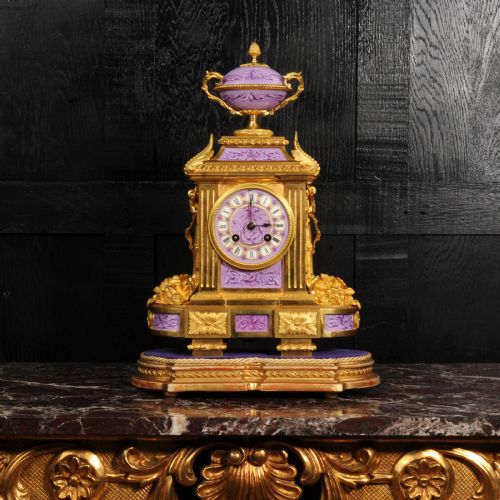
A nineteenth century ornate clock brings heavy gilt bronze, porcelain panels and intricate dial work into a room.
Nineteenth Century Ornate Clock
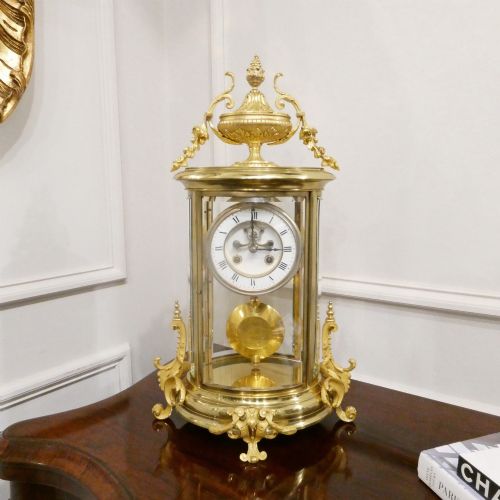
A nineteenth century ornate clock typically manifests as a French mantel clock, a carriage clock with a glass case, or a larger clock garniture set featuring side pieces.
The selections span the Victorian era, Regency period, and Napoleon III style, capturing elaborate revivals of Louis XIV, Louis XVI, and Rococo aesthetics.
Mantel clocks and desk clocks dominate the offerings, often pairing heavy cast metal cases with painted enamel dials and porcelain inserts.
Materials and Construction
Foundries cast cases in brass, bronze, and spelter, applying heavy ormolu or gilt finishes to create a brilliant metallic lustre.
Dials and decorative panels utilise fired porcelain, frequently painted with classical scenes or floral motifs and framed by bevelled glass panels in carriage clocks.
Nineteenth Century Ornate Clock Retail Price Guide 2026
Typical asking prices for nineteenth century ornate clock among the pieces listed under this phrase on Sellingantiques today, from the lower quarter to the upper quarter. They describe what is for sale here now, not the wider market.
Listings feature works from the Victorian period, Regency era, and Napoleon III style, utilising ormolu, porcelain, and patinated bronze.
Assessing Craftsmanship
The crispness of the cast ornamentation dictates the visual hierarchy, separating sharp, hand-chased gilt bronze from softer, shallower metalwork.
Movement sophistication determines utility, where jewelled platforms, grand sonnerie striking trains, and signed maker plates elevate a piece above standard domestic timepieces.
Achille Brocot·Samuel Marti·Japy Freres·Gontard and Bolviller Paris·William Payne·Auguste Moreau·Farcot
The Nineteenth Century Ornate Clock Glossary
- Ormolu
- Gilded bronze produced by applying a mercury-gold amalgam to a bronze base and heating the metal to drive off the mercury.
- Grand Sonnerie
- A complex striking mechanism that chimes both the hours and the quarters automatically on every quarter-hour.
- Garniture
- A set consisting of a central clock flanked by matching decorative objects such as urns or candelabra.
- Platform escapement
- A small, self-contained escapement unit fitted to carriage clocks that replaces the pendulum and allows portable timekeeping.
Nineteenth Century Ornate Clock: Frequently Asked Questions
Where should I place a clock garniture?
A clock garniture set looks best centred on a wide mantelpiece, a heavy sideboard, or a large console table. The central clock anchors the arrangement, while the matching side urns or vases balance the overall visual weight.
Keep these heavy pieces away from direct heat sources and damp walls to protect the delicate gilt surfaces and painted porcelain panels.
What is the difference between a mantel clock and a carriage clock?
Mantel clocks generally feature substantial gilt bronze, marble, or porcelain cases designed to stay stationary on a shelf or fireplace mantel. They often rely on pendulum regulation for accurate timekeeping.
Carriage clocks are smaller, portable timepieces housed within brass and glass frames, equipped with a handle and a platform escapement instead of a hanging pendulum.
How do I identify a Louis XVI revival clock?
Louis XVI revival pieces lean towards neoclassical symmetry, featuring straight architectural lines, urn motifs, laurel wreaths, and restrained geometric mounts rather than asymmetrical curves.
They frequently combine gilt bronze with dark patinated elements and white enamel dials, reflecting the late eighteenth-century taste revived during the nineteenth century.