


Neoclassical Marble Candelabra
Neoclassical marble candelabra bring classical proportion and refined metalwork into a room, offering both sculptural presence and functional lighting.
Neoclassical Marble Candelabra
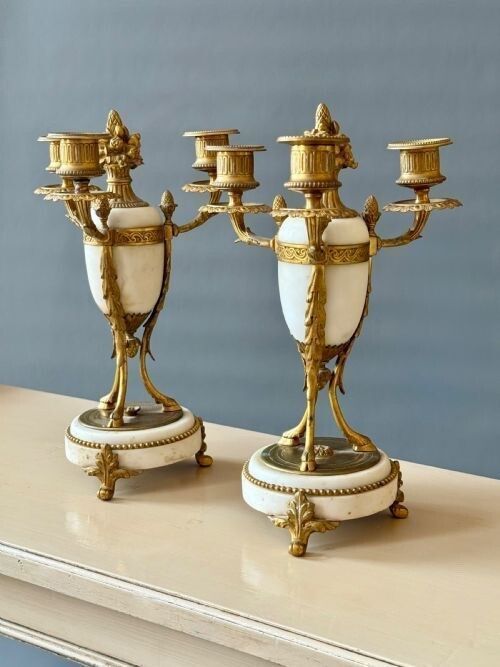
When you search for neoclassical marble candelabra, you are looking at items designed to hold multiple candles, combining carved stone bodies with cast metal mounts. These pieces draw heavily on classical architecture and ornamentation, often featuring symmetrical forms and balanced proportions.
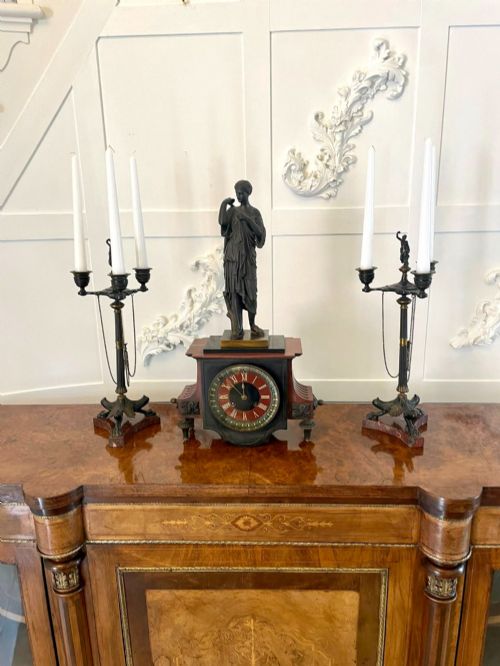
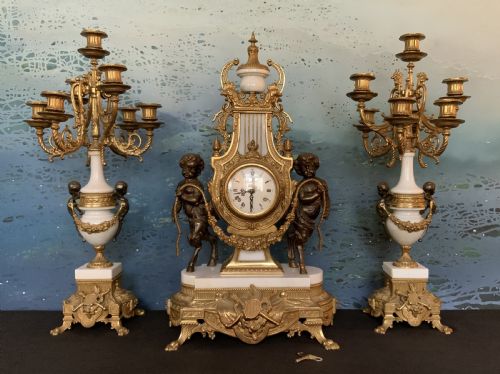
The versions most likely to meet you on this page are pairs of candleholders or matching garniture sets originating from the nineteenth century. They frequently appear alongside mantel clocks in French Louis XVI style or Louis XVI revival designs.
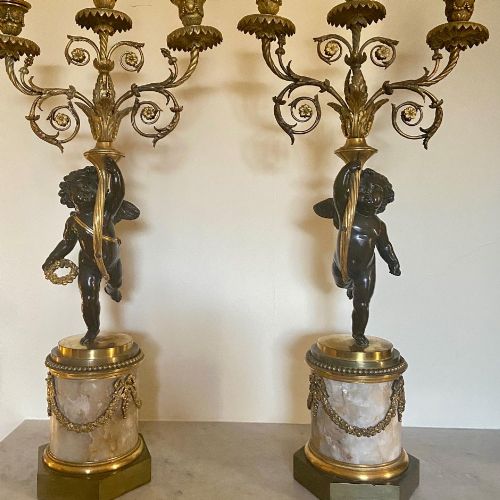
Many of these objects incorporate figural elements such as putti or cherubs alongside the stonework and candle arms. They span forms from simple two-arm candelabra to grand multi-piece clock garnitures.
How they were made
Makers shaped white marble and other stone varieties into architectural columns, urns, or plinths to form the central body of each piece. This stonework was turned or carved to precise geometrical profiles.
Foundries cast bronze, brass, and ormolu to create decorative mounts, foliate arms, and figural details which were then fire-gilded or patinated. These metal components were secured to the marble base with threaded rods and pins.
Listings feature white marble combined with gilt bronze, ormolu, and patinated bronze across nineteenth-century periods.
What varies in quality
The distinction between tiers of work rests largely on the crispness of the bronze casting and the depth of the hand-chiselling applied after casting. Finer pieces show sharply rendered foliage and smooth integration between the stone and metal components.
The selection of the marble itself, alongside the weight and richness of the ormolu or gilt bronze, marks out the more ambitious commissions. Softer detailing in the figures and simpler mounting generally indicate more commercial production.
Francois Redmond·Claude Clodion·AD Mougin Paris·Thomas Hope
The Neoclassical Marble Candelabra Glossary
- Ormolu
- Gilded bronze produced by applying a mercury and gold amalgam to the metal surface and heating it. This technique creates a durable, warm golden finish characteristic of French decorative metalwork.
- Garniture
- A set of matching decorative objects, typically consisting of a mantel clock flanked by a pair of candelabra or vases. These sets were designed to display symmetrically on a fireplace mantel.
- Putti
- Depictions of plump, winged male infants, often appearing as cherubs in classical art. They are frequently cast in bronze and posed around the marble shafts of candelabra.
- Patinated bronze
- Bronze that has been chemically treated to alter its surface colour, usually to shades of brown, green, or near-black. This finish contrasts with bright gilt or ormolu mounts.
- Louis XVI style
- A revival of classical restraint and symmetry in French design, prominent during the nineteenth century. It relies on straight lines, architectural motifs, and classical antiquity.
Neoclassical Marble Candelabra: Frequently Asked Questions
How do I clean marble and ormolu candelabra?
Dust the stone and metal surfaces regularly with a soft, dry cloth to prevent dirt accumulation. Avoid using water, abrasive cleaners, or chemical polishes, as these can strip the gilding or stain the marble.
For stubborn grime on marble, use a slightly damp cloth with mild soap, drying the surface immediately. Professional conservation is recommended for delicate ormolu mounts to preserve the historic finish.
Were these candelabra meant for everyday use?
These decorative objects served both functional and aesthetic purposes in nineteenth-century interiors. They were lit during evening gatherings to provide ambient illumination in reception rooms.
Over time, many of these pieces transitioned into purely decorative items displayed on mantelpieces or console tables. Using modern candles carefully can still bring gentle illumination to a room today.
How do I identify Louis XVI style pieces?
Look for symmetrical designs, straight structural lines, and motifs drawn from ancient Greek and Roman architecture. Details like acanthus leaves, urns, and fluted columns commonly define this aesthetic.
Nineteenth-century makers adopted these classical elements enthusiastically, often combining white marble bases with gilt bronze mounts to evoke eighteenth-century luxury.
What is a clock garniture set?
A clock garniture is a matching ensemble composed of a central mantel clock accompanied by two side pieces, such as candelabra or urns. These sets were manufactured to create a balanced, decorative display across a fireplace.
The materials and motifs of the clock match the flanking candelabra to present a unified decorative scheme. They represent some of the most substantial ornamental items from the period.