



Neoclassical Clock Set
These neoclassical clock set pieces bring classical symmetry and architectural bronze work into a room.
Neoclassical Clock Set
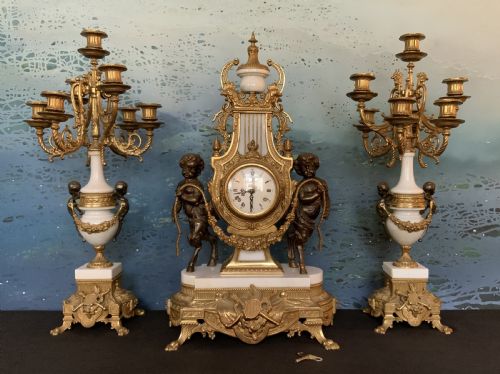
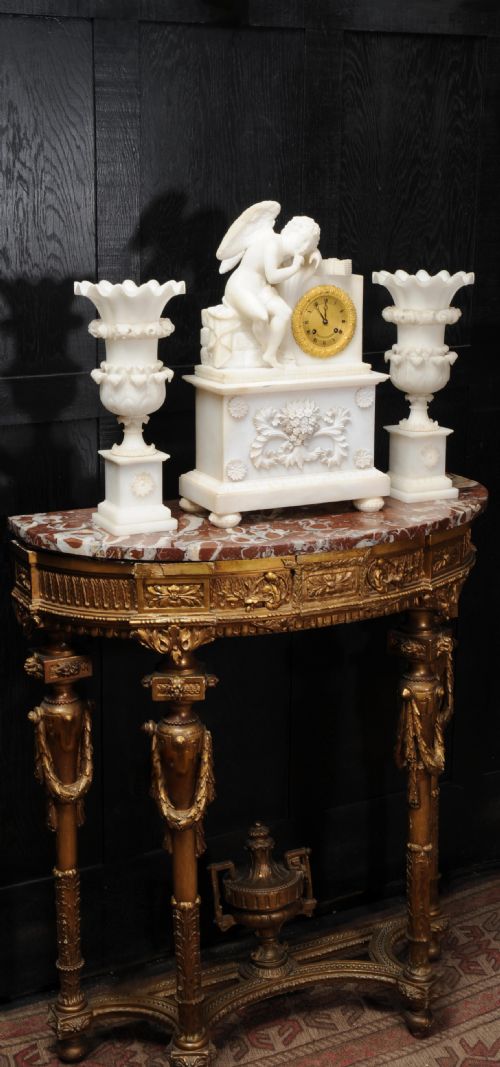
A neoclassical clock set consists of a central mantel clock flanked by matching ornaments such as candelabras or urns, forming a balanced arrangement for a fireplace mantel or console table.
The versions met most frequently on this page belong to the nineteenth century, particularly in French Louis XVI and Victorian revival styles.
Makers paired the central timekeeper with matching side pieces to achieve the strict proportion characteristic of the period.
Materials and construction
Makers combined natural stone bodies, principally white and Sienna marble, with cast bronze, ormolu, and gilded brass mounts.
Dials frequently feature enamel numerals set behind glass panels, while sculptural figures cast in bronze complete the decorative garniture.
Listings feature materials including marble, ormolu, brass, enamel, and glass across various nineteenth-century periods.
Judging the quality
Quality rests on the crispness of the bronze casting and the depth of the gilding, where sharper chisel work distinguishes better workshops.
The selection of the marble and the weight of the matching side pieces separate standard production from finer examples.
AD Mougin Paris·Ferdinand Berthoud·Japy Freres
The Neoclassical Clock Set Glossary
- Garniture
- A set of matching decorative objects designed to be displayed together on a mantelpiece.
- Ormolu
- Gilded bronze used extensively for decorative mounts and figures on French clocks.
- Enamel
- A fused glass surface applied to clock dials for the chapter rings and numerals.
- Candelabra
- A branched candlestick used as matching side pieces in a clock set.
Neoclassical Clock Set: Frequently Asked Questions
What is a neoclassical clock set?
A neoclassical clock set is a matching group of mantel ornaments featuring a central clock and paired side pieces like candelabras or urns.
These arrangements follow classical architectural lines and symmetry.
How were these clock sets used?
They served as decorative centrepieces on drawing room mantelpieces and console tables in grand nineteenth-century interiors.
The matching side pieces balanced the visual weight of the central timekeeper.
How do I care for marble and ormolu?
Dust marble gently with a soft dry cloth and avoid harsh chemical cleaners that can damage the stone surface.
Gilded bronze mounts require similar care to preserve the original metal finish.
What periods do these pieces span?
The listings span from the eighteenth century through the Victorian era up to the mid-twentieth century.
Many examples date from the nineteenth century using earlier Louis XVI revival styles.