

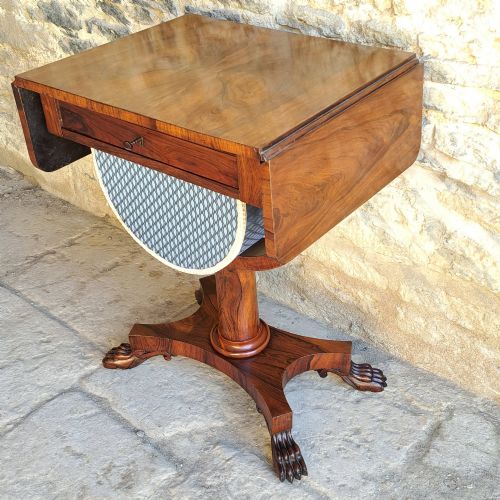
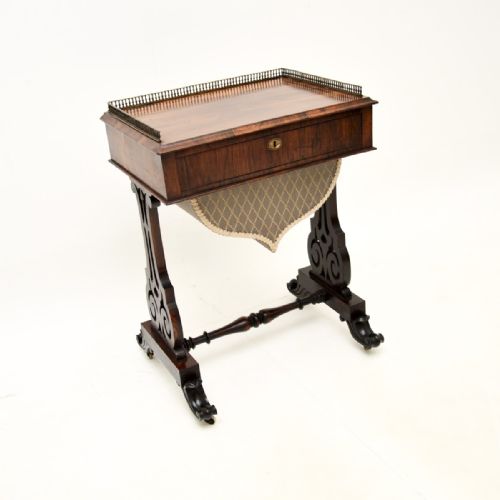


Needlework Table Fabric Well
A needlework table fabric well is a clever piece of furniture designed for sewing and crafts, offering a practical compartment to keep materials tidy.
Needlework Table Fabric Well
A needlework table fabric well combines a sturdy surface with an integrated textile pouch or compartment underneath to hold ongoing projects and sewing gear. These items appear primarily from the 19th Century, spanning the Regency and Victorian eras.
The forms on this page include specific work tables, sewing tables, and occasional side tables equipped with drop flaps or fitted compartments. Buyers most commonly encounter Victorian and Regency examples configured in rosewood, mahogany, and burr walnut.
Materials and construction
Cabinet makers utilised dense hardwoods like rosewood, mahogany, and burr walnut to build these pieces, often pairing them with brass accents. The timber is selected for rich grain patterns and polished to a smooth finish.
Textiles and velvet form the interior linings of the integrated wells and work boxes, providing a soft enclosure for delicate threads and fabrics. Drop flaps and hinged lids require precise joinery to function smoothly alongside the hanging fabric containers.
The material palette spans timber solids and veneers like rosewood, mahogany, and burr walnut, alongside velvet and brass.
Assessing quality and craftsmanship
Finer examples distinguish themselves through superior timber selection, such as highly figured burr walnut or carefully matched rosewood veneers, rather than plain secondary woods. The smoothness of the mechanical actions for drop flaps and internal compartments also indicates higher workshop standards.
The detailing of the under-frame and the quality of the attached fabric well show the original tier of production. Pieces with robust brass hardware and well-executed joinery retain their structural integrity better than simpler utilitarian builds.
The Needlework Table Fabric Well Glossary
- Work table
- A multi-functional piece of furniture designed for sewing, needlework, and small crafts, usually featuring internal compartments and a fabric pouch. These items became essential domestic fixtures during the 19th Century.
- Burr walnut
- A highly decorative wood veneer taken from the warted growths on walnut trees, prized for swirling patterns. Cabinet makers utilised it on prominent surfaces of Victorian sewing furniture.
- Drop flap
- A hinged leaf on the side of a table that can be raised to extend the surface area or lowered when space is limited. This mechanism frequently appears on Regency and Victorian work tables.
- Regency
- An architectural and design style spanning the early 19th Century, characterised by classical restraint and refined proportions. Furniture from this period often incorporates dark hardwoods and brass inlay.
Needlework Table Fabric Well: Frequently Asked Questions
What is a needlework table fabric well used for?
These pieces served as dedicated stations for Victorian and Regency needlework, allowing gentle craft projects to be kept close at hand. The top surface provided a stable platform for sewing or lighting, while the suspended textile pouch held wools, fabrics, and tools.
Today, they function as versatile side or lamp tables in living spaces. The internal compartments remain useful for storing small modern items while maintaining historical character.
How do I date a sewing table?
Dating relies on observing the primary timber used, the construction methods of the frame, and the overarching style characteristics. Regency pieces often feature simpler classical lines, whereas Victorian examples frequently showcase elaborate burr walnut veneers and heavier proportions.
Reference to specific periods like William IV or the mid-19th Century helps narrow the timeline. Examining the hardware and the interior lining construction provides additional clues to the era of manufacture.
Are these tables sturdy enough for daily use?
Most surviving 19th Century examples remain robust enough for gentle everyday service as lamp or occasional tables. The hardwood frames, constructed from rosewood, walnut, or mahogany, offer lasting structural stability.
Care should be taken not to overload the drop flaps or the hanging fabric well with heavy objects. Placing them away from direct heat sources preserves both the timber and the antique finish.
What woods were commonly used?
Rosewood and mahogany dominate the earlier Regency examples seen here, offering deep colour and smooth grain. Cabinet makers favoured these dense timbers for their durability and polished appearance.
As the 19th Century progressed into the Victorian era, burr walnut gained popularity for its striking visual patterns. These figured veneers were applied to table tops and sides to create a more decorative effect.